National Food Security Act Revision Explained for UPSC

Context: National Food Security Act revision

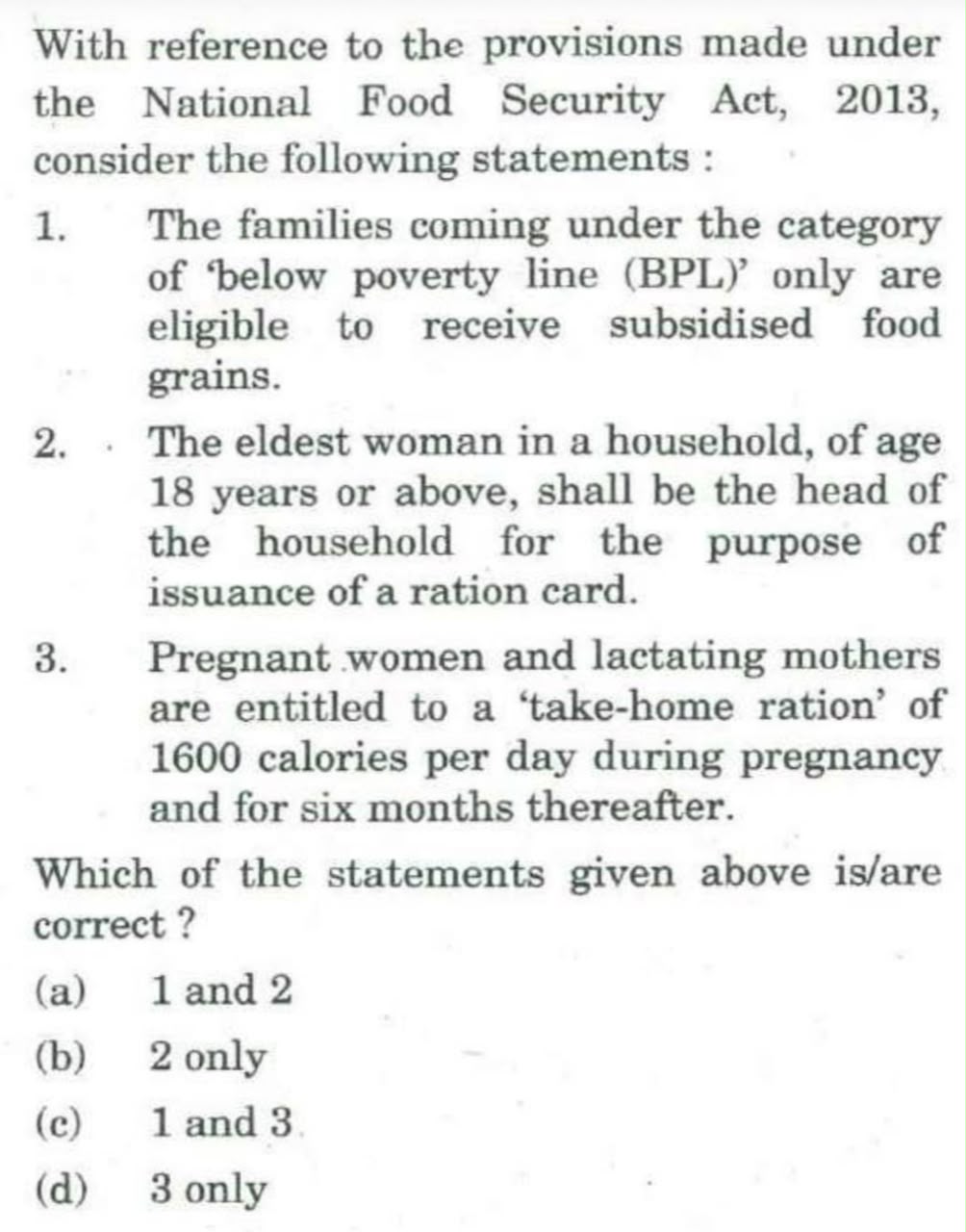
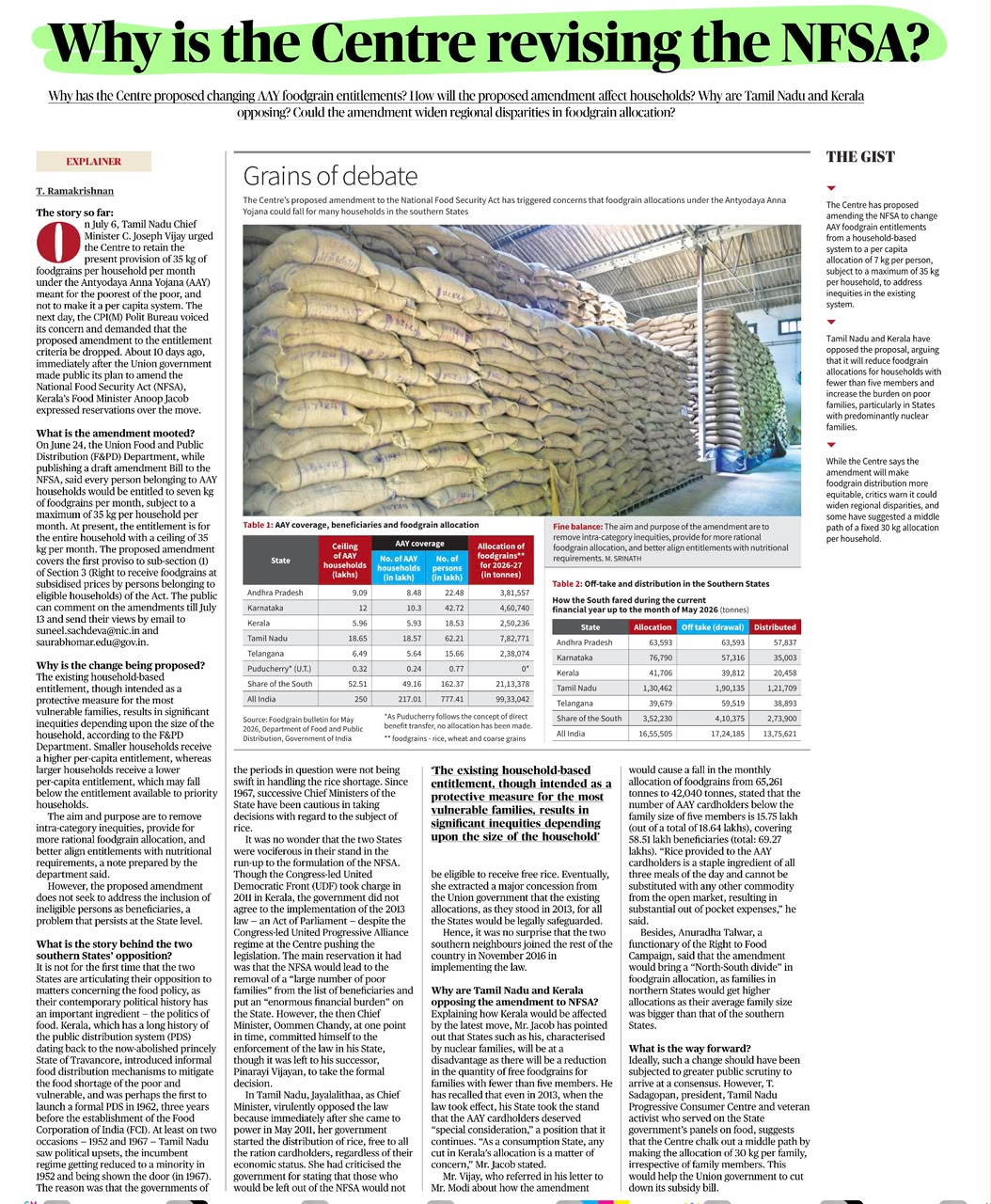
The Union Government has proposed amendments to the National Food Security Act (NFSA), 2013, especially regarding foodgrain entitlement under the Antyodaya Anna Yojana (AAY).

The proposal aims to shift from a household-based allocation system to a per-person entitlement model.

National Food Security Act (NFSA), 2013

Objective

To provide legal entitlement to subsidised foodgrains and strengthen food and nutritional security through the Targeted Public Distribution System (TPDS).

Coverage

Rural Areas

  • Up to 75% population

Urban Areas

  • Up to 50% population

Beneficiary Categories

1. Priority Households (PHH)

Eligible members receive:

  • 5 kg foodgrains/person/month at subsidised prices.

2. Antyodaya Anna Yojana (AAY)

Covers:

  • Poorest and most vulnerable households.

Current entitlement:

  • 35 kg foodgrains per household per month.

The proposed amendment concerns only AAY households.


Proposed Amendment

Present System

  • Every AAY household receives 35 kg/month.
  • Allocation depends on household, not number of members.

Proposed System

  • 7 kg/person/month.
  • Maximum entitlement remains 35 kg per household.
  • Allocation will depend on the number of eligible members.

Why Does the Centre Want This Change?

1. Reduce Inequity

Under the existing system:

  • Small households and large households receive the same quantity.

2. Person-Centric Allocation

The proposed system links entitlement with actual beneficiaries.

3. Better Nutritional Targeting

Helps align food support with household size.

4. Rationalisation of Food Subsidy

Improves efficiency in foodgrain allocation.


Why Are Tamil Nadu and Kerala Opposing It?

1. Smaller Household Size

Southern States have a higher proportion of nuclear families.

2. Reduced Entitlement

Many AAY households with fewer than five members may receive less than 35 kg.

3. State-Level Food Security Concerns

States argue that it may reduce foodgrain allocation.

4. Universal PDS Model

Tamil Nadu highlights its long-standing Universal Public Distribution System.


Centre’s Position

  • No beneficiary will lose eligibility under NFSA.
  • Only the method of calculating entitlement is changing.
  • The reform aims to make allocation more equitable and person-centric.

Significance

  • Balances equity with food security.
  • Impacts food subsidy management.
  • Has implications for Centre-State relations.
  • Highlights challenges in designing uniform welfare policies while considering demographic differences.
Subscribe
Notify of
guest
0 Comments
Oldest
Newest Most Voted

National Food Security Act Revision Explained for UPSC

Got a question? We're here to help!

Our dedicated Student Support team is ready to assist you and guide you every step of the way.
Reach out to us, and let’s tackle your queries together!

About the UPSC Civil Services Examination (UPSC CSE)

The UPSC Civil Services Examination (CSE) is one of the most competitive and esteemed examinations in India, conducted by the Union Public Service Commission to recruit officers for services such as the Indian Administrative Service (IAS), Indian Police Service (IPS), Indian Foreign Service (IFS), and others. The exam comprises three stages — Prelims, Mains, and the Personality Test (Interview) — designed to test a candidate’s knowledge, aptitude, decision-making, and leadership skills.


How to Prepare Effectively for UPSC CSE

Cracking the UPSC CSE requires a deep understanding of the syllabus, consistent revision, structured answer writing, and smart test-taking strategies. The Prelims test analytical and conceptual clarity, the Mains focuses on critical thinking, articulation, and subject mastery, while the Interview assesses presence of mind, ethical judgment, and personality traits relevant to public service.

At UnderStand UPSC, we empower aspirants with a personalized and focused approach to each stage of the exam.


Why Choose UnderStand UPSC?

UnderStand UPSC is a mentorship-driven platform offering a clear, clutter-free strategy to tackle the Civil Services Examination. Our programs like Transform (for beginners and intermediate learners) and Conquer (for advanced mains preparation) provide structured study plans, syllabus-wise video content, interactive live sessions, and answer writing support.

We emphasize:

  • Concept clarity through topic-wise lectures

  • Test series designed around real UPSC standards

  • Personalized mentorship in small groups

  • Regular performance tracking and peer benchmarking

  • Doubt-clearing sessions, current affairs analysis, and monthly magazines


Join the UnderStand UPSC Learning Community

Our mission is to make UPSC preparation less overwhelming and more strategic. We combine mentorship, discipline, and academic rigor to help you clear CSE with confidence. Whether you’re preparing from Delhi, Mumbai, Bangalore, or a remote village — our online-first model ensures quality guidance reaches every corner of India.

Join the thousands of aspirants who trust UnderStand UPSC to guide their journey toward becoming civil servants.

Stay connected with us through our Telegram, YouTube, and Instagram channels for daily tips, strategies, and updates.

Copyright © 2026 USARAMBHA EDUCATION (UnderStand UPSC). All Rights Reserved.

Fill out the form for

Downloading the free Agriculture Short Notes


0
Would love your thoughts, please comment.x
()
x