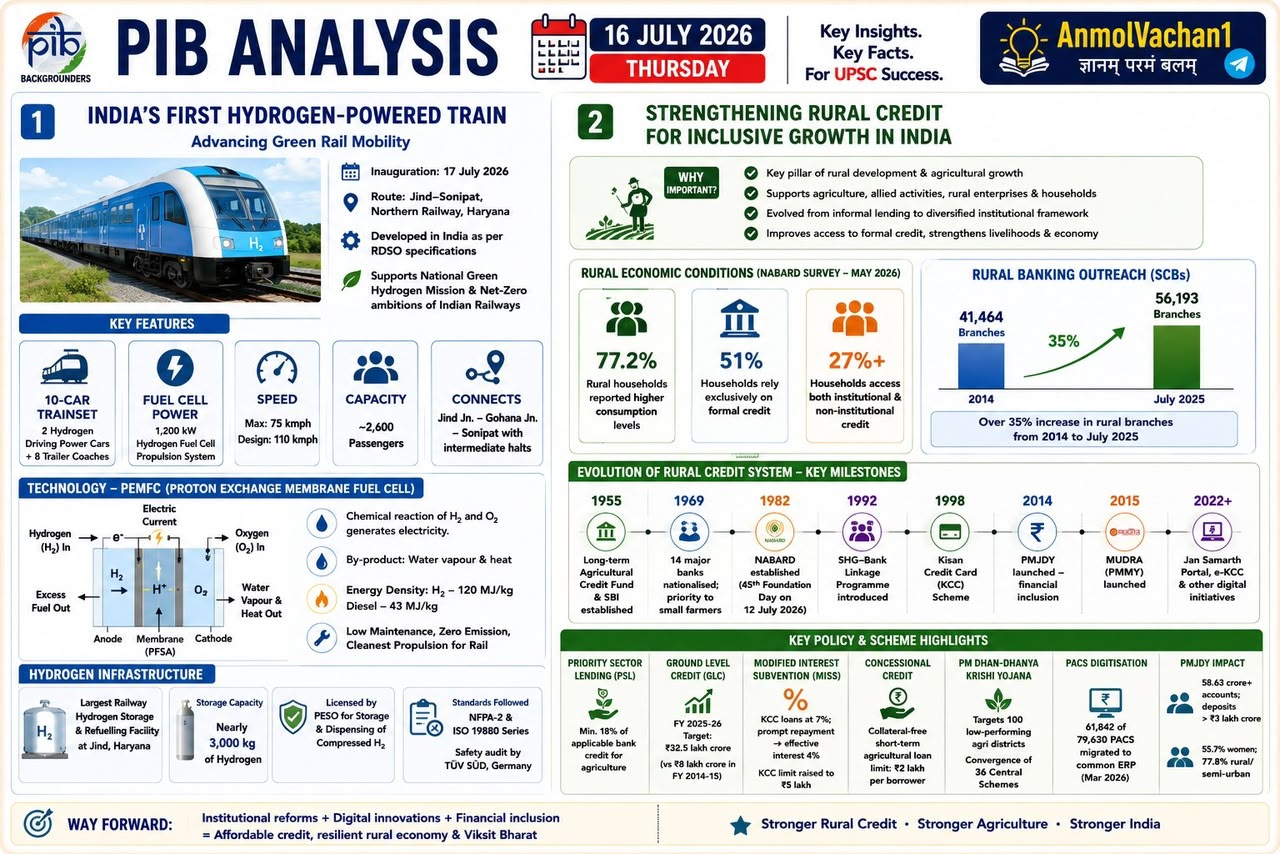
Context:Rural Credit Inclusive Growth India
On the occasion of NABARD’s 45th Foundation Day, the Government highlighted reforms in rural credit, digital outreach and financial inclusion for a stronger and sustainable rural economy.
Why Rural Credit Matters
Rural credit is important because it ensures timely and affordable finance for:
- Agriculture
- Allied activities
- MSMEs
- Rural enterprises
It helps reduce dependence on informal moneylenders and supports productivity, rural income and employment.
Rural Credit – Key Data
As per NABARD Rural Economic Conditions Survey:
- 77.2% rural households reported higher consumption.
- 51% households depend exclusively on formal institutional credit.
- 27%+ households access both institutional and informal credit.
Rural Banking Network
Scheduled Commercial Bank rural branches increased from:
- 41,464 branches in 2014
- 56,193 branches by July 2025
This reflects over 35% increase in rural branches from 2014 to July 2025.
Evolution of Rural Credit
1955
Long-Term Agricultural Credit Fund and State Bank of India.
1969
Nationalisation of 14 major banks.
1982
NABARD established as the Bank for Agriculture and Rural Development.
1992
Self-Help Group–Bank Linkage Programme.
1998
Kisan Credit Card Scheme.
2014
Pradhan Mantri Jan Dhan Yojana.
2015
Pradhan Mantri Mudra Yojana.
2022 onwards
Jan Samarth Portal, e-KCC and other digital initiatives.
Key Policy and Scheme Highlights
1. Priority Sector Lending
Minimum 18% of Adjusted Net Bank Credit is targeted for agriculture.
2. Ground Level Credit
Ground level credit reached ₹32.5 lakh crore.
3. Modified Interest Subvention Scheme
Crop loans are available at 7%.
Interest can reduce to 4% on prompt repayment.
4. Collateral-Free Agricultural Loan
Limit increased to ₹2 lakh per borrower.
5. PM Dhan-Dhaanya Krishi Yojana
Targets 100 low-performing agricultural districts through convergence of 36 Central schemes.
6. PACS Digitisation
61,842 out of 79,630 PACS migrated to a common ERP system by March 2026.
7. PMJDY Impact
Pradhan Mantri Jan Dhan Yojana has enabled:
- 58.63 crore accounts
- ₹3 lakh crore deposits
- 55.7% women beneficiaries
- 77.8% accounts in rural and semi-urban areas
NABARD – Key Facts
Established
1982
Headquarters
Mumbai
Parent Act
National Bank for Agriculture and Rural Development Act, 1981
Role
NABARD is the apex development financial institution for agriculture and rural development.
Challenges
- Dependence on informal credit still persists.
- Regional disparities in credit flow.
- Limited access for tenant farmers and smallholders.
- Need for stronger digital infrastructure.
- Need for improved financial literacy.
Way Forward
- Ensure universal access to affordable institutional credit.
- Expand digital credit through e-KCC, PACS and Jan Samarth.
- Strengthen Farmer Producer Organisations and rural MSME value chains.
- Integrate credit with insurance, markets and agri-infrastructure.
- Improve financial literacy and digital access.
Key Takeaway
Stronger rural credit means stronger agriculture, stronger rural enterprise and stronger inclusive growth.