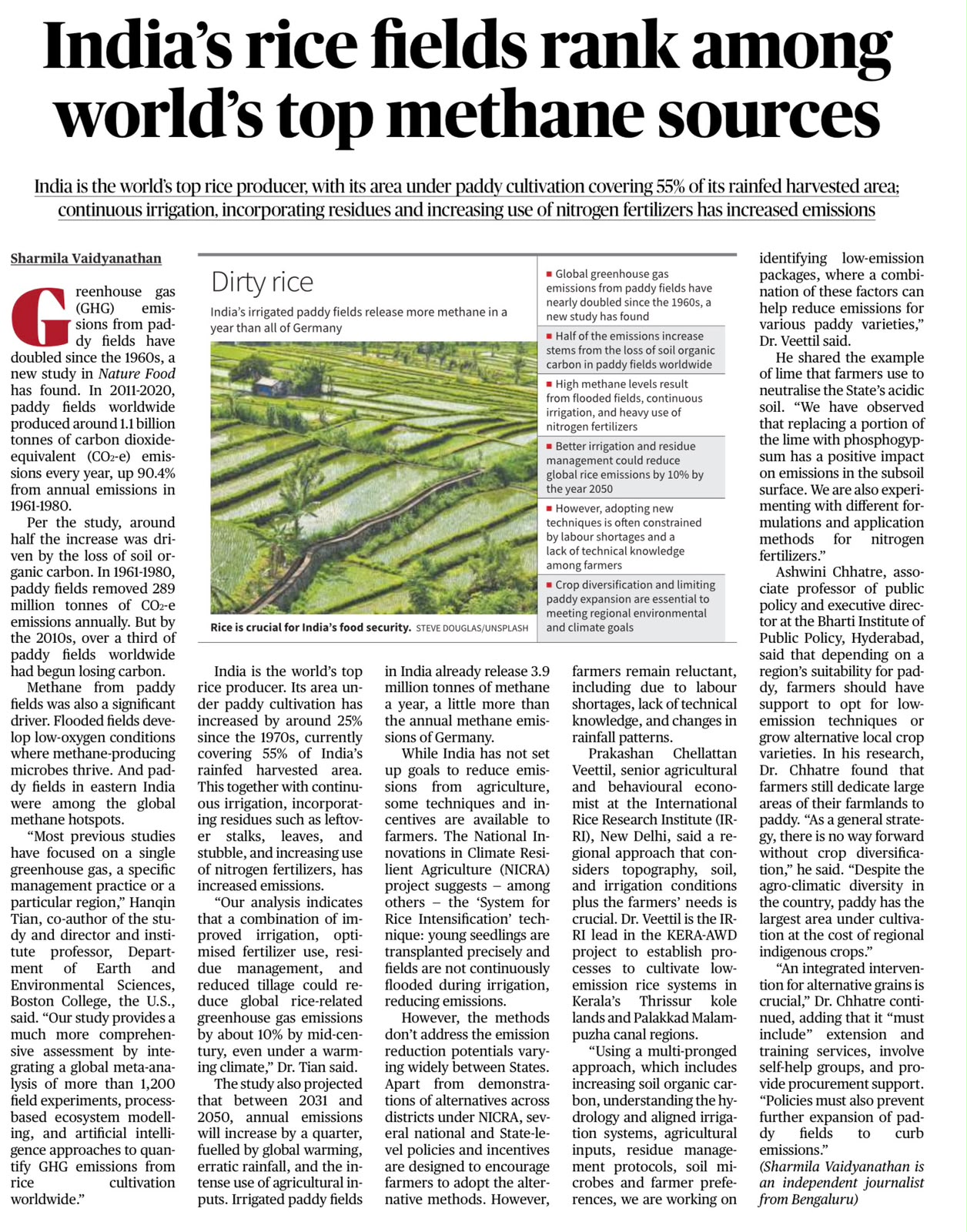
Context: India rice methane emissions
A Nature Food study reported by The Hindu found that greenhouse gas emissions from paddy fields have nearly doubled since the 1960s.
India, being the world’s largest rice producer, is among the largest methane emitters from rice cultivation due to flooded fields, crop residue incorporation and intensive fertiliser use.
Methane
Methane, or CH₄, is a powerful greenhouse gas.
It is much more potent than carbon dioxide in terms of warming impact over a 100-year period.
Methane is produced under anaerobic conditions, where oxygen is absent or very limited.
Why Paddy Fields Emit Methane
Rice is often grown in flooded fields.
Flooded soil creates oxygen-deficient conditions.
Under such conditions, methane-producing microbes become active and release methane into the atmosphere.
Major Sources of Methane
Important methane sources include:
- Wetlands
- Paddy fields
- Livestock
- Landfills
- Oil and gas extraction
- Coal mining
Indian Context
India is the world’s largest rice producer.
Paddy cultivation covers around 55% of India’s rainfed harvested area.
Irrigated paddy fields in India emit around 3.9 million tonnes of methane per year.
The main drivers are:
- Continuous flooding
- Crop residue incorporation
- Nitrogen fertiliser use
- Large paddy cultivation area
Environmental Concern
Methane from rice cultivation adds to agricultural greenhouse gas emissions.
This makes paddy farming important not only for food security but also for climate policy.
India must balance rice production with low-emission agricultural practices.
Mitigation Measures
Alternate Wetting and Drying
This method allows fields to dry for certain periods instead of keeping them continuously flooded.
It reduces methane emissions by limiting anaerobic conditions.
System of Rice Intensification
SRI uses improved water, seedling and soil management practices.
It can reduce water use and help lower emissions.
Better Fertiliser and Residue Management
Efficient fertiliser use and improved crop residue handling can reduce emissions.
Crop Diversification
Diversifying away from water-intensive paddy in suitable regions can reduce environmental stress.
Key Takeaway
Rice is crucial for India’s food security, but paddy cultivation is also a major methane source. India needs climate-smart rice farming to protect both food security and environmental goals.