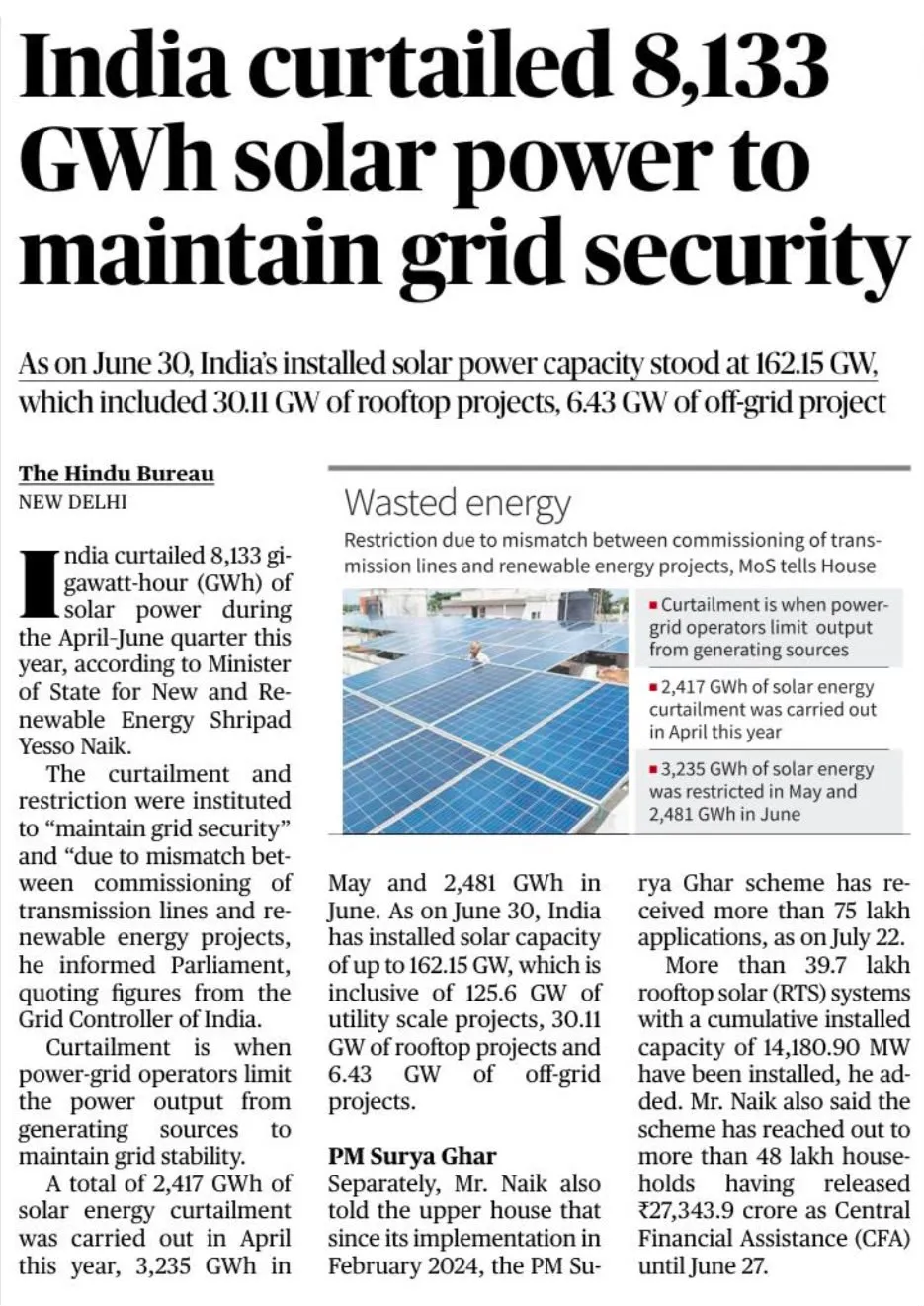
Context: India solar power curtailment 2026
The Government informed Parliament that India curtailed 8,133 GWh of solar power during April–June 2026 to maintain grid security.
This highlights the challenge of integrating rapidly growing renewable energy capacity with inadequate transmission infrastructure.
What Is Solar Curtailment?
Solar curtailment means deliberately reducing electricity generation from solar plants despite available sunlight.
This is done when the grid cannot safely absorb the power.
Grid operators curtail power to maintain:
- Grid stability
- Frequency balance
- Reliability
- Safety of the power system
Why India Curtailed Solar Power
1. Transmission Bottlenecks
Renewable energy projects have been commissioned faster than transmission lines.
This creates mismatch between generation and evacuation capacity.
2. Grid Security
Too much electricity without matching transmission capacity can destabilise the grid.
It may increase blackout risks.
3. Renewable Intermittency
Solar generation peaks during daytime.
Electricity demand may not always match this timing.
This creates integration challenges.
Key Data
Total solar power curtailed during April–June 2026 was 8,133 GWh.
Month-wise data:
- April: 2,417 GWh
- May: 3,235 GWh
- June: 2,481 GWh
Installed solar capacity as of 30 June 2026 was 162.15 GW.
This includes:
- Utility-scale solar: 125.6 GW
- Rooftop solar: 30.11 GW
- Off-grid solar: 6.43 GW
Why It Matters
Curtailment wastes clean electricity.
It reduces revenue for renewable energy developers.
It slows India’s renewable energy transition.
It also shows that generation capacity and grid infrastructure must be planned together.
Way Forward
India should expand Green Energy Corridors and transmission infrastructure.
Battery Energy Storage Systems and pumped-storage projects must be deployed faster.
Smart grids, forecasting and demand-response systems should be strengthened.
Renewable generation and transmission planning must happen simultaneously.
Key Takeaway
India’s solar growth is impressive, but renewable energy transition cannot succeed without grid readiness, storage and transmission planning.