Context:
India has expanded its Free Trade Agreement network to improve exports and integrate with global markets.
However, recent evidence suggests that many FTAs have become import-driven, widened trade deficits and delivered limited gains in Global Value Chain integration.
Free Trade Agreement
A Free Trade Agreement is an agreement between two or more countries to reduce or remove trade barriers such as tariffs, quotas and restrictions.
The aim is to promote trade, investment and market access.
Why India’s FTAs Are Being Questioned
India’s imports have grown faster than exports with several major FTA partners.
Market access has not automatically translated into export competitiveness.
India’s participation in Global Value Chains has also remained weak.
This means India has not gained enough from regional production networks despite tariff concessions.
Key Evidence
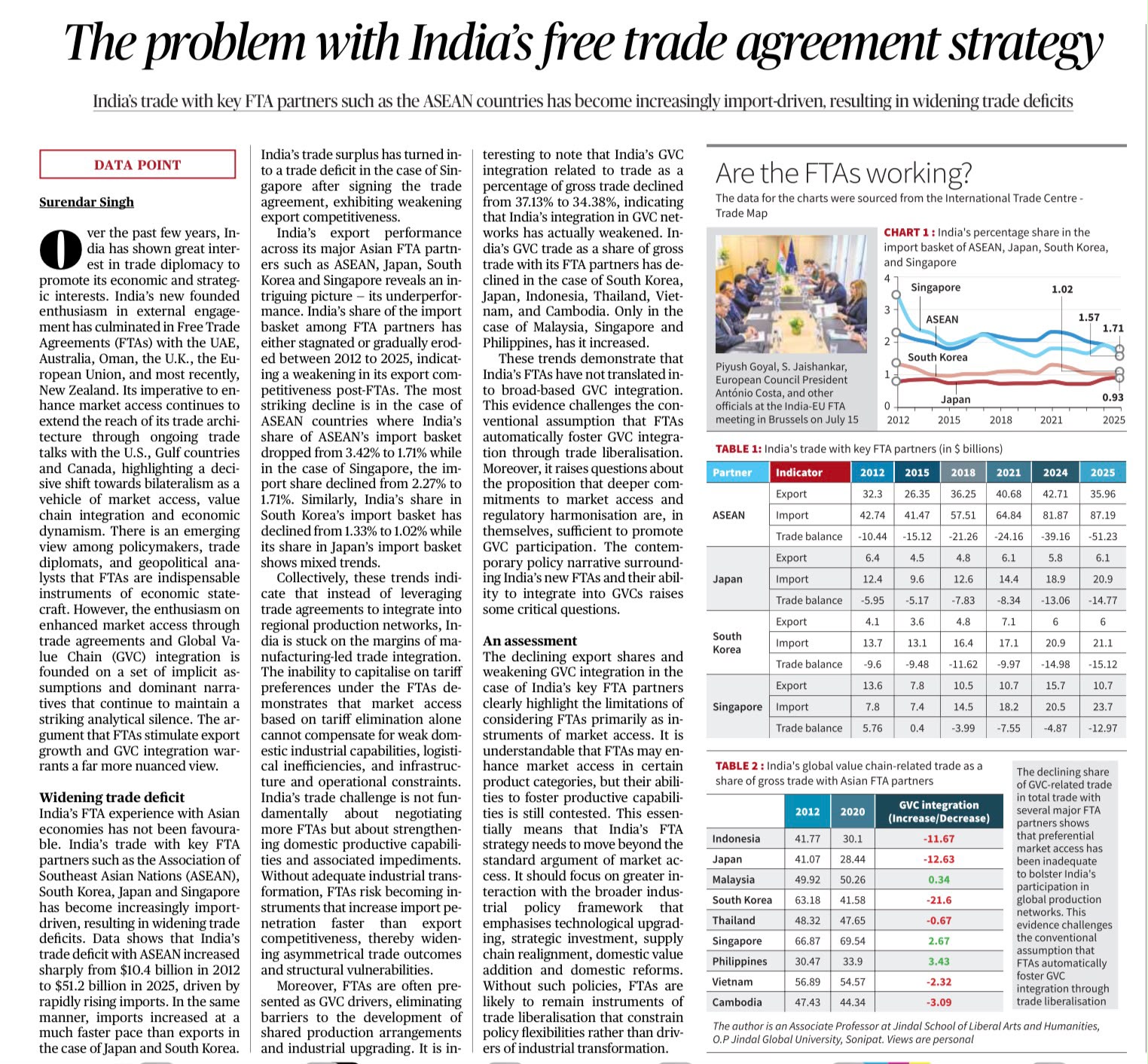
India’s trade deficit with ASEAN widened from US$10.4 billion in 2012 to US$51.2 billion in 2025.
India’s share in ASEAN’s import basket declined from 3.42% to 1.71%.
India’s GVC-related trade share declined from 37.1% to 34.4%.
This shows weaker integration into global production networks.
Why FTAs Alone Are Not Enough
FTA-led market access cannot compensate for weak domestic competitiveness.
Indian exports face challenges such as:
- High logistics costs
- Infrastructure gaps
- Regulatory bottlenecks
- Limited manufacturing scale
- Low domestic value addition
- Weak participation in production networks
If imports rise faster than exports, FTAs can widen trade deficits instead of strengthening the economy.
Global Value Chains
Global Value Chains refer to production systems where different stages of manufacturing are spread across countries.
For example, one country may produce components, another may assemble the product and another may provide design or marketing.
India’s weak GVC integration limits its ability to benefit from FTAs.
Way Forward
India should align future FTAs with industrial policy.
The focus should shift from tariff reduction alone to export competitiveness.
India must improve logistics, ports, infrastructure and ease of doing business.
FTAs should promote technology transfer, investment, domestic value addition and manufacturing depth.
India should periodically review FTAs based on export outcomes and sector-specific performance.
Key Takeaway
India’s FTA strategy needs a reset. Market access works only when domestic manufacturing, logistics and Global Value Chain integration are strong.