
Table of Contents:
Learn how to balance UPSC Optional vs GS with a practical study plan, revision strategy, and stage-wise preparation for better Mains performance.
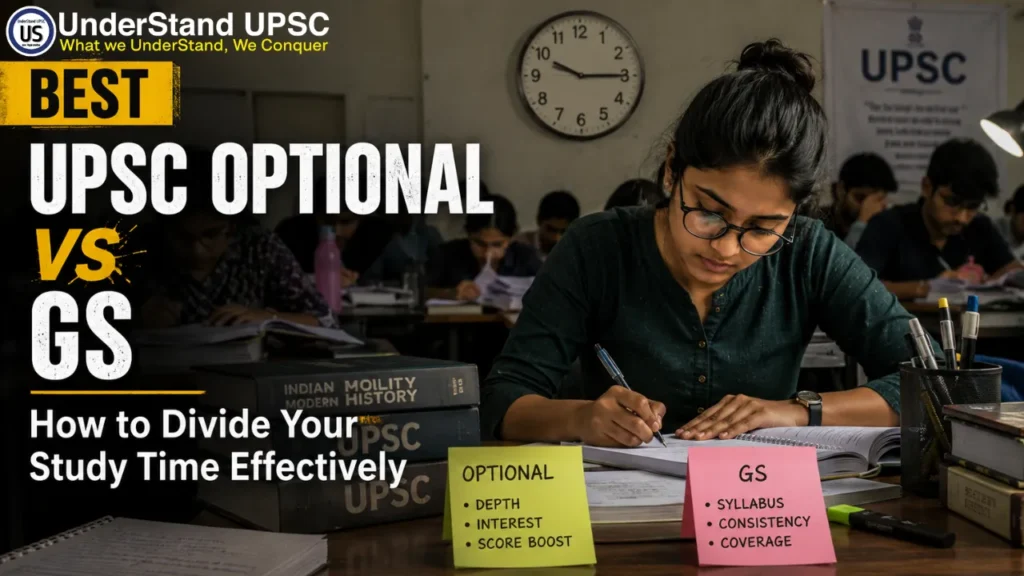
UPSC Optional vs GS: Why Time Allocation Matters
Every year, aspirants make one of two expensive mistakes. Some postpone the optional until it becomes a post-Prelims emergency. Others become so absorbed in Anthropology, PSIR, Sociology or Geography that their Prelims base quietly collapses.
The problem is not poor time management. It is misunderstanding how the two parts behave.
GS protects your floor. Optional determines how far your Mains score can rise or fall. GS is wide, fragmented and relevant across stages. The optional is narrower, but it demands depth, subject vocabulary, revision and specialised answers under pressure. They should be protected from different failures.
Optional Debt Becomes Expensive Quickly
A neglected GS topic can often be repaired quickly. A neglected optional usually cannot.
If a PSIR aspirant has not understood Western political thought, later answers on justice, liberty and democracy remain superficial. If an Anthropology aspirant has not consolidated thinkers, diagrams and tribal examples, completing lectures does not make the subject answer-ready. If a Geography aspirant delays map practice and applied diagrams, adding sources will not solve the problem.
Optional preparation compounds. Concepts connect across the syllabus, and answer quality improves only after several cycles of recall, enrichment and writing. This is why optional cannot be treated as a Sunday subject.
During the foundation phase, give it a non-negotiable daily anchor block of two-and-a-half to three hours. Place it in your strongest concentration window. GS can rotate; the optional should not disappear.
An optional unit is complete only when you can:
explain the concept without notes, identify related PYQs, reproduce the thinkers or evidence required, and write a usable answer within time.
If you cannot do these four things, the unit is covered, not prepared.
GS Fails Through Breadth, Optional Through Shallowness
GS creates a different problem. Aspirants often mistake familiarity for preparation. They have “done” polity, economy and society, but cannot retrieve the committee, example, constitutional anchor or current illustration needed in an answer.
Run a simple audit every fortnight.
Pick two optional PYQs and four GS questions. Give yourself seven minutes per question to create a framework without notes. Judge only retrieval.
If optional frameworks lack scholars, theories, criticism, subject vocabulary or specialised examples, the subject needs depth. If GS frameworks repeat generic points such as awareness, technology, implementation and political will, GS needs enrichment and sharper issue notes.
Now allocate the next ten serious study hours according to the bigger weakness.
This is better than copying a permanent 60:40 ratio from a topper with a different background and preparation stage.
An aspirant with completed Sociology notes but weak GS III may use the next ten hours as three for Sociology revision and answer writing, five for economy and agriculture consolidation, and two for Ethics or Essay. An aspirant beginning Philosophy while already comfortable with GS may reverse that split.
The question is not where you spent fewer hours. It is where the next hour can still change performance.
Change the Ratio Before the Examination Forces You To
The allocation must shift with the calendar.
In the early phase, optional needs continuity because it has the longest completion cycle. Later, the focus should move from coverage to conversion: PYQs, condensed notes and timed answers.
In the final months before Prelims, GS, current affairs, CSAT, revision and full-length tests must dominate. Optional should enter maintenance mode rather than vanish. One weekly session can preserve condensed notes, diagrams, thinkers or PYQ frameworks.
After Prelims, return to the optional immediately. Waiting for the result is costly. The post-Prelims period is too short to begin answer writing, test analysis and enrichment from zero.
UnderStand UPSC’s micro-syllabus and test schedules can make both sides visible. Their value lies in revealing uncovered GS units and optional units never tested under time.
Use a Floor-and-Ceiling Weekly Plan
Instead of allocating percentages, set a minimum floor for both components.
Your optional floor may be five focused sessions, four PYQ frameworks and two timed answers each week. Your GS floor may be three micro-topics revised, five answers written, one Ethics set and one prelims test analysed.
After protecting both floors, give remaining time to the current bottleneck. This creates continuity without pretending both subjects deserve identical attention every single day.
This prevents mood-based preparation. You cannot spend an entire week on your favourite optional topic while GS disappears. You also cannot hide inside endless current affairs while the optional remains untouched.
Review the split every fourteen days using three indicators: coverage debt, recall quality and answer conversion. Change the ratio only when the evidence changes.
The mature strategy is not balance for its own sake. It is preventing either component from becoming irrecoverable.
GS keeps you competitive across the examination. Optional decides whether your Mains preparation has real scoring depth. Treat one as the foundation and the other as leverage, and divide time accordingly.
1. How should I divide study time between UPSC Optional and GS?
The ideal study split depends on your preparation stage. During the foundation phase, give the optional subject a fixed daily study block while continuing regular GS preparation. Adjust the ratio based on your weak areas rather than following a fixed timetable.
2. Is the optional subject more important than General Studies in UPSC Mains?
Both are important but serve different purposes. GS builds a strong foundation across all stages of the exam, while the optional subject has greater scoring potential in the Mains examination and requires deeper conceptual preparation.
3. Should I stop studying the optional subject before the UPSC Prelims?
No. Before the Prelims, the optional subject should move into maintenance mode instead of being completely stopped. Regular revision and brief practice sessions help retain concepts for the Mains.
4. When should I restart optional preparation after the UPSC Prelims?
Resume optional preparation immediately after the Prelims examination. Waiting for the result reduces the time available for answer writing, revision, and test practice before the Mains.
5. What is the biggest mistake while preparing UPSC Optional vs GS?
A common mistake is neglecting one component while focusing entirely on the other. Successful preparation requires consistent progress in both GS and the optional subject, supported by regular revision, PYQs, and answer writing practice.







