Context: School Consolidation Policy India
With declining fertility, changing demographics and falling student enrolment, several States are consolidating under-enrolled government schools into larger, better-equipped institutions.
The challenge is to improve education quality and public resource efficiency without reducing access for rural, tribal and disadvantaged children.
What Is School Consolidation?
School consolidation means merging or rationalising under-enrolled schools into larger and better-equipped schools.
The aim is to improve the use of:
- Teachers
- Infrastructure
- Financial resources
- Learning facilities
It seeks to improve quality of education by giving students access to better academic and physical resources.
Need for School Consolidation
Declining Enrolment
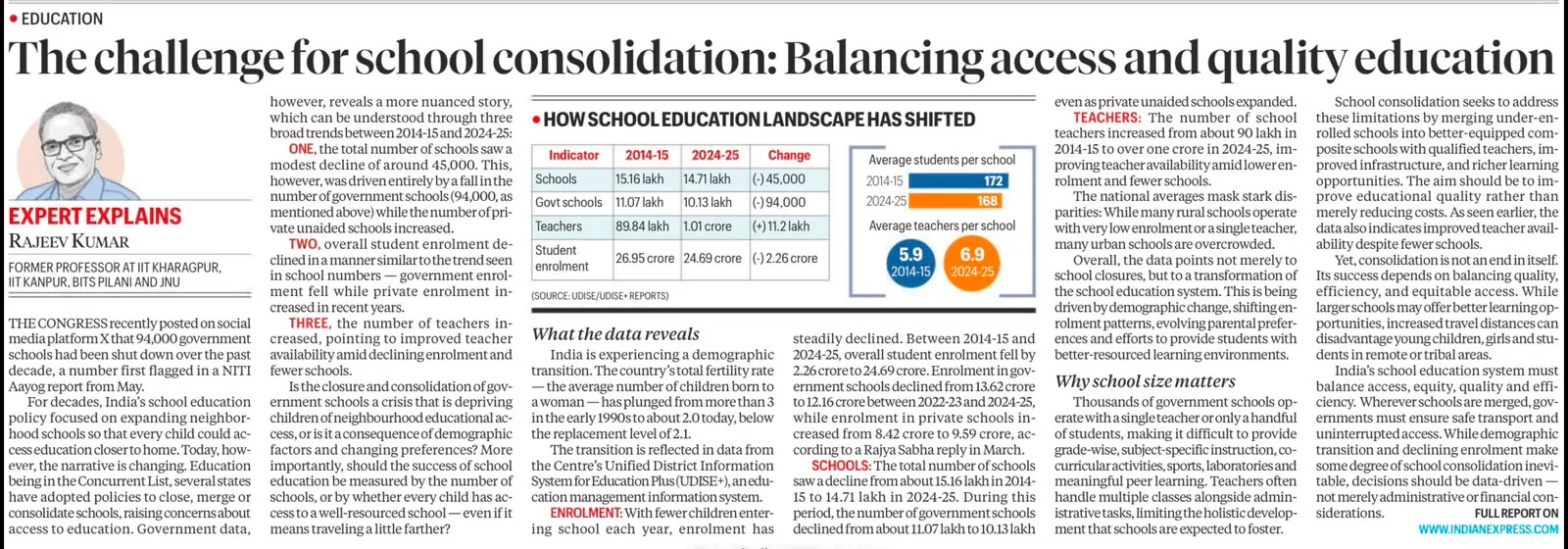
Student enrolment declined from 26.95 crore in 2014–15 to 24.69 crore in 2024–25.
This reflects demographic transition and falling fertility.
Under-Utilised Government Schools
Government schools declined from 11.07 lakh to 10.13 lakh.
The average number of students per school fell from 172 to 168.
Teacher Deployment
Teachers increased from 89.84 lakh to 1.01 crore.
This means better teacher deployment and infrastructure use have become important policy questions.
The data comes from UDISE+ 2024–25, Department of School Education and Literacy, Ministry of Education.
Benefits
School consolidation can improve learning outcomes by giving students better access to:
- Subject teachers
- Laboratories
- Libraries
- ICT facilities
- Better infrastructure
It can optimise public expenditure and reduce duplication of infrastructure.
It also supports the National Education Policy, 2020, which promotes multidisciplinary and holistic education.
Challenges
Accessibility
Longer travel distances may affect girls, tribal children and students in remote areas.
This raises concerns under Article 14 and Article 21A.
Dropout Risk
Poor transport can increase absenteeism and dropout.
This can affect progress towards Sustainable Development Goal 4, which focuses on quality education.
Regional Disparities
Uniform consolidation may not work in geographically difficult or sparsely populated regions.
Mountain, tribal, desert and remote regions may require special treatment.
Way Forward
School consolidation must be done through careful local mapping.
States should ensure transport, hostels or residential support where needed.
No child should lose access because a nearby school was merged.
Consolidation should focus on quality, not just cost-cutting.
Local communities, parents and teachers should be consulted.
Key Takeaway
School consolidation can improve education quality, but only if access is protected. Efficiency must not come at the cost of equity.