Context:
The 23rd Commonwealth Games were held in Glasgow from 23 July to 2 August 2026.
Athletes from 74 nations participated across 11 sports and 215 medal events.
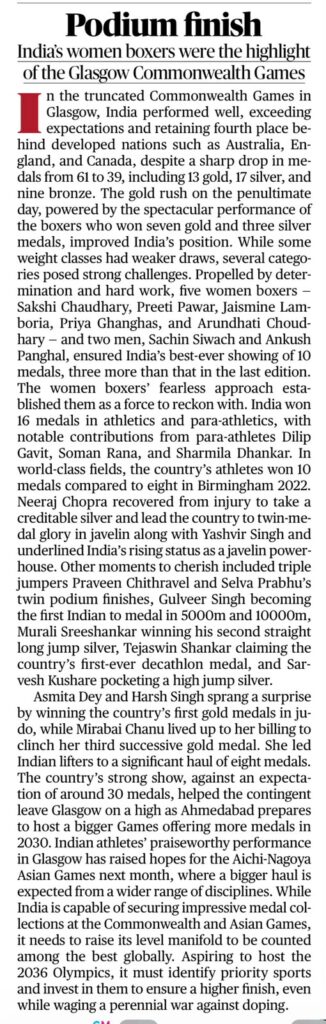
India finished 4th with 39 medals: 13 Gold, 17 Silver and 9 Bronze. More than the medal count, the performance showed India’s growing depth in women’s sport, boxing, judo, athletics and para-sport.
India’s Medal Position
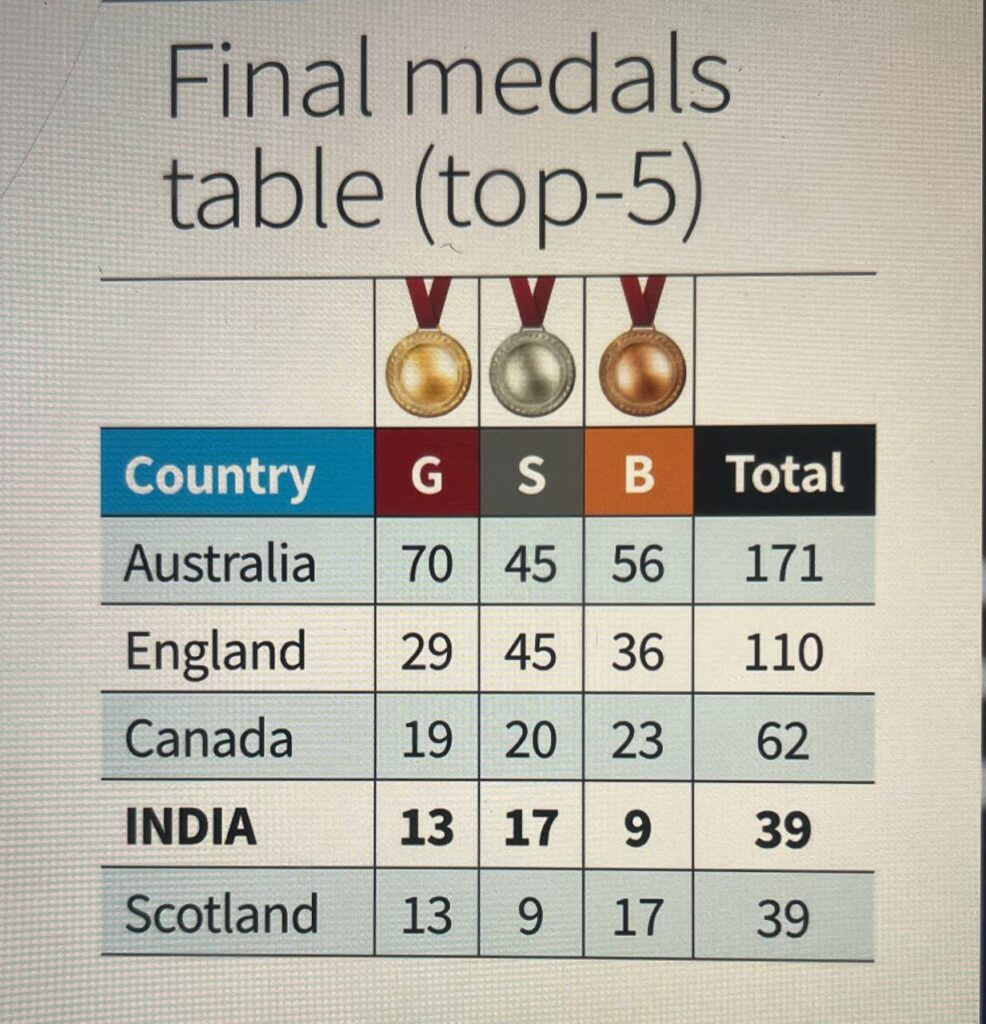
India retained the 4th position, behind Australia, England and Canada.
The final top-five medal table showed:
- Australia: 70 Gold, 45 Silver, 56 Bronze — Total 171
- England: 29 Gold, 45 Silver, 36 Bronze — Total 110
- Canada: 19 Gold, 20 Silver, 23 Bronze — Total 62
- India: 13 Gold, 17 Silver, 9 Bronze — Total 39
- Scotland: 13 Gold, 9 Silver, 17 Bronze — Total 39
India and Scotland both had 39 medals, but India ranked higher because of more silver medals.
Bigger Significance of India’s Performance
Record Boxing Campaign
India won 10 medals in boxing.
This included:
- 7 Gold
- 3 Silver
This was India’s best-ever boxing performance at a Commonwealth Games and the highest boxing medal haul at Glasgow.
Women’s Excellence
Women boxers were the highlight of India’s campaign.
Gold medals were won by:
- Preeti Pawar
- Jaismine Lamboria
- Sakshi Chaudhary
- Priya Ghanghas
- Arundhati Choudhary
This shows the growing rise of women’s high-performance sport in India.
Judo Breakthrough
India also achieved a historic breakthrough in judo.
Asmita Dey won Gold in the 48 kg category.
Harsh Singh won Gold in the 60 kg category.
These were India’s first Commonwealth Games Gold medals in judo.
This shows that India’s medal base is slowly expanding beyond traditional strong disciplines.
Athletics Performance
India also showed progress in track and field.
Important performances included:
- Neeraj Chopra — Silver in Javelin
- Murali Sreeshankar — Silver in Long Jump
- Gulveer Singh — Silver in 10,000m and Bronze in 5,000m
These performances reflect India’s growing capability in athletics.
Para-Sport
India secured 7 para-sport medals, including 3 Gold.
This shows growing inclusivity and competitive depth in India’s sporting ecosystem.
Broader Message
India’s 39-medal haul was not only about quantity.
It represented:
- Diversification of sports
- Women’s empowerment
- Para-sport inclusion
- Emergence of new medal disciplines
- Rising sporting depth
Persisting Challenges
India’s success is still concentrated in a few disciplines.
Talent identification remains uneven across regions and socio-economic groups.
Sports science support such as nutrition, psychology, biomechanics, rehabilitation and performance analytics still needs wider reach.
Long-term funding and better infrastructure remain essential.
Sports federations also need professional management, transparent selection systems, athlete welfare support and stronger anti-doping mechanisms.
Way Forward
India should build a seamless talent pipeline connecting:
- Khelo India
- Schools
- Universities
- Academies
- High-performance centres
Athletes need integrated support in sports science, nutrition, psychology, physiotherapy and data analytics.
India should provide multi-year, outcome-linked support to Olympic, Paralympic and non-traditional disciplines.
Dedicated pathways are needed for women, para-athletes and under-represented regions.
Ahmedabad 2030 should be used strategically as a catalyst for lasting sports infrastructure, stronger domestic competitions and better institutional capacity.
Key Takeaway
India’s Commonwealth Games 2026 performance shows growing sporting depth, especially in women’s boxing, judo, athletics and para-sport. The next challenge is to convert this progress into deeper, wider and more consistent global performance.