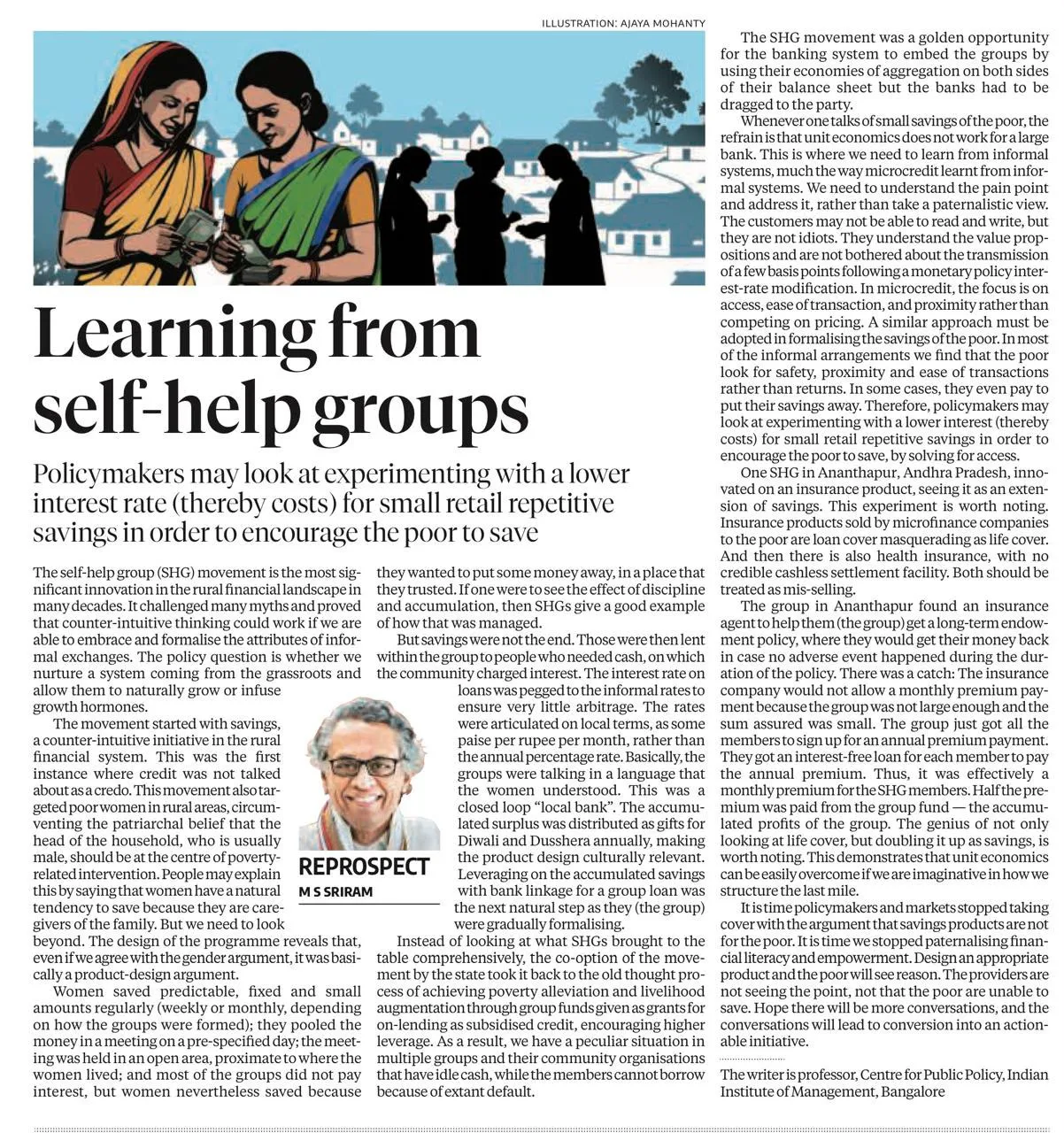
Context: Self Help Groups financial inclusion
The Self-Help Group movement shows how collective savings, social trust and need-based finance can strengthen the financial resilience of poor households.
It also offers lessons for making formal banking more inclusive and more suited to the needs of low-income communities.
What Is a Self-Help Group?
A Self-Help Group is a voluntary group, usually of 10–20 members.
Members pool small regular savings, provide small internal loans and collectively access formal financial services.
SHGs as a Financial Inclusion Model
Savings-Led Inclusion
Small and regular savings build financial discipline.
They reduce dependence on informal moneylenders.
They also help poor households manage emergencies and recurring expenses.
Social Collateral
SHGs use peer monitoring and collective responsibility.
This reduces information asymmetry and lending risk for banks.
It allows banks to lend to groups that may not have conventional collateral.
Last-Mile Banking
Under Deendayal Antyodaya Yojana–National Rural Livelihoods Mission, or DAY-NRLM, 90.91 lakh SHGs covering 10.05 crore rural households had been mobilised by December 2025.
This shows the scale of SHGs as a last-mile financial delivery system.
SHGs as Women-Led Development
Financial Autonomy
Access to savings and credit strengthens women’s control over money and household decisions.
Collective Empowerment
Group-based action improves women’s bargaining power, confidence and participation in community institutions.
Financial Protection
SHGs can provide access not only to credit but also to:
- Insurance
- Pensions
- Risk-management products
- Livelihood support
Institutional Credit
Since 2013–14, SHGs have accessed ₹12.18 lakh crore of bank credit.
This shows their growing integration with formal finance.
Core Lesson for Formal Banking
Banks should adapt products to the poor’s financial reality.
Poor households often have small savings, irregular incomes and frequent transaction needs.
Formal banking should not impose conventional products that do not match their lives.
Financial inclusion should combine:
- Savings
- Credit
- Insurance
- Pensions
- Livelihood support
Credit should be linked with skills, technology, market linkages and infrastructure.
SHG networks can reduce the cost and difficulty of last-mile financial service delivery.
Key Takeaway
SHGs show that financial inclusion works best when it is built on trust, savings, collective responsibility and products designed around the real needs of poor households.