Context: Supreme Court Police Custody BNSS
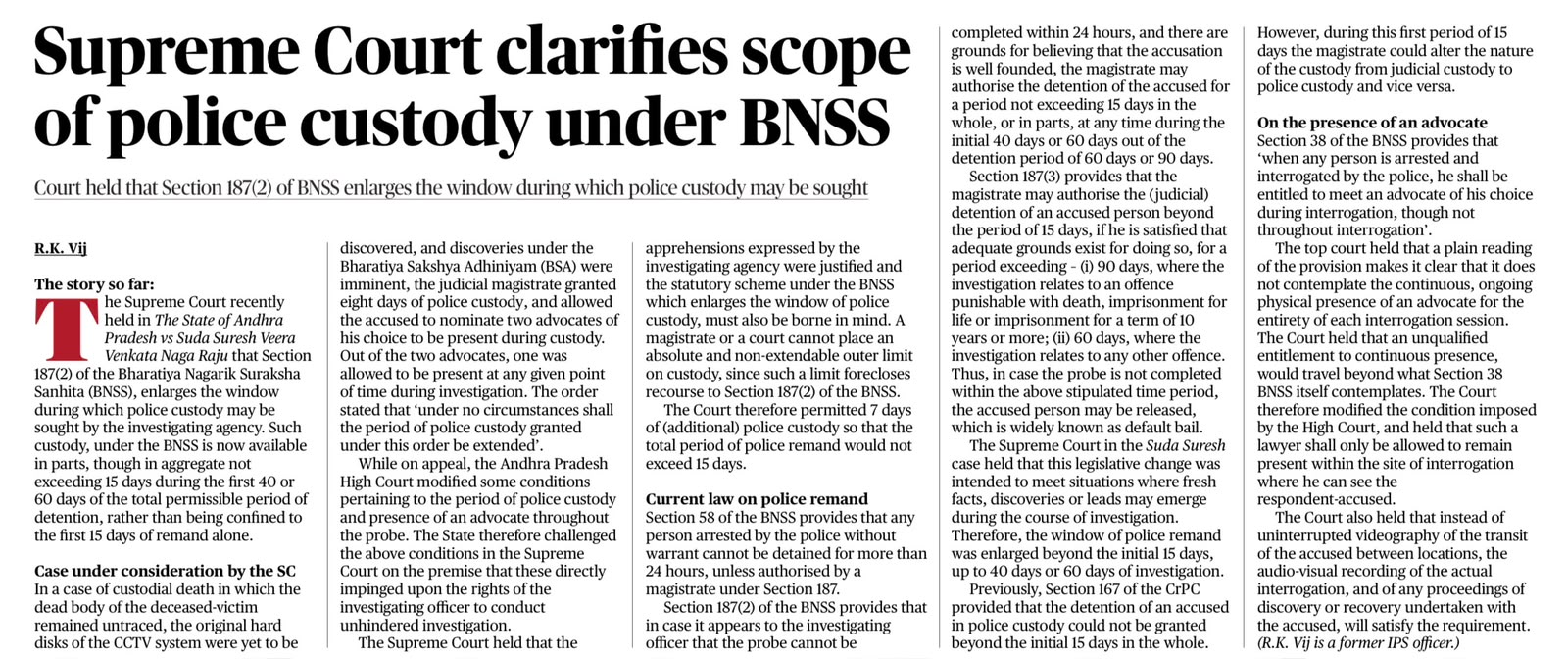
The Bharatiya Nagarik Suraksha Sanhita, 2023, which replaced the Code of Criminal Procedure, 1973, has altered the framework of arrest and remand. In The State of Andhra Pradesh v. Suda Suresh Veera Venkata Naga Raju, the Supreme Court clarified the scope of police custody and safeguards available to arrested persons.
Key BNSS Provisions
Section 58: 24-hour safeguard
An arrested person cannot ordinarily be detained beyond 24 hours, excluding journey time, without production before a Magistrate and further authorisation.
This provision protects individuals from arbitrary and prolonged detention without judicial oversight.
Section 187(2): Police custody
Police custody remains capped at 15 days in total.
However, under BNSS, this 15-day police custody can be taken in parts during:
- The first 40 days of a 60-day detention period, or
- The first 60 days of a 90-day detention period
This depends on the nature of the offence.
Section 38: Advocate
An arrested person can meet an advocate of their choice during interrogation.
However, this does not mean that the advocate has to remain continuously present throughout the interrogation.
Supreme Court’s Clarification
15-day limit unchanged
The Supreme Court clarified that BNSS has not increased the maximum police custody period.
The total police custody continues to remain capped at 15 days.
What has changed is the time window during which those 15 days may be used.
Separate spells permitted
Police can seek custody at different stages when fresh evidence or investigative requirements justify it.
However, this is subject to Magistrate approval.
Earlier Position
This differs from Central Bureau of Investigation v. Anupam J. Kulkarni, 1992.
Under the earlier Code of Criminal Procedure, police custody was confined to the first 15 days.
BNSS expands the window for using police custody, while keeping the overall 15-day cap intact.
Constitutional Balance
Investigation vs Liberty
Greater investigative flexibility must operate within constitutional safeguards.
This involves:
- Article 21: Life and personal liberty
- Article 22: Protection against arbitrary arrest and detention
Judicial Oversight
Magistrate authorisation remains the key safeguard against unnecessary or prolonged police custody.
The Magistrate must examine whether police custody is genuinely required and whether legal safeguards are being followed.
Key Takeaway
The Supreme Court clarified that BNSS does not increase the total police custody limit beyond 15 days. It only expands the window during which police may seek custody in separate spells, subject to judicial approval and constitutional safeguards.