
Learn how to Stop Procrastination During UPSC Preparation with practical study strategies, small actions, timed practice, and better focus.
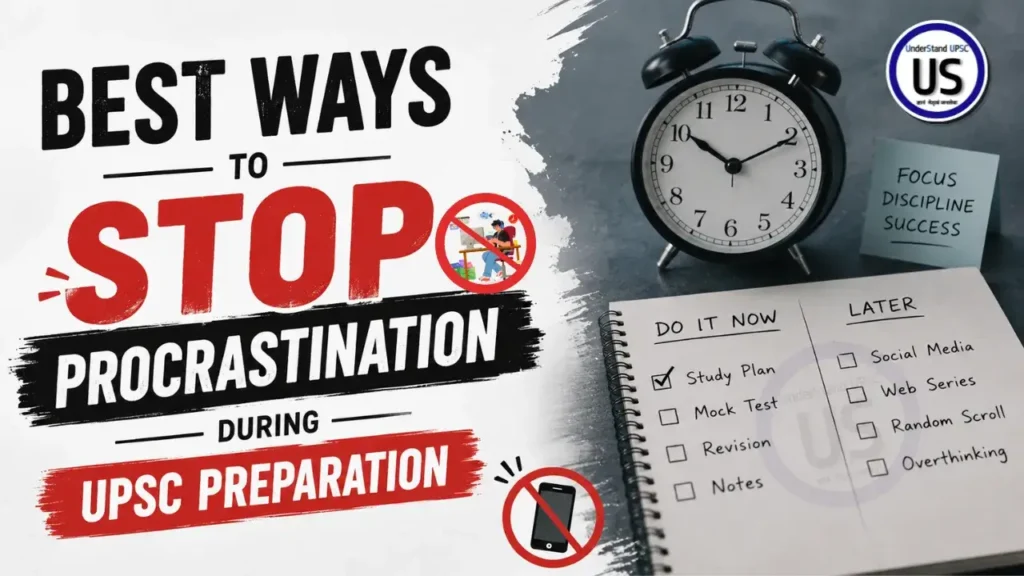
Most UPSC aspirants do not postpone everything. They postpone the tasks that create discomfort: a mock that may expose weak elimination, an answer that may reveal poor structure, or an optional chapter that makes them feel intellectually inadequate. They then replace these tasks with safer work, such as reading familiar notes, reorganising PDFs, watching strategy videos, or redesigning the timetable.
That pattern is not simply laziness. In research, procrastination is understood as a self-regulation failure in which a person voluntarily delays an intended action despite expecting the delay to be harmful. Large-scale evidence has repeatedly linked procrastination with task aversiveness, impulsiveness, weak confidence in completing the task, and rewards that feel too distant. For a UPSC aspirant, the discomfort of a mock is immediate; the possible reward of selection is uncertain and months away. The brain therefore prefers the smaller reward available now: relief.
“Stop Procrastination During UPSC Preparation”
Procrastination Is Often Mood Repair
A useful scientific explanation is the mood-regulation model. An unpleasant task creates anxiety, boredom, confusion, or fear of failure. Avoiding it improves mood immediately, so avoidance is reinforced. The relief is real, but temporary. The unfinished task later produces more guilt and stress, making the next attempt even harder. This is why self-criticism often worsens the cycle instead of correcting it.
Read Also – UPSC Anxiety Management Tips, Pomodoro Technique for UPSC and UPSC Motivation Tips
Begin with a seven-day diagnostic log. Whenever you delay a task, record four things:
Planned task: Write a timed answer on cooperative federalism.
Emotion before starting: Uncertain and afraid of producing an average answer.
Substitute activity: Watched a topper’s answer-writing video.
Immediate reward: Felt informed without risking evaluation.
Do not record “lack of discipline.” It explains nothing. Record the emotion, substitute, and reward. After seven days, a pattern usually appears. You may not be avoiding environment; you may be avoiding the experience of getting environment questions wrong.
The correction is controlled exposure. If full mocks have been avoided for weeks, do not begin with a heroic three-hour paper. Start with twenty-five timed questions, analyse every error, then increase to fifty and one hundred.
The purpose is not to make testing comfortable. It is to teach the nervous system that an imperfect score is information, not catastrophe.
Replace Intentions With Triggered Actions
“I will study ethics tomorrow” is a goal intention. It states what you want but leaves the moment of action undecided.
Research on implementation intentions shows that specific if-then plans improve the translation of intentions into action because a predetermined cue triggers a predetermined response. A major meta-analysis covering 94 independent tests found a meaningful positive effect on goal attainment.
Use this format:
If it is 7:00 a.m. and I sit at my desk, then I will solve ten polity MCQs before opening Telegram.
If I feel the urge to watch a strategy video during optional study, then I will write the question on my later list and complete the current subsection first.
If a mock score is below my expectation, then I will classify errors before changing any source.
The plan must name a cue and a physical response. “I will be more consistent” has neither. The more decisions left for the study moment, the more opportunities the mind has to negotiate, delay, and choose an easier substitute, especially when energy is low and anxiety is high.
Also reduce the size of the first action. Behavioural interventions for procrastination commonly combine graded task initiation, self-monitoring, realistic goal-setting, and control of distractions rather than waiting for motivation.
Open the test booklet, attempt the first five questions, or write only the answer framework. Momentum is not guaranteed, but initiation becomes less dependent on mood.
Do Not Worship Deadlines
The popular claim that evenly spaced deadlines automatically cure procrastination is weaker than productivity culture suggests.
A preregistered 2026 replication of a famous deadline experiment found negligible effects on performance. The researchers concluded that externally imposed, evenly spaced deadlines did not stand out as an effective solution.
Deadlines can still organise work, but a date without a defined behaviour is not an intervention.
Replace “Finish modern history by Sunday” with:
Wednesday: Recall 1857 without notes and solve fifteen PYQs.
Friday: Compare Swadeshi, Non-Cooperation, and Civil Disobedience from memory.
Sunday: Attempt a fifty-question sectional test and analyse all uncertain answers.
Each deadline now contains evidence-producing work.
At the end of every week, measure four outputs: questions attempted under time, answers submitted, errors re-tested, and topics recalled without notes. Do not reward yourself for sitting with books for ten hours if the week produced no evidence of retrieval.
The scientifically serious response to procrastination is not motivation, punishment, or a perfect timetable. It is to identify the emotion being escaped, make the first action smaller, attach action to a reliable cue, expose yourself gradually to evaluation, and measure observable work.
You do not defeat procrastination by feeling ready. You weaken it by making avoidance less rewarding and action more automatic.
Read Also – UPSC Preparation: How to Start UPSC Preparation from Zero in 2026
FAQs
1. How can UPSC aspirants stop procrastinating during preparation?
UPSC aspirants can reduce procrastination by identifying the emotion behind task avoidance, starting with smaller tasks, using specific if-then action plans, limiting distractions, and tracking measurable outputs such as questions attempted and answers submitted.
2. Why do UPSC aspirants procrastinate during preparation?
UPSC aspirants often procrastinate when a task creates discomfort, such as fear of a poor mock score, difficulty with answer writing, or uncertainty about an optional subject. Avoiding the task provides temporary relief but can increase stress later.
3. What is the best way to start studying when you feel like procrastinating?
Start with a very small, clearly defined action. Instead of planning to study for several hours, open the test booklet, attempt five questions, or write an answer framework. Small actions can make task initiation easier.
4. Do if-then plans help with UPSC procrastination?
If-then plans can help convert an intention into a specific action. For example, an aspirant can decide: “If I sit at my desk at 7 a.m., then I will solve ten polity MCQs before opening Telegram.” Research on implementation intentions supports using specific cues and responses to improve goal-directed action.
5. How should UPSC aspirants measure progress instead of study hours?
Aspirants should track evidence-producing activities such as timed questions attempted, answers submitted, errors re-tested, and topics recalled without notes. This gives a clearer picture of actual preparation than counting hours spent with books.







