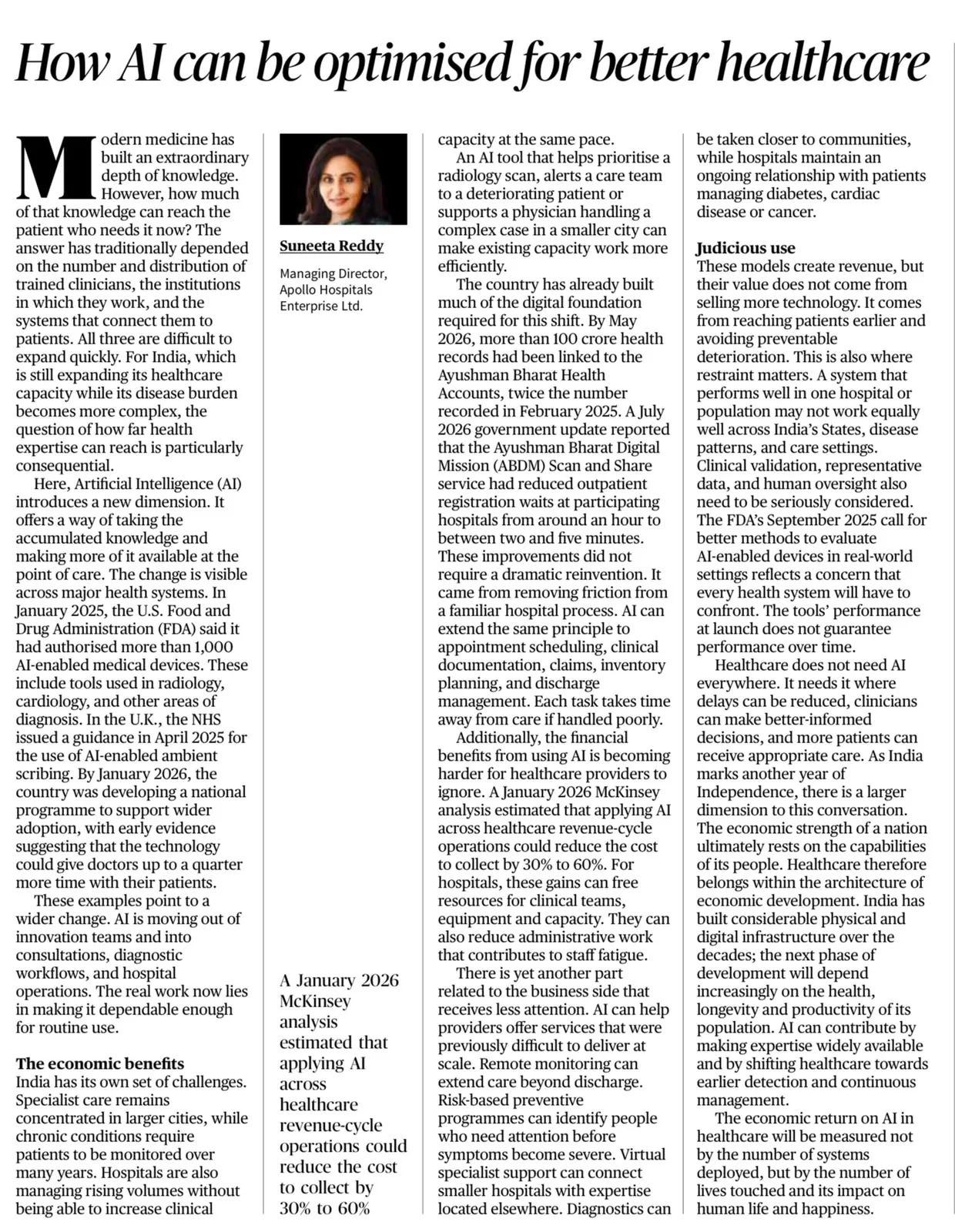
Context: AI Optimisation in Healthcare
India’s healthcare challenge is increasingly one of access, specialist availability and continuity of care. Artificial Intelligence can act as a capacity multiplier by extending medical expertise, enabling earlier diagnosis and reducing the administrative burden on healthcare professionals.
1. AI as a Healthcare Capacity Multiplier
Clinical decision support: AI can assist in medical imaging, diagnosis and risk assessment, particularly where specialist doctors are scarce.
Early detection: Predictive tools can identify patients at risk of deterioration → shift from reactive treatment to preventive intervention.
Remote & continuous care: AI-enabled monitoring and virtual specialist support can extend healthcare beyond hospitals, particularly for chronic diseases.
Administrative efficiency: AI can automate documentation, appointments, claims, inventory and hospital workflows, allowing doctors and nurses to devote more time to patients.
2. India’s Digital Foundation
Ayushman Bharat Digital Mission: By May 2026, more than 100 crore health records had been linked to Ayushman Bharat Health Accounts, creating a large digital-health foundation for AI applications.
Scan and Share: Digital registration reduced outpatient registration time in participating hospitals from around one hour to 2–5 minutes, demonstrating how digital tools can improve health-system efficiency.
Economic potential: A 2026 McKinsey analysis estimated that AI applications in healthcare revenue-cycle operations could reduce collection costs by 30–60%.
3. What AI Can Deliver
Wider access: Specialist-level assistance can reach smaller towns and underserved regions without requiring every location to have a full specialist workforce.
Better resource utilisation: AI can optimise hospital capacity, workforce, equipment and supply chains.
Personalised care: Patient data and predictive analytics can support more targeted treatment and continuous monitoring.
Systemic shift: Healthcare can move from “treating illness” → “predicting, preventing and managing illness.”
4. Key Challenges
Data bias: AI trained on non-representative datasets can produce inaccurate or unequal outcomes across populations.
Real-world reliability: A model validated in one hospital or population may not perform equally well elsewhere.
Human oversight: AI should augment rather than replace clinical judgement, particularly for high-risk medical decisions.
Privacy & cybersecurity: Large-scale health-data use increases risks of breaches, misuse and unauthorised access.
Accountability: Clear responsibility is needed when an AI-assisted decision causes harm.
5. Way Forward
Adopt a “judicious AI” approach — deploy AI where it produces demonstrable clinical value.
Build representative, high-quality health datasets and interoperable digital systems.
Mandate clinical validation, real-world testing and continuous monitoring.
Strengthen privacy, cybersecurity, transparency and accountability.
Retain human-in-the-loop decision-making for consequential medical decisions.
EDITORIAL TO MAINS ANSWER | DAY 8
10 Marks | 150 Words
Q. Artificial Intelligence can act as a capacity multiplier for India’s healthcare system, but its benefits depend on responsible and judicious deployment. Discuss.
प्रश्न. आर्टिफिशियल इंटेलिजेंस भारत की स्वास्थ्य सेवा प्रणाली की क्षमता को बढ़ानेमेंसहायक हो सकता है, लेकिन इसके लाभ इसकेजिम्मेदार और विवेकपूर्णउपयोग पर निर्भर करतेहैं। चर्चाकीजिए।