Context: Criminal Cases Against MPs and MLAs
The Supreme Court is monitoring the long-pending criminal cases involving sitting and former MPs and MLAs. Despite special courts and repeated judicial directions, delays persist at both the investigation and trial stages, raising concerns over timely justice and institutional accountability.
1. Scale of Pendency — Key Data
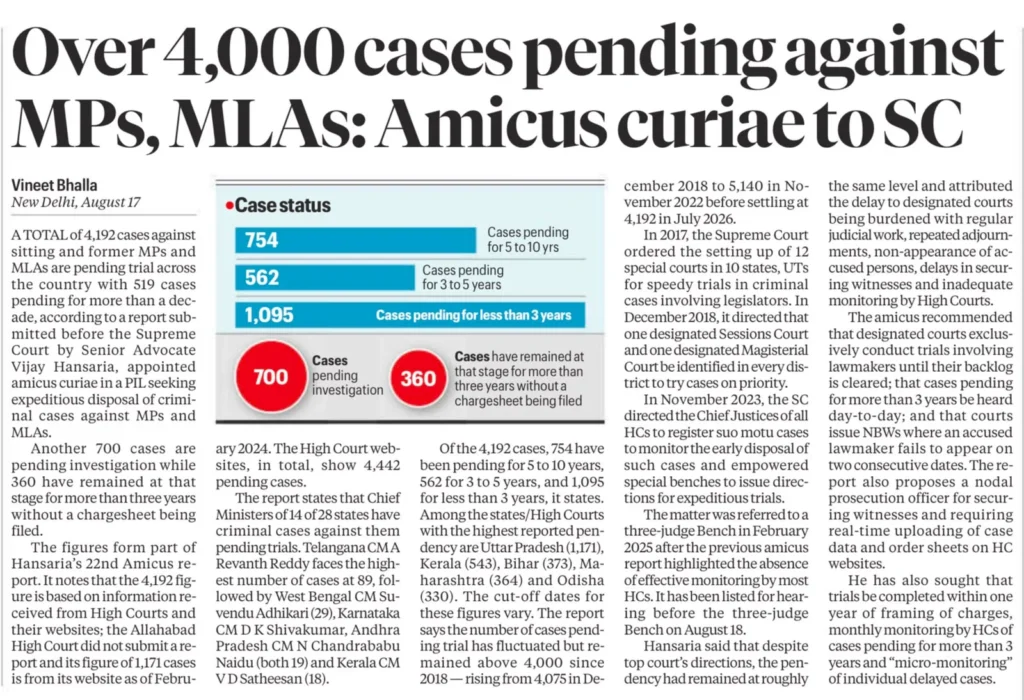
4,192 cases are pending against sitting and former MPs/MLAs across India.
519 cases have been pending for more than 10 years.
754 cases have been pending for 5–10 years.
562 cases have been pending for 3–5 years.
700 cases remain under investigation.
In 360 cases, no chargesheet has been filed even after more than 3 years.
Pendency trend:
- 2018 — 4,075
- 2022 — 5,140
- 2026 — 4,192
This shows persistence despite judicial intervention.
Highest pendency:
- Uttar Pradesh — 1,171
- Bihar — 543
- Maharashtra — 364
- Odisha — 330
2. What the Data Reveals — Investigation to Trial Bottlenecks
The problem is not limited to court delays.
Prolonged investigation and delayed filing of chargesheets are major bottlenecks.
519 cases pending for over a decade indicate that criminal proceedings can extend across multiple electoral cycles.
360 cases without chargesheets for over three years point to weaknesses in:
- Investigation
- Prosecution
- Case management
14 of 28 States have Chief Ministers facing pending criminal cases, highlighting the wider relevance of timely adjudication of cases involving political representatives.
A pending case does not establish guilt.
The concern is ensuring a timely determination of guilt or innocence.
3. Supreme Court Intervention
2017:
Directed establishment of 12 special courts across 10 States/UTs for speedy trials involving legislators.
2018:
Directed designated courts in every district to prioritise such cases.
2023:
High Courts directed to suo motu monitor cases involving legislators.
2025:
Matter referred to a 3-judge Bench amid concerns over inadequate implementation and monitoring.
4. Way Forward — From Judicial Directions to Implementation
Time-bound investigation:
Prevent cases from remaining at the investigation stage indefinitely.
Priority trials:
Cases pending for more than 3 years should receive focused, day-to-day hearings wherever feasible.
Judicial capacity:
Strengthen designated courts with adequate judges, prosecutors and court infrastructure.
Digital monitoring:
Real-time uploading of case status and orders can enable High Court-level supervision and transparency.
Micro-monitoring:
Track individual long-pending cases rather than relying only on aggregate pendency figures.