Admissions Open: MAD-X for UPSC Prelims 2027 · Batch starts 1st Nov 2026 Explore MAD-X
US
UnderStand UPSC Daily Current Affairs Practice
0.00Score / 14
0 / 7MCQs Attempted
0%Accuracy
1–2 November 2026 • UPSC CSE

Read the news. Test the concept. Write the Mains answer.

This interactive edition converts each current-affairs item into one Prelims-level MCQ, one Mains-level question, and a compact value-addition section for revision.

+2 correct −0.66 incorrect Explanation after attempt Image/PDF answer upload
NEWS 1 GS2 • Indian Polity — Tenth Schedule Source: The Hindu

Bihar Opposition Seeks Disqualification of Two Independent MLCs under the Anti-Defection Law

Context: The Opposition in Bihar has sought the disqualification of two newly elected Independent MLCs, Bansidhar Brajwasi and Rahul Raj, under the Tenth Schedule after the BJP announced they had joined the party. Hours later the BJP said the two had only 'extended support'.
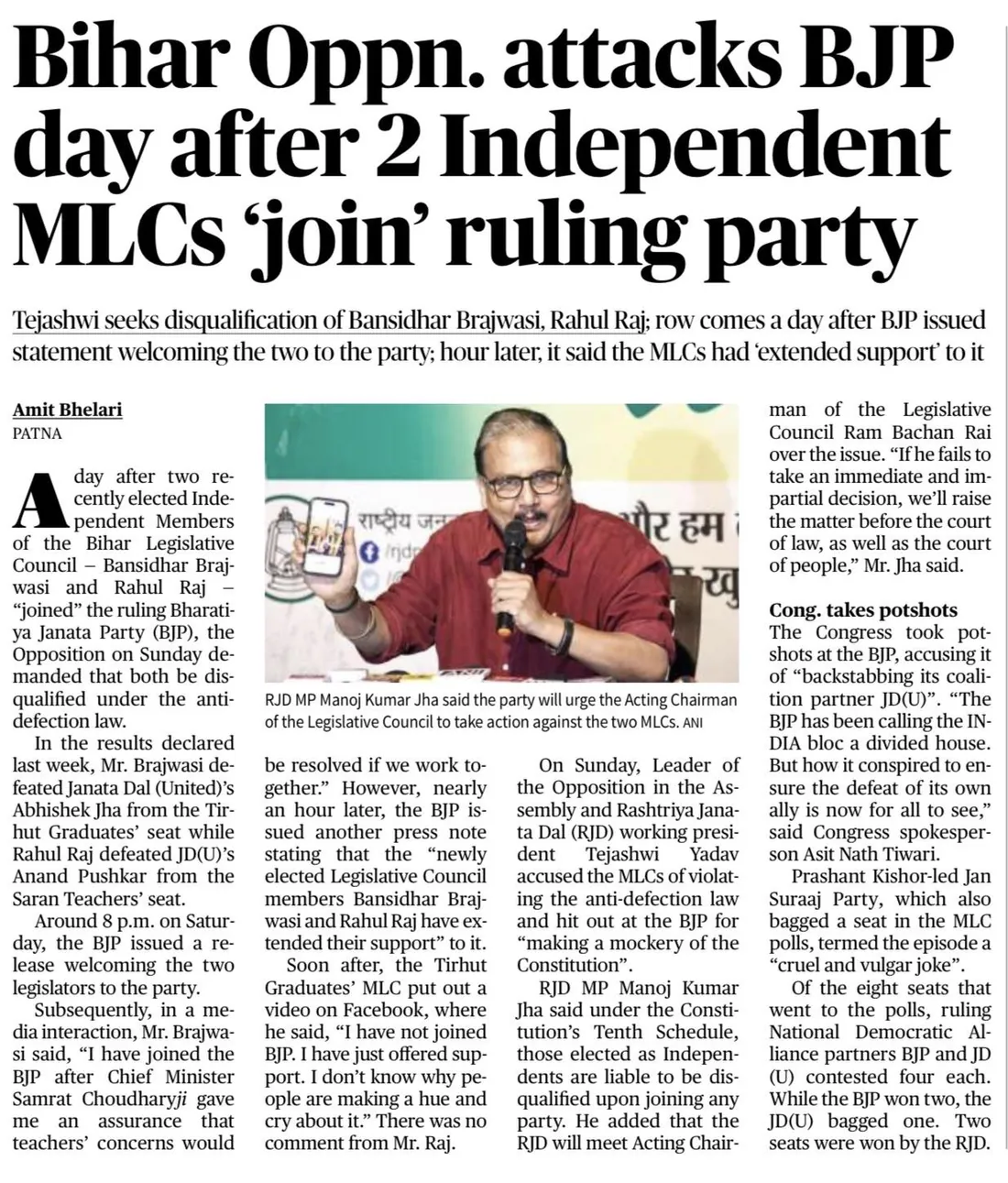
Bihar Opposition seeks disqualification of Independent MLCs Bansidhar Brajwasi and Rahul Raj under the anti-defection law (The Hindu)
RJD MP Manoj Kumar Jha says the party will urge the Acting Chairman of the Legislative Council to act against the two MLCs. Source: The Hindu

The Bihar Case

The MLCs
Bansidhar Brajwasi (Tirhut Graduates' seat) and Rahul Raj (Saran Teachers' seat), both elected as Independents.
The dispute
BJP first welcomed them into the party, then said they had only extended support; Brajwasi said on video he had not joined.
Opposition demand
Disqualification petition before the Acting Chairman of the Legislative Council; RJD says it will go to court if there is no decision.

Tenth Schedule: Constitutional Background

Origin
Added by the 52nd Constitutional Amendment Act, 1985.
Applies to
Lok Sabha, Rajya Sabha, State Legislative Assemblies and Legislative Councils.
Articles
Article 102(2) — MPs; Article 191(2) — State legislators.

Grounds for Disqualification

Party members — Para 2(1)
Voluntarily giving up party membership, or voting/abstaining against the party whip without permission (if not condoned within 15 days).
Independents — Para 2(2)
Disqualified if they join any political party after election. Merely extending support is not, by itself, joining.
Nominated members — Para 2(3)
May join a party within six months of taking their seat; joining after that attracts disqualification.

Exceptions & Decision

Merger — Para 4
Protection if at least two-thirds of the legislature party agree to the merger.
Deciding authority
Speaker (Lok Sabha, Assembly) or Chairman (Rajya Sabha, Legislative Council).
Time limit
No deadline in the Schedule; Keisham Meghachandra Singh (2020) — ordinarily decide within three months.
Judicial review
Decisions are open to judicial review — Kihoto Hollohan (1992).

Previous-Year Question

UPSC Prelims 2022 — Anti-defection
1. A nominated legislator cannot join any party within six months of appointment. 2. The law gives no time-frame for the presiding officer. Answer: (b) 2 only — a nominated member can join a party within six months.
Key Takeaway: For an Independent, the line is between 'support' and 'joining'. Because the presiding officer decides and no deadline is written into the Schedule, the outcome often depends on timing — which is why the courts have pushed for a three-month limit.

Prelims Practice MCQ

+2 correct • −0.66 wrong

With reference to the Tenth Schedule of the Constitution, consider the following statements:
1. An Independent member who joins a political party after election is liable to be disqualified.
2. A nominated member is disqualified if he or she joins a political party at any time after taking the seat.
3. Disqualification of a member of a State Legislative Council is decided by its Chairman.
Which of the statements given above are correct?

Explanation: Statements 1 and 3 are correct. A nominated member may join a political party within six months of taking the seat; only joining after six months attracts disqualification.

UPSC Mains Question

10 Marks • 150 Words

The anti-defection law has curbed defections but weakened the role of individual legislators. Examine with reference to recent cases involving Independent members.

Attempt before opening the value-addition tab.
Accepted: JPG, JPEG, PNG, WEBP or PDF. The standalone file previews your answer locally; connect the API hook for real server submission.
Use after attempting the Mains answer
  • Basics — 52nd Amendment 1985; Articles 102(2), 191(2); Paras 2(1), 2(2), 2(3), 4.
  • Independents — joining a party = disqualification; 'support' grey zone (Bihar MLC case).
  • Cases — Kihoto Hollohan 1992 (judicial review), Keisham Meghachandra 2020 (three months).
  • Issues — delay and partisanship of presiding officers, whip limits free debate.
  • Reforms — Election Commission/tribunal to decide (2nd ARC, Law Commission), fixed deadlines.
NEWS 2 GS3 • Science & Technology — Biotechnology Source: The Hindu

Gene Therapy CRMA-1001 Aims for a Cure by Silencing Hepatitis B DNA

Context: A study in Nature Biomedical Engineering reports an experimental therapy, CRMA-1001, that silences hepatitis B viral DNA through epigenetic control instead of attacking the virus directly — a possible path to a lasting functional cure.

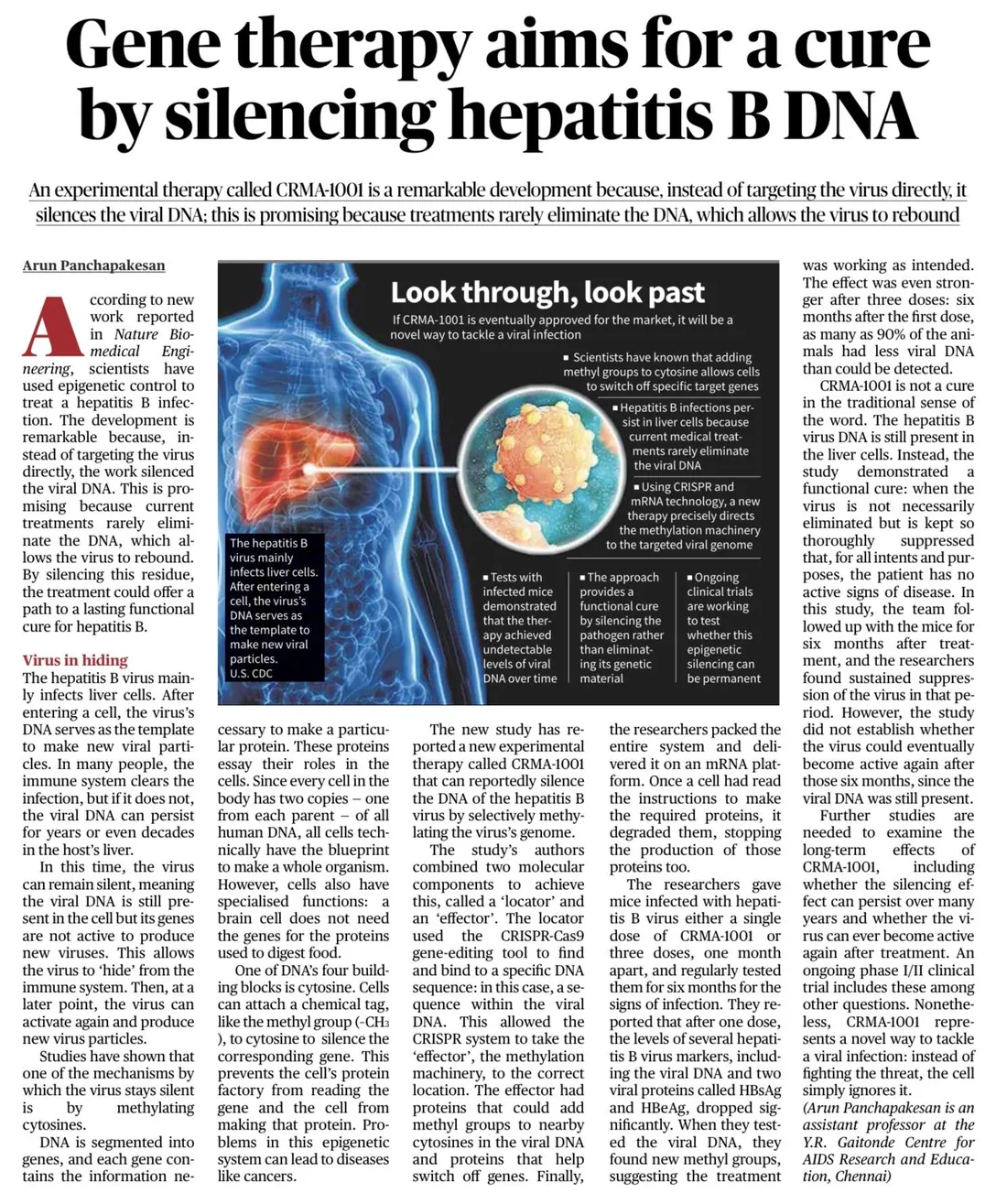
CRMA-1001 gene therapy silences hepatitis B viral DNA using CRISPR and DNA methylation (The Hindu)
CRMA-1001 switches off hepatitis B DNA in liver cells instead of removing it. Source: The Hindu

Important Concepts

Gene therapy
Treating disease by correcting, replacing or regulating genetic material.
Genome editing
Targeted changes to DNA using tools such as CRISPR-Cas9.
Epigenetic modification
Changing gene expression without changing the DNA sequence.
DNA methylation
Adding methyl groups (–CH₃) to cytosine, which switches a gene off.

How CRMA-1001 Works

Locator
CRISPR-Cas9 finds and binds to a specific sequence in the viral DNA.
Effector
Methylation machinery adds methyl groups to the viral DNA and switches off its genes.
Delivery
The whole system is delivered on an mRNA platform; the proteins degrade after use.
Results in mice
Viral DNA and proteins HBsAg and HBeAg fell sharply; after three doses, about 90% of animals had undetectable viral DNA at six months.

Hepatitis A, B and C

Hepatitis A
Contaminated food and water; acute only; vaccine available.
Hepatitis B
Blood and body fluids; acute and chronic (cirrhosis, liver cancer); vaccine available; antivirals only control it.
Hepatitis C
Mainly infected blood; acute and chronic; no vaccine, but curable in most cases with direct-acting antivirals.
D and E
Hepatitis D needs HBV to replicate; Hepatitis E spreads by contaminated water and is dangerous in pregnancy.

Significance & Limitations

Functional cure
Virus is kept suppressed, not eliminated — no active disease.
New approach
Combines CRISPR targeting with epigenetics; may help other persistent viral infections.
Limits
Viral DNA stays in liver cells and may reactivate; durability unknown; results are from mice; a Phase I/II human trial is ongoing.

Previous-Year Questions

UPSC Prelims 2026 — Genetic medicine
Correct/compensate faulty genes; engineered viruses and lipid nanoparticles as carriers; do not alter the entire DNA. Answer: (c) 1 and 2 only.
UPSC Prelims 2026 — GenomeIndia
Funded by the Department of Biotechnology; aims to catalogue genetic diversity; not part of the Human Genome Project. Answer: (b) 2 and 3 only.
Key Takeaway: Current hepatitis B drugs stop the virus from multiplying but leave its DNA behind. CRMA-1001 tries to make that leftover DNA permanently silent — a functional cure — but whether the silence lasts in humans is still the open question.

Prelims Practice MCQ

+2 correct • −0.66 wrong

With reference to the experimental therapy CRMA-1001 for hepatitis B, consider the following statements:
1. It removes the hepatitis B viral DNA from infected liver cells.
2. It uses CRISPR-Cas9 to locate a target sequence in the viral DNA.
3. It silences viral genes by adding methyl groups to the viral DNA.
Which of the statements given above are correct?

Explanation: Statements 2 and 3 are correct. The viral DNA remains in the liver cells; the therapy silences it through methylation, which is why it is called a functional cure, not a complete cure.

UPSC Mains Question

10 Marks • 150 Words

Epigenetic editing offers a new way to treat chronic viral infections. Discuss with reference to recent research on hepatitis B, and highlight the ethical and safety concerns involved.

Attempt before opening the value-addition tab.
Accepted: JPG, JPEG, PNG, WEBP or PDF. The standalone file previews your answer locally; connect the API hook for real server submission.
Use after attempting the Mains answer
  • Burden — chronic HBV causes cirrhosis and liver cancer; drugs control but do not clear viral DNA.
  • Mechanism — CRISPR locator + methylation effector, delivered by mRNA; gene sequence unchanged.
  • Evidence — mice: HBsAg/HBeAg fall; ~90% undetectable DNA after three doses; Phase I/II trial ongoing.
  • Concerns — reactivation, off-target epigenetic changes, delivery, cost and access.
  • India link — National Viral Hepatitis Control Programme, HBV birth-dose vaccination, GenomeIndia.
NEWS 3 GS3 • Economy, Energy & Environment Source: The Hindu

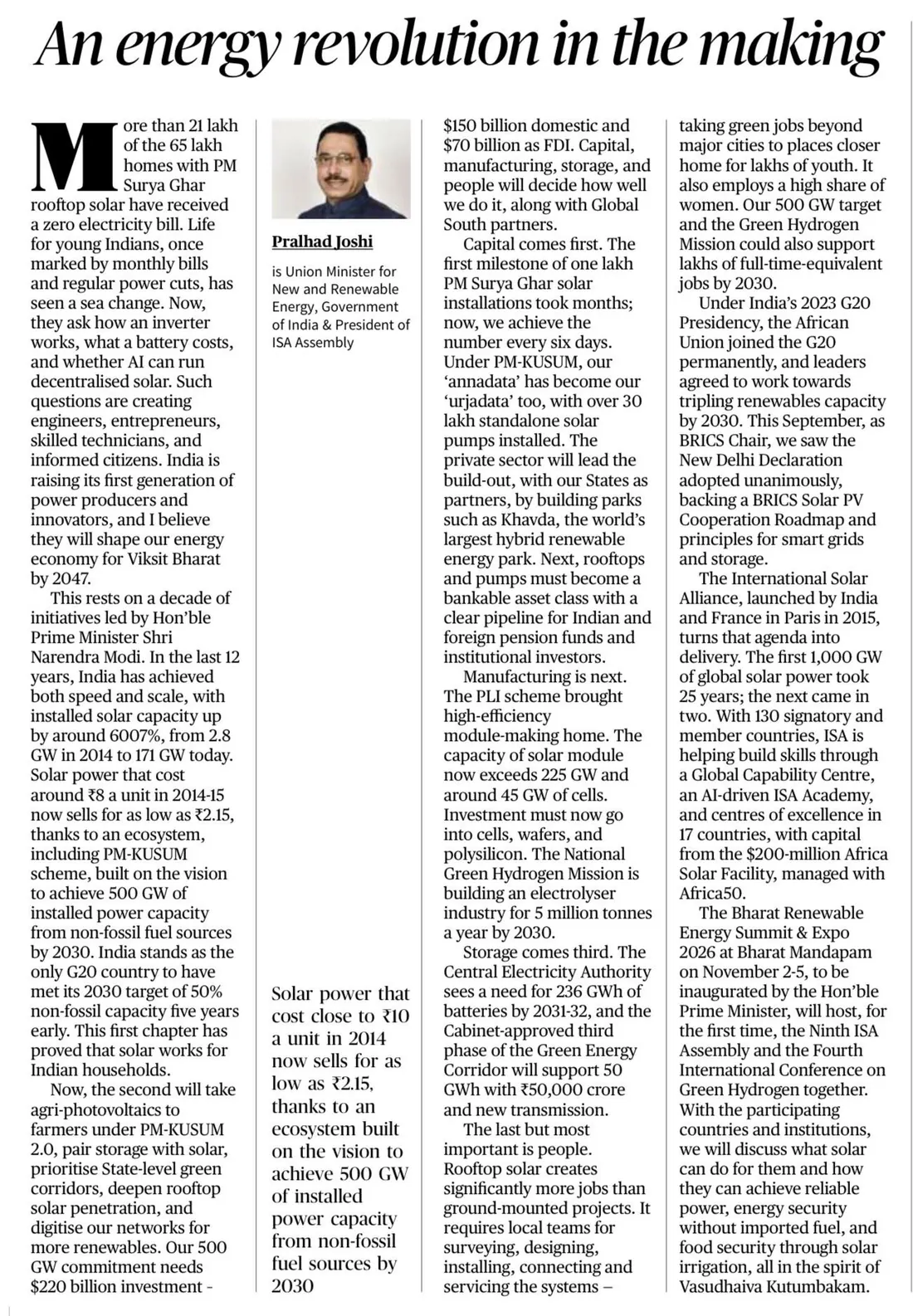
An Energy Revolution in the Making: India's 500 GW Renewable Energy Target

Context: In an article, Union Minister for New and Renewable Energy Pralhad Joshi sets out India's path to 500 GW of non-fossil capacity by 2030 — built on capital, manufacturing, storage and people — ahead of the Bharat Renewable Energy Summit & Expo (2–5 November 2026).

An energy revolution in the making – India 500 GW non-fossil capacity target, PM Surya Ghar and PM-KUSUM (The Hindu, Pralhad Joshi)
Solar capacity rose from 2.8 GW (2014) to 171 GW; the 500 GW goal needs about $220 billion. Source: The Hindu

India's Progress

Solar capacity
From 2.8 GW (2014) to 171 GW today (as cited).
Cost
Solar power fell from about ₹8 a unit (2014–15) to as low as ₹2.15.
50% non-fossil
Only G20 country to meet its 2030 target of 50% non-fossil capacity — five years early.
Households & farmers
PM Surya Ghar: over 21 lakh of 65 lakh homes got a zero bill; PM-KUSUM: over 30 lakh standalone solar pumps.

Four Pillars of the Next Phase

Capital
500 GW needs about $220 billion ($150 bn domestic, $70 bn FDI); make rooftops and pumps a bankable asset.
Manufacturing
PLI scheme — module capacity over 225 GW, cells about 45 GW; next: wafers and polysilicon.
Storage
CEA sees need for 236 GWh of batteries by 2031–32; third phase of the Green Energy Corridor.
People
Rooftop solar creates more local green jobs; National Green Hydrogen Mission targets 5 MMT a year by 2030.

International Cooperation

ISA
Launched by India and France in 2015 (Paris); 130 signatory and member countries.
BRICS
New Delhi Declaration backs a BRICS Solar PV Cooperation Roadmap.
Summit
Bharat Renewable Energy Summit (Bharat Mandapam) hosts the Ninth ISA Assembly and the 4th International Conference on Green Hydrogen.

Challenges & Way Forward

Challenges
Intermittency, high capital needs, import dependence for cells, wafers and polysilicon, grid gaps, land-use conflicts, storage costs.
Way forward
Agri-photovoltaics under PM-KUSUM 2.0, storage with solar, State green corridors, full manufacturing value chain, smart grids.

Previous-Year Questions

UPSC Prelims 2026 — Green hydrogen
Produced by electrolysis using renewable power; NGHM targets abatement of ~50 MMT of GHG. Gas reforming + CCS is blue hydrogen. Answer: (b) 2 and 3 only.
UPSC Prelims 2024 — Pumped storage
Pumped-storage hydropower is about long-duration energy storage. Answer: (c).
UPSC Prelims 2014 — Solar technology
PV gives DC, not AC. Answer: (a) 1 only.
UPSC Mains 2022 — GS III
Will India meet 50% of its energy needs from renewables by 2030? How will shifting subsidies from fossil fuels to renewables help?
Key Takeaway: Adding solar capacity was the easy first chapter. The next one is harder — storage, grids, domestic cells and wafers, and finance — because without them more solar simply cannot be used when it is needed.

Prelims Practice MCQ

+2 correct • −0.66 wrong

With reference to India's renewable energy sector, consider the following statements:
1. The International Solar Alliance was launched jointly by India and France in 2015.
2. The National Green Hydrogen Mission targets production of at least 5 million metric tonnes of green hydrogen a year by 2030.
3. Solar photovoltaic cells directly produce alternating current.
Which of the statements given above are correct?

Explanation: Statements 1 and 2 are correct. Photovoltaic cells generate direct current (DC); an inverter converts it to alternating current (AC).

UPSC Mains Question

15 Marks • 250 Words

India has met its 50% non-fossil capacity target early, but the next phase of the energy transition depends on storage, grids and domestic manufacturing. Discuss.

Attempt before opening the value-addition tab.
Accepted: JPG, JPEG, PNG, WEBP or PDF. The standalone file previews your answer locally; connect the API hook for real server submission.
Use after attempting the Mains answer
  • Data — solar 2.8 GW → 171 GW; tariff ₹8 → ₹2.15; 50% non-fossil capacity achieved early.
  • Schemes — PM Surya Ghar, PM-KUSUM (2.0), PLI for modules, NGHM (5 MMT), Green Energy Corridor.
  • Gaps — storage (236 GWh by 2031–32), wafers/polysilicon, transmission, land, finance ($220 bn).
  • Global — ISA, BRICS Solar PV roadmap, G20 tripling renewables, Global South partnerships.
  • Link — energy security, Panchamrit/net zero 2070, green jobs, women's employment.
NEWS 4 GS2 • International Relations — Indo-Pacific Source: The Hindu

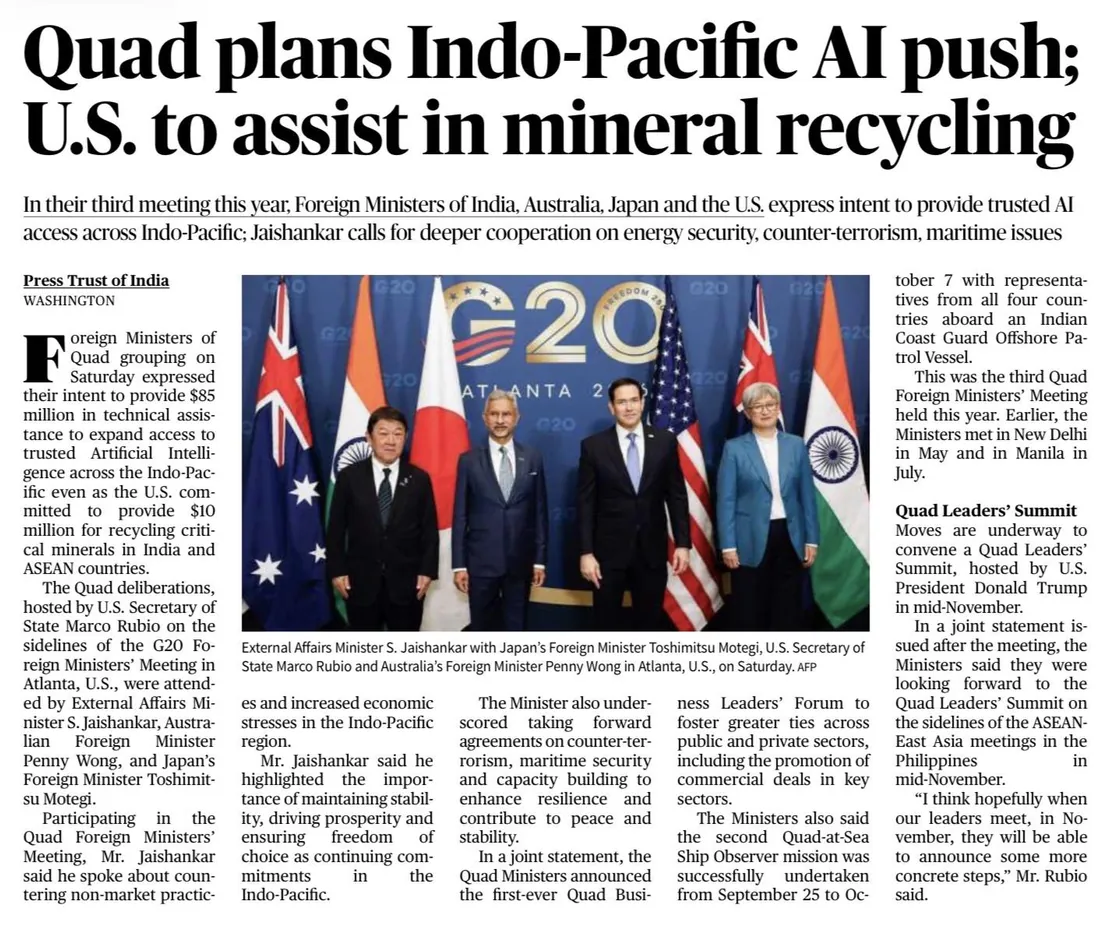
Quad Plans Indo-Pacific AI Push; U.S. to Assist in Critical Mineral Recycling

Context: At their third meeting of 2026, held in Atlanta on the sidelines of the G20 Foreign Ministers' Meeting, the Quad Foreign Ministers announced $85 million in technical assistance for trusted AI across the Indo-Pacific, while the U.S. committed $10 million for critical mineral recycling in India and ASEAN.

Quad Foreign Ministers Jaishankar, Motegi, Rubio and Penny Wong in Atlanta – Indo-Pacific AI push and critical mineral recycling (The Hindu)
Quad Foreign Ministers in Atlanta, U.S., on the sidelines of the G20 Foreign Ministers' Meeting. Source: The Hindu
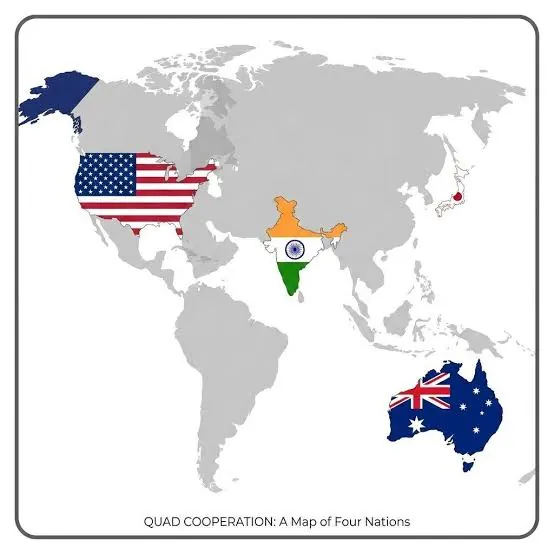
Quad countries map – India, United States, Japan and Australia in the Indo-Pacific
Quad: India, the United States, Japan and Australia

Outcomes of the Meeting

Trusted AI
$85 million in technical assistance to expand access to trusted AI across the Indo-Pacific.
Critical minerals
U.S. to give $10 million for recycling critical minerals in India and ASEAN.
Business
First-ever Quad Business Leaders' Forum announced.
Quad-at-Sea
Second Ship Observer Mission (25 Sept–7 Oct) aboard an Indian Coast Guard offshore patrol vessel.
India's points
Jaishankar raised non-market practices, energy security, counter-terrorism and maritime security.

Quad: Basics

Members
India, Australia, Japan, United States.
Origin
Cooperation during the 2004 Indian Ocean tsunami; first meeting 2007; revived 2017; leaders' level from 2021.
Nature
Informal strategic partnership — not a military alliance or treaty body.
Goal
A free, open, inclusive and rules-based Indo-Pacific.

Significance for India

Strategy
Balances power in the Indo-Pacific while keeping strategic autonomy.
Technology & minerals
Access to AI, semiconductors and diversified critical mineral supply chains.
Maritime
Maritime Domain Awareness (IPMDA), sea lanes and HADR cooperation.

Challenges & Way Forward

Challenges
Different priorities, the China factor, no binding treaty, gap between declarations and delivery, ASEAN centrality concerns.
Way forward
Deliver practical projects in AI, minerals and maritime security; keep the grouping inclusive and respect ASEAN centrality.

Previous-Year Questions

UPSC Mains 2026 — GS II
IPMDA bridges the gap between India's SAGAR vision and the Quad's Indo-Pacific strategy. Critically assess.
UPSC Mains 2020 — GS II
'The Quad is transforming itself into a trade bloc from a military alliance in present times.' Discuss.
Key Takeaway: The Quad keeps widening from maritime security into technology and supply chains. For India, projects such as AI access and mineral recycling matter more than statements — they build capacity without signing up to a military alliance.

Prelims Practice MCQ

+2 correct • −0.66 wrong

With reference to the Quadrilateral Security Dialogue (Quad), consider the following statements:
1. It is a treaty-based military alliance with a collective defence clause.
2. Its members are India, Australia, Japan and the United States.
3. Cooperation among its members began during the 2004 Indian Ocean tsunami relief.
Which of the statements given above are correct?

Explanation: Statements 2 and 3 are correct. The Quad is an informal strategic partnership; it has no treaty and no collective defence commitment.

UPSC Mains Question

10 Marks • 150 Words

The Quad is increasingly focused on technology and supply chains rather than only maritime security. Examine the opportunities and limits of this shift for India.

Attempt before opening the value-addition tab.
Accepted: JPG, JPEG, PNG, WEBP or PDF. The standalone file previews your answer locally; connect the API hook for real server submission.
Use after attempting the Mains answer
  • Latest — $85 million trusted AI; $10 million U.S. mineral recycling for India & ASEAN; Quad Business Leaders' Forum.
  • Evolution — 2004 tsunami core group → 2007 → 2017 revival → 2021 leaders' summits.
  • Initiatives — IPMDA, Quad-at-Sea, Critical & Emerging Technology, vaccines, HADR.
  • Limits — no treaty, China factor, U.S. policy shifts, implementation gaps, ASEAN centrality.
  • India — strategic autonomy, SAGAR/MAHASAGAR, IPOI, supply-chain diversification.
NEWS 5 GS2 • India–Bhutan Relations & Development Partnership Source: The Hindu

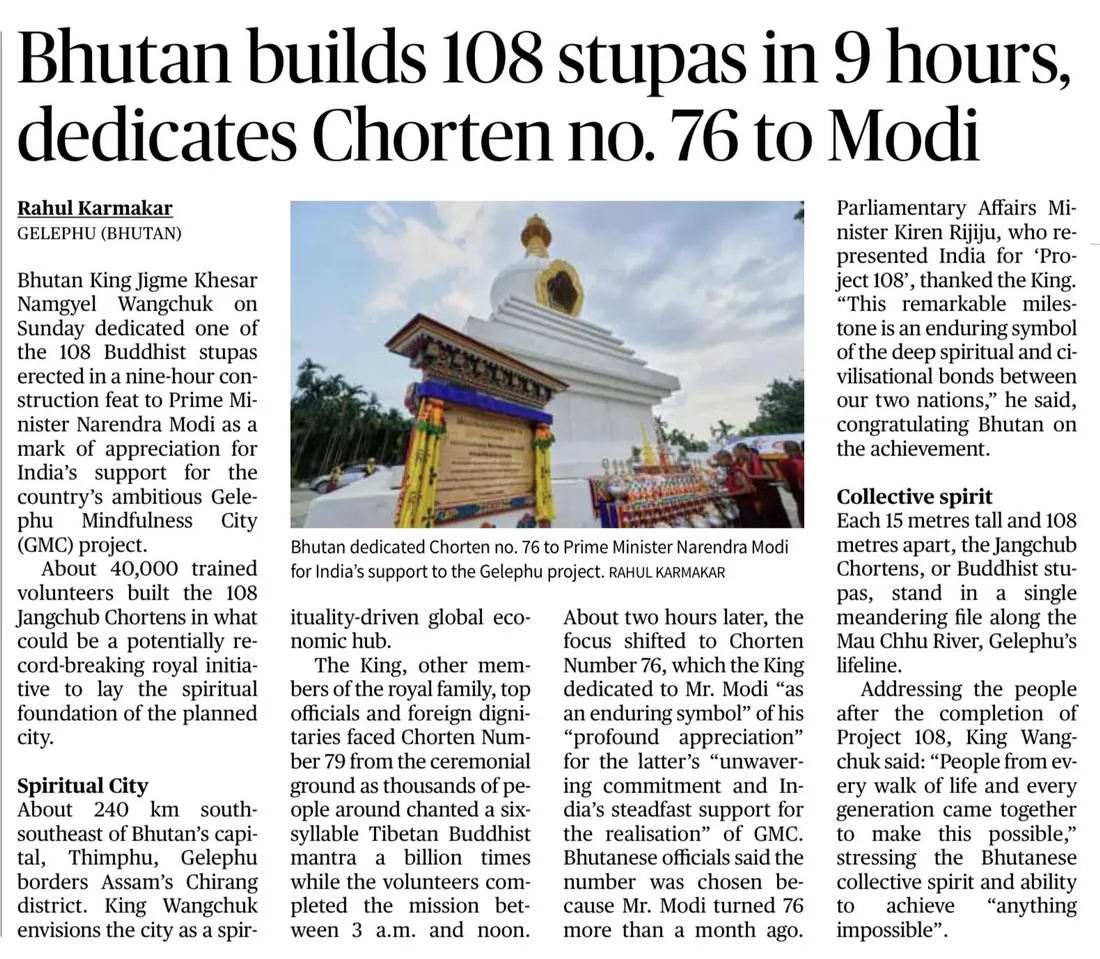
Bhutan Builds 108 Stupas in 9 Hours, Dedicates Chorten No. 76 to PM Modi

Context: Bhutan's King Jigme Khesar Namgyel Wangchuk dedicated Chorten No. 76, one of 108 Buddhist stupas built in nine hours by about 40,000 volunteers at Gelephu, to PM Narendra Modi for India's support to the Gelephu Mindfulness City (GMC) project.

Bhutan builds 108 stupas in nine hours at Gelephu Mindfulness City, Chorten No. 76 dedicated to PM Modi (The Hindu)
Chorten No. 76 dedicated to PM Modi for India's support to the Gelephu project. Source: The Hindu

Project 108: Key Facts

Stupas
108 Jangchub Chortens, each 15 m tall and 108 m apart, along the Mau Chhu river.
Volunteers
About 40,000 trained volunteers built them between 3 a.m. and noon.
Chorten No. 76
Dedicated to PM Modi (who turned 76) for India's support to GMC; India was represented by Kiren Rijiju.

Gelephu Mindfulness City

Location
Southern Bhutan, about 240 km from Thimphu; borders Assam's Chirang district.
Vision
A spirituality-driven economic hub — sustainability, well-being and growth.
Aim
Attract investment, create jobs and slow the migration of skilled Bhutanese youth.
India's role
Connectivity, infrastructure, energy and economic cooperation (e.g. proposed rail links to Assam).

India's Development Partnership Model

Tools
Grants, Lines of Credit, capacity building, technical assistance.
Sectors
Infrastructure, hydropower and energy, health, education, digital connectivity.
Policy
Neighbourhood First — demand-driven projects that respect partner priorities.

Challenges & Way Forward

Challenges
Project delays, competition from other powers, difficult terrain, long-term sustainability.
Way forward
Timely delivery, local jobs and skills, energy and digital links, respect for sovereignty.

Previous-Year Question

UPSC Prelims 2026 — Indian-supported projects
Mangdechhu HEP – Bhutan; Stor Palace – Afghanistan; District Hospital Dickoya – Sri Lanka; Institute of Security and Law Enforcement Studies – Maldives. Answer: (b) A-3, B-2, C-4, D-1.
Key Takeaway: The dedication is symbolic, but GMC is concrete: a Bhutanese bet on a new economic hub on the Assam border. India's support turns it into a test of how well Neighbourhood First can deliver connectivity and jobs.

Prelims Practice MCQ

+2 correct • −0.66 wrong

With reference to the Gelephu Mindfulness City (GMC), consider the following statements:
1. It is being developed in southern Bhutan, close to the Indian State of Assam.
2. One of its aims is to reduce the migration of skilled Bhutanese youth.
3. It is being built along the Teesta river.
Which of the statements given above are correct?

Explanation: Statements 1 and 2 are correct. The 108 stupas of Project 108 stand along the Mau Chhu river, Gelephu's lifeline — not the Teesta.

UPSC Mains Question

10 Marks • 150 Words

Development partnership is the core of India's Neighbourhood First policy. Discuss with reference to India's support for the Gelephu Mindfulness City in Bhutan.

Attempt before opening the value-addition tab.
Accepted: JPG, JPEG, PNG, WEBP or PDF. The standalone file previews your answer locally; connect the API hook for real server submission.
Use after attempting the Mains answer
  • News — 108 Jangchub Chortens in nine hours; 40,000 volunteers; Chorten No. 76 for PM Modi.
  • GMC — southern Bhutan, near Assam's Chirang; economic hub; jobs; reverse youth migration.
  • India–Bhutan — hydropower (Mangdechhu, Punatsangchhu), 1949/2007 Friendship Treaty, rail links.
  • Model — grants, LoCs, capacity building; demand-driven projects.
  • Concerns — delays, China factor, debt and sustainability; way forward: timely delivery.
NEWS 6 GS3 • Defence & Security Source: The Hindu

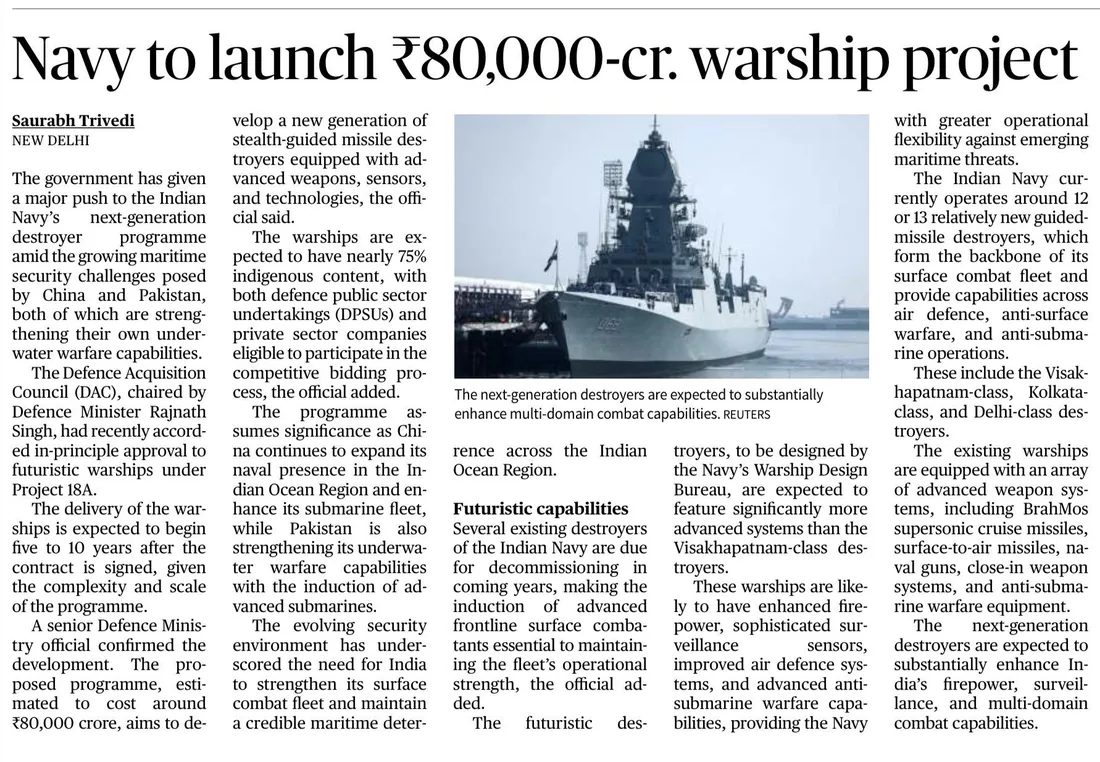
Navy to Launch ₹80,000-Crore Next-Generation Destroyer Project (Project 18A)

Context: The Defence Acquisition Council (DAC), chaired by Defence Minister Rajnath Singh, has given in-principle approval to a programme worth about ₹80,000 crore to develop next-generation stealth guided-missile destroyers for the Indian Navy.

Navy to launch ₹80,000 crore next-generation stealth guided-missile destroyer project – DAC approval (The Hindu)
Next-generation destroyers to enhance the Navy's multi-domain combat capability. Source: The Hindu

Key Facts

Cost
About ₹80,000 crore; in-principle approval by the DAC.
Indigenisation
Nearly 75% indigenous content; DPSUs and private firms can bid.
Design
Indian Navy's Warship Design Bureau; more advanced than the Visakhapatnam class.
Delivery
To begin 5–10 years after the contract is signed.

Destroyers: Prelims Facts

Definition
A multi-role surface combatant for fleet protection and offensive/defensive operations.
Roles
Anti-surface warfare, air defence, anti-submarine warfare, maritime surveillance.
Indian classes
Visakhapatnam, Kolkata and Delhi classes (about 12–13 in service).
Weapons
BrahMos supersonic cruise missile, surface-to-air missiles, naval guns, CIWS.

Why Now

China
Expanding naval presence and submarine fleet in the Indian Ocean Region.
Pakistan
Strengthening underwater warfare with advanced submarines.
Fleet gap
Several destroyers due for decommissioning in coming years.

Defence Technologies: Quick Revision

RCS & RAM
Lower radar cross-section = harder to detect; Radar Absorbing Material reduces reflection.
Stealth
Reduces detectability — not invisibility.
Drone swarm & GPS spoofing
Coordinated UAVs; false positioning signals used to mislead navigation (a counter-drone tool).
Interoperability
Ability of different equipment and agencies to work together.

Previous-Year Questions

UPSC Prelims 2026 — Stealth
Small RCS and RAM; detectable with specific frequencies; metamaterials are not used to increase scattering. Answer: 1 and 2 only.
UPSC Prelims 2026 — Made in India
Su-30 MKI and T-90 MK-III are made in India under licence; the Akula-class submarine is Russian-built.
UPSC Prelims 2026 — Army Corps
33 Corps is at Sukna, not Srinagar (15 Corps is at Srinagar).
Key Takeaway: Destroyers take a decade to build, so approval now is about the 2035 fleet. With 75% indigenous content and private firms allowed to bid, the project is as much an industrial policy decision as a naval one.

Prelims Practice MCQ

+2 correct • −0.66 wrong

With reference to the Indian Navy's next-generation destroyer programme recently cleared by the Defence Acquisition Council, consider the following statements:
1. The ships will be designed by the Navy's Warship Design Bureau.
2. Only Defence Public Sector Undertakings are eligible to bid.
3. The ships are expected to have nearly 75% indigenous content.
Which of the statements given above are correct?

Explanation: Statements 1 and 3 are correct. Both DPSUs and private sector companies are eligible to take part in the competitive bidding.

UPSC Mains Question

10 Marks • 150 Words

Indigenous warship building is essential for India's maritime security in the Indian Ocean Region. Discuss in the light of the recently approved next-generation destroyer programme.

Attempt before opening the value-addition tab.
Accepted: JPG, JPEG, PNG, WEBP or PDF. The standalone file previews your answer locally; connect the API hook for real server submission.
Use after attempting the Mains answer
  • Facts — ~₹80,000 crore; DAC approval; ~75% indigenous; WDB design; delivery 5–10 years after contract.
  • Context — China's IOR presence, Pakistan's submarines, ageing destroyers.
  • Capabilities — stealth, air defence, ASW, BrahMos, sensors; multi-domain operations.
  • Policy — Aatmanirbhar Bharat, DAP 2020, private sector role, shipbuilding capacity.
  • Link — SAGAR/MAHASAGAR, net security provider; also note the recent ₹40,000 crore NGC corvettes.
NEWS 7 GS1 • Geography — Tropical Cyclones | GS3 • Disaster Management Source: The Hindu

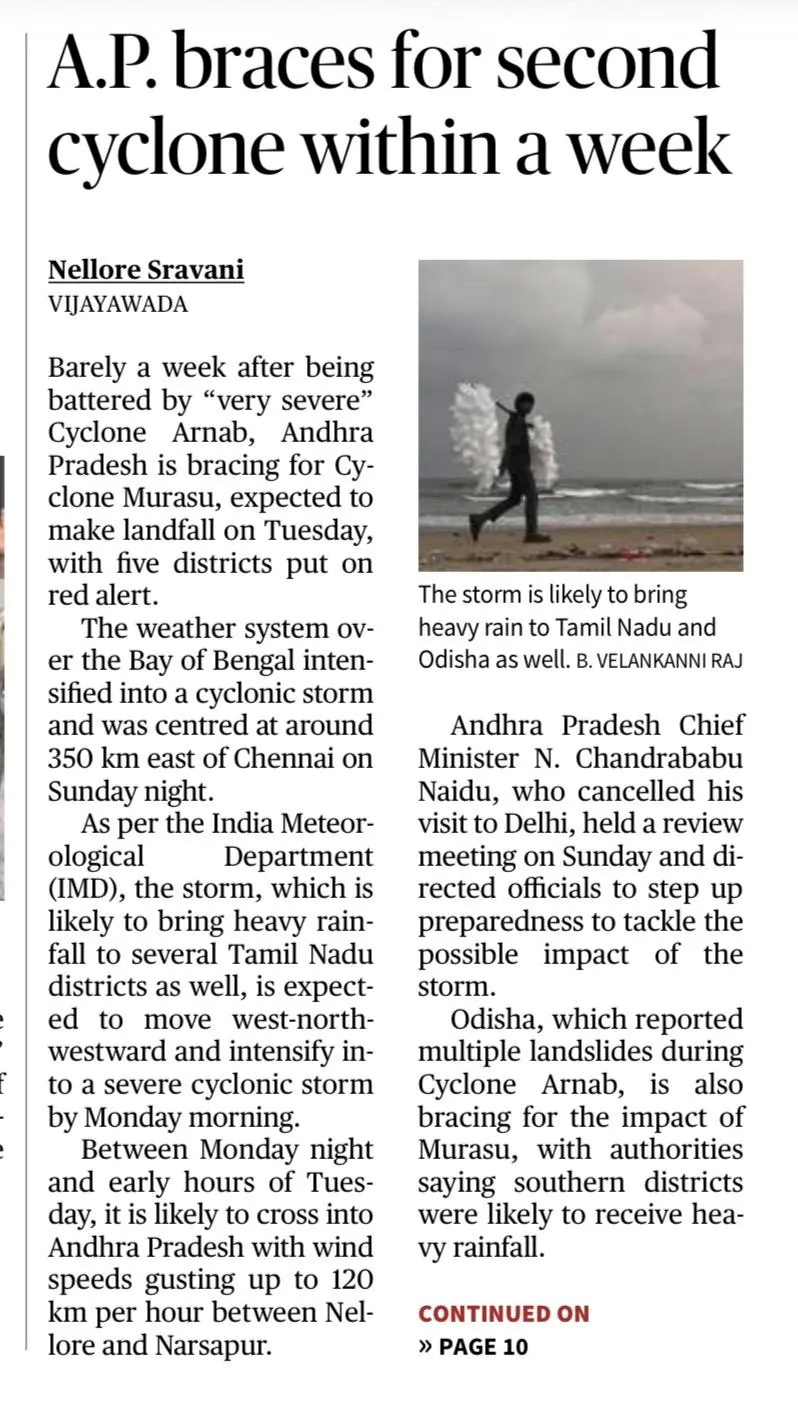
Andhra Pradesh Braces for Cyclone Murasu, the Second Cyclone within a Week

Context: Barely a week after 'very severe' Cyclone Arnab, Andhra Pradesh is preparing for Cyclone Murasu, which is expected to cross the coast between Nellore and Narsapur with gusts up to 120 km/h; five districts are on red alert.

Cyclone Murasu – Andhra Pradesh red alert, Bay of Bengal cyclone after Cyclone Arnab (The Hindu)
Cyclone Murasu is likely to bring heavy rain to Andhra Pradesh, Tamil Nadu and Odisha. Source: The Hindu

Cyclone Murasu: Key Developments

Formation
Cyclonic storm over the Bay of Bengal, about 350 km east of Chennai.
Track
Moving west-northwest; expected to become a severe cyclonic storm.
Landfall
Between Nellore and Narsapur, with gusts up to 120 km/h.
Impact
Heavy rain in Andhra Pradesh, Tamil Nadu and Odisha; five A.P. districts on red alert.

Cyclone Naming

Arnab
Name given by Bangladesh.
Murasu
Name given by India — means 'drum' in Tamil.
Authority
WMO/ESCAP Panel on Tropical Cyclones; IMD New Delhi is the RSMC for the North Indian Ocean.
List
13 countries × 13 names = 169 names; a system is named at 34 knots (about 62 km/h).

Why the Bay of Bengal Gets More Cyclones

Warm water
Higher sea-surface temperatures and low salinity stratification.
Remnant systems
Remnants of western Pacific typhoons often re-intensify over the Bay.
Season
Post-monsoon (October–December) is a peak cyclone season for the east coast.

Disaster Preparedness

Institutions
NDMA, NDRF, State disaster authorities; IMD colour-coded warnings.
Measures
Early warning, evacuation and cyclone shelters, fishing bans, power and drainage readiness.
Programme
National Cyclone Risk Mitigation Project; Odisha's model of near-zero casualties.
Key Takeaway: Two cyclones in a week is not unusual for the post-monsoon Bay of Bengal. What has changed is preparedness: early warnings and evacuation now save most lives, so losses shift to crops, power and housing.

Prelims Practice MCQ

+2 correct • −0.66 wrong

With reference to the naming of tropical cyclones in the North Indian Ocean, consider the following statements:
1. The India Meteorological Department, New Delhi, is the Regional Specialised Meteorological Centre for the region.
2. Thirteen member countries have contributed thirteen names each.
3. A cyclone is named when its maximum sustained wind speed reaches 34 knots.
Which of the statements given above are correct?

Explanation: All three statements are correct. The list of 169 names is maintained by the WMO/ESCAP Panel on Tropical Cyclones; Murasu was contributed by India.

UPSC Mains Question

15 Marks • 250 Words

Why is the east coast of India more prone to tropical cyclones than the west coast? Discuss the measures that have reduced cyclone-related deaths in India.

Attempt before opening the value-addition tab.
Accepted: JPG, JPEG, PNG, WEBP or PDF. The standalone file previews your answer locally; connect the API hook for real server submission.
Use after attempting the Mains answer
  • News — Murasu after Arnab; landfall Nellore–Narsapur; gusts 120 km/h; five red-alert districts.
  • Geography — warm Bay waters, Pacific remnants, shallow shelf, funnel-shaped coast, storm surge.
  • Naming — WMO/ESCAP panel, 13 × 13 = 169 names, IMD as RSMC, 34 knots.
  • Preparedness — IMD warnings, NDMA guidelines, NDRF, NCRMP, cyclone shelters; Odisha model.
  • Way forward — impact-based forecasting, resilient housing, mangroves, insurance.

Copyright © 2026 USARAMBHA EDUCATION (UnderStand UPSC). All Rights Reserved.

MAD-X Orientation

Talk to Our Counsellor

Share your details and our counselling team will call you back in 10 minutes.

Please enter your name.
+91
Please enter a valid 10-digit mobile number.
When do you plan to enroll in MAD-X?
Please select an option.

Thank you, !

Our counselling team will call you within 10 minutes.
Please keep your phone handy.