New Batch Starts 30 Nov: UPSC GS Foundation 2028/29 Enroll Now
US
UnderStand UPSC Daily Current Affairs Practice
0.00Score / 12
0 / 6MCQs Attempted
0%Accuracy
24 November 2026 • UPSC CSE

Read the news. Test the concept. Write the Mains answer.

This interactive edition converts each current-affairs item into one Prelims-level MCQ, one Mains-level question, and a compact value-addition section for revision.

+2 correct −0.66 incorrect Explanation after attempt Image/PDF answer upload
NEWS 1 GS2 • International Relations | India and Neighbourhood Source: The Hindu

India–Nepal Relations: ₹15,000-Crore Assistance Package and Joint Vision

Context: During Nepal Prime Minister Balendra Shah’s first bilateral visit abroad (22–23 November 2026), India announced a ₹15,000-crore assistance package. Both countries also adopted the Joint Vision Document, ‘Viksit Bharat and Samunnat Nepal: Re-imagining the Partnership’.
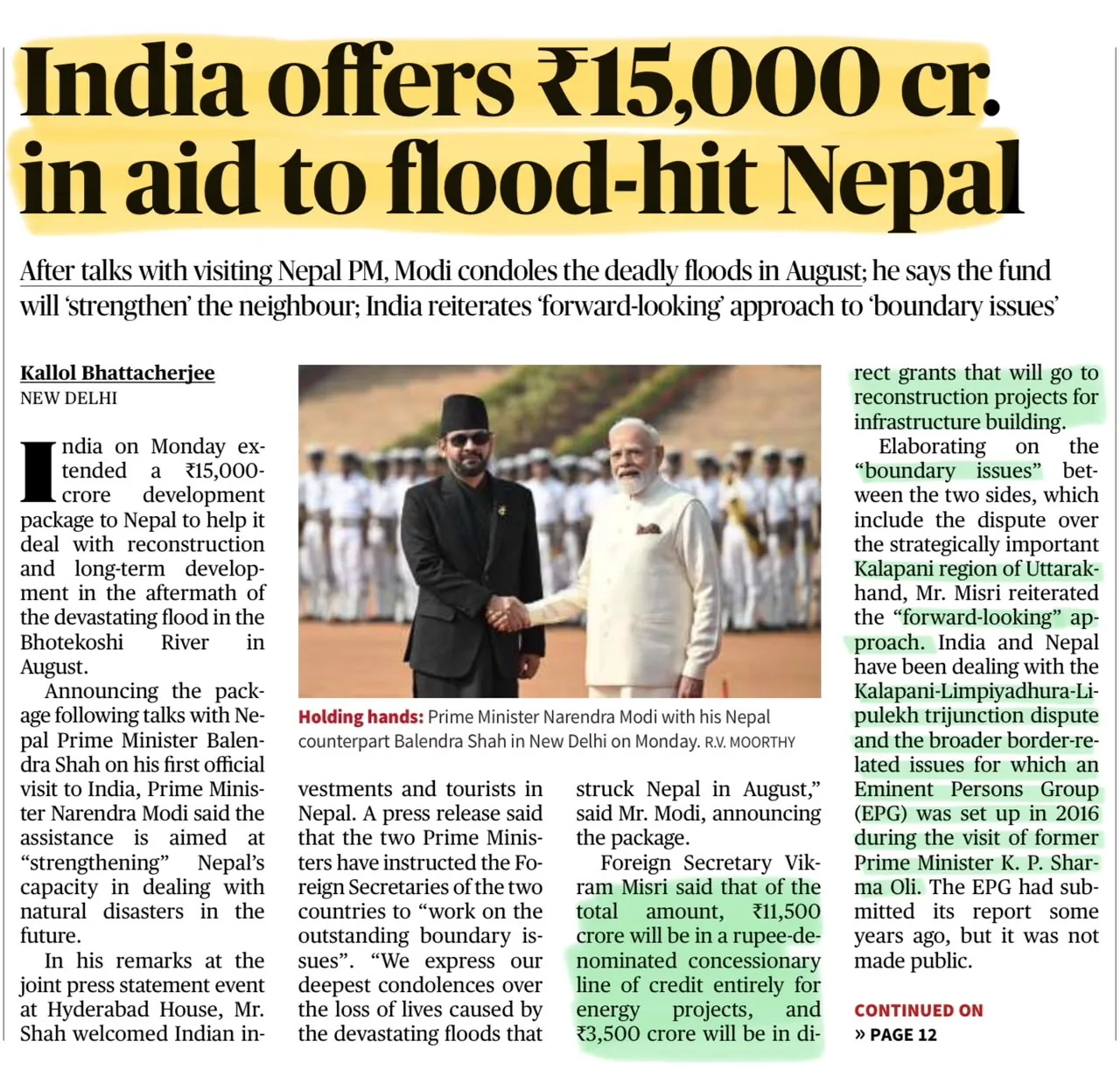
India offers ₹15,000 crore in aid to flood-hit Nepal (The Hindu)
India offers ₹15,000 crore in aid to flood-hit Nepal. Source: The Hindu
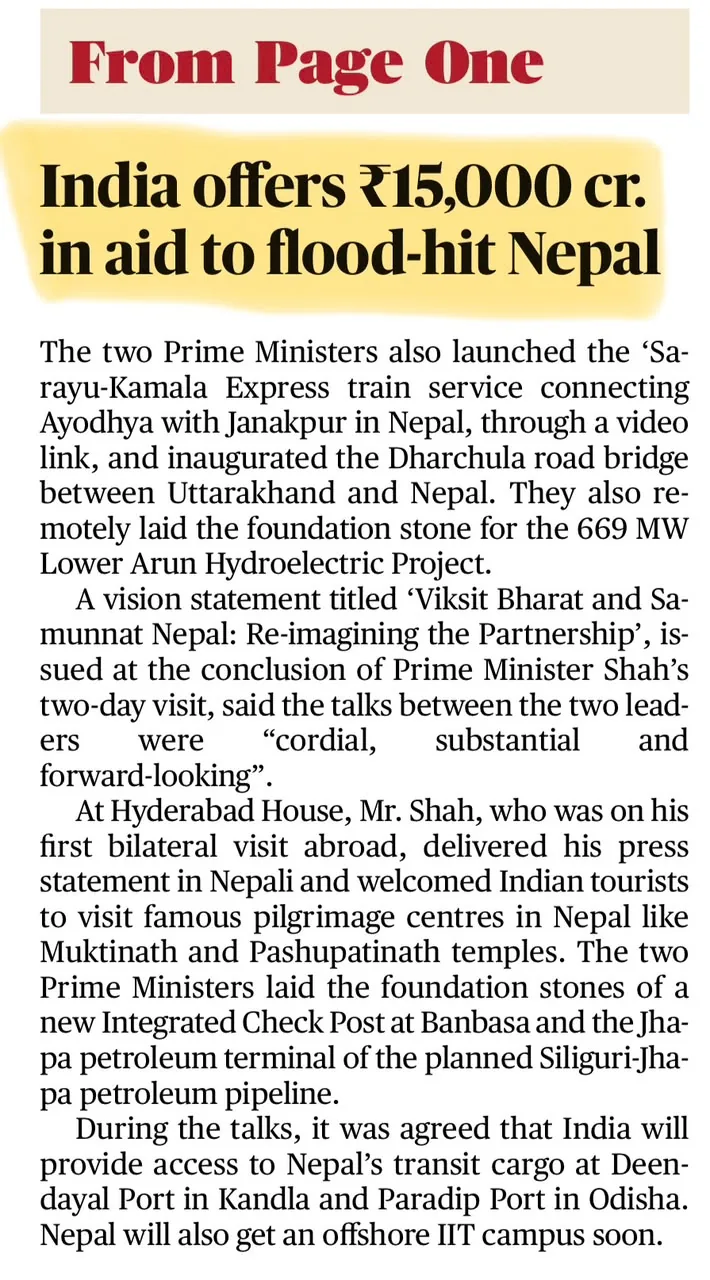
India–Nepal joint vision statement and projects (The Hindu)
Joint vision statement and projects launched. Source: The Hindu

India’s ₹15,000-Crore Assistance Package

Line of Credit
₹11,500 crore rupee-denominated concessional LoC – entirely for energy projects.
Direct grants
₹3,500 crore for infrastructure reconstruction.
Purpose
Reconstruction and long-term development after the August 2026 floods in the Bhotekoshi River region.

Ten Pillars of the Joint Vision Document

1. Economy & development
Review trade agreements, investment, cross-border SEZs and IT parks, transit connectivity.
2. Energy, water & climate
Hydropower and multipurpose projects, early-warning systems, post-disaster recovery.
3. Physical & digital connectivity
Rail, road, ICPs, petroleum pipelines and UPI integration.
4. Good governance
Civil-service training and exchange of administrative best practices.
5. Technology & space
India–Nepal Startup Partnership, Centre of Excellence in Kathmandu.
6. Education & skills
Indian institutions’ branches in Nepal; more scholarships.
7. Sports
National cricket academy in Nepal; access to Indian training facilities.
8. Culture & tourism
Ramayana, Buddhist and Shiva-Shakti religious circuits.
9. Health
Upgrade Nepal’s National Medical Laboratory; affordable medicines.
10. Agriculture
Agro-Industrial Park in Chitwan; ICAR Centre of Excellence.

Major Projects and Announcements

Railways
Sarayu-Kamala Express (Ayodhya–Janakpur); Jayanagar–Bardibas and Jogbani–Biratnagar links.
Road
Dharchula road bridge between Uttarakhand and Nepal.
Hydropower
669 MW Lower Arun Hydroelectric Project.
Petroleum
Siliguri–Jhapa pipeline and Jhapa petroleum terminal.
Border & transit
New ICP at Banbasa; Nepal cargo via Deendayal (Kandla) and Paradip ports.
Education
Proposed offshore IIT campus in Nepal.

Treaties and Institutional Mechanisms

Treaty of Sugauli (1816)
Nepal–East India Company treaty; basis of boundary interpretations.
Treaty of Peace and Friendship (1950)
Framework of close ties; Nepal seeks revision.
Eminent Persons Group (2016)
Reviewed overall ties incl. the 1950 Treaty; report not made public.
Joint Commission
Foreign Minister-level review mechanism.
Boundary Working Group
Technical work incl. boundary pillars.
High-Level Monitoring Group
Monitors the Joint Vision; meets at least every six months.

Major Challenges

Kalapani–Limpiyadhura–Lipulekh
Dispute near the India–Nepal–China trijunction over the source of the Kali River.
Susta
Dispute linked to the shifting course of the Gandak.
China factor
Rising Chinese investment and infrastructure in Nepal.
Trade & water
Trade deficit, transit dependence and benefit-sharing in hydropower.
Security & Gorkhas
Open-border crime; Agnipath uncertainty over Gorkha recruitment.

Way Forward

Border dialogue
Use historical records, maps and technical surveys.
Modern frameworks
Address the 1950 Treaty through consensus.
Economic integration
Trade, transit and infrastructure to cut asymmetry.
Implementation
Regular monitoring of the Joint Vision through the HLMG.
Key Takeaway: A large development package plus a 10-pillar vision show India’s ‘Neighbourhood First’ intent; resolving the boundary issue and timely project delivery will decide its credibility.

Prelims Practice MCQ

+2 correct • −0.66 wrong

With reference to India–Nepal relations, consider the following statements:
1. The Kalapani–Limpiyadhura–Lipulekh dispute lies near the India–Nepal–China trijunction.
2. The Treaty of Sugauli was signed between Nepal and independent India in 1950.
3. The Eminent Persons Group set up in 2016 reviewed the overall bilateral relationship, including the 1950 Treaty.
Which of the statements given above are correct?

Explanation: The Kalapani dispute is near the trijunction, and the EPG (2016) reviewed the overall relationship including the 1950 Treaty. The Treaty of Sugauli was signed in 1816 with the British East India Company; the 1950 treaty is the Treaty of Peace and Friendship.

UPSC Mains Question

GS2 • 15 Marks • 250 Words

Development partnership is India’s most effective tool in Nepal, but unresolved political issues limit its impact. Discuss with reference to the recent Joint Vision Document.

Attempt before opening the value-addition tab.
Accepted: JPG, JPEG, PNG, WEBP or PDF. The standalone file previews your answer locally; connect the API hook for real server submission.
Use after attempting the Mains answer
  • Policies — Neighbourhood First, Act East connectivity, HIT formula (Highways, I-ways, Trans-ways).
  • Treaties — Sugauli 1816, Peace and Friendship 1950, Mahakali Treaty 1996.
  • Projects — Arun III, Lower Arun, Motihari–Amlekhgunj pipeline, ICPs.
  • Keywords — asymmetric interdependence, China factor, open border, hydro-diplomacy.
NEWS 2 GS2 • Polity | Parliament & Parliamentary Procedures Source: The Hindu

Winter Session of Parliament: Skipped Only Four Times in History

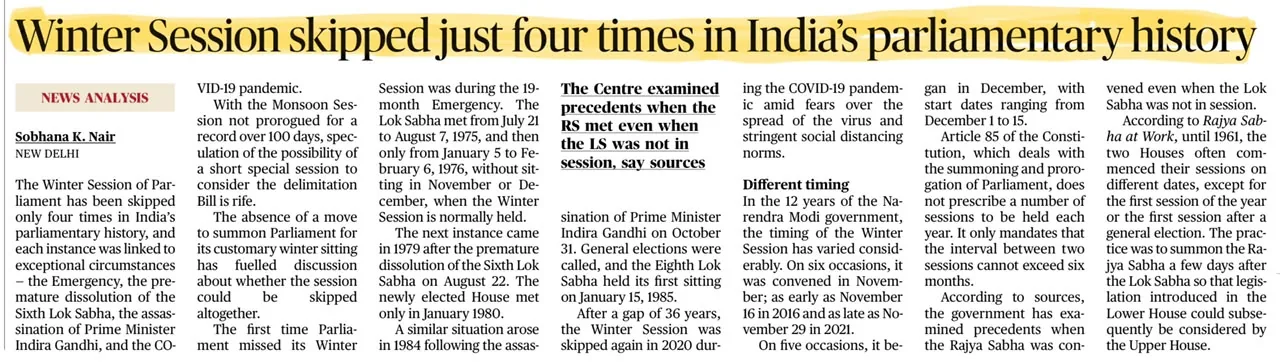
Context: The Winter Session has been skipped only four times in India’s parliamentary history, each due to exceptional circumstances. With the Monsoon Session not prorogued for over 100 days, there is debate on whether this year’s session will be held.

Winter Session skipped just four times in India's parliamentary history (The Hindu)
Winter Session skipped just four times in India’s parliamentary history. Source: The Hindu

Parliamentary Sessions – Basics

Session
Period between the summoning and prorogation of a House.
Three sessions
Budget (Feb–Apr/May), Monsoon (Jul–Aug), Winter (Nov–Dec).
Convention
The Constitution does not mandate three sessions a year.

Important Terms

Summoning
Calling a session – by the President.
Adjournment
Suspends a sitting for a specified period.
Adjournment sine die
Suspends a sitting without a next date.
Prorogation
Formal end of a session – by the President.
Dissolution
Ends the Lok Sabha’s term; Rajya Sabha is never dissolved.

Article 85

85(1)
President summons Parliament; gap between sessions cannot exceed six months.
85(2)(a)
President may prorogue either or both Houses.
85(2)(b)
President may dissolve the Lok Sabha.
Key point
No fixed number of sessions or minimum sitting days; the six-month rule means at least two sessions a year.

Four Times the Winter Session Was Skipped

1975
National Emergency – no sitting in November or December.
1979
Sixth Lok Sabha dissolved in August; new House met in January 1980.
1984
Assassination of Indira Gandhi (31 Oct); Eighth Lok Sabha met in January 1985.
2020
COVID-19 pandemic and social-distancing concerns.

Other Observations

Varying dates
Under the present government, start dates ranged from 16 Nov (2016) to 29 Nov (2021).
Rajya Sabha
Can meet even when the Lok Sabha is not in session.
Before 1961
The two Houses often began sessions on different dates.
Key Takeaway: Sessions are a convention, not a constitutional count – only the six-month gap is mandatory. Skipping the Winter Session has always needed exceptional reasons.

Prelims Practice MCQ

+2 correct • −0.66 wrong

With reference to the sessions of the Parliament of India, consider the following statements:
1. The Constitution requires Parliament to hold three sessions every year.
2. The gap between two sessions of Parliament cannot exceed six months.
3. The Rajya Sabha is not subject to dissolution.
Which of the statements given above are correct?

Explanation: Article 85(1) only says that six months shall not intervene between two sessions; three sessions a year is a convention. The Rajya Sabha is a permanent House and is never dissolved.

UPSC Mains Question

GS2 • 10 Marks • 150 Words

The Constitution prescribes no minimum number of sittings for Parliament. Should India adopt a fixed parliamentary calendar? Discuss.

Attempt before opening the value-addition tab.
Accepted: JPG, JPEG, PNG, WEBP or PDF. The standalone file previews your answer locally; connect the API hook for real server submission.
Use after attempting the Mains answer
  • Articles — 85, 86, 107(3) (Bills do not lapse on prorogation).
  • Committees — NCRWC (2002): at least 120 sittings for Lok Sabha, 100 for Rajya Sabha.
  • Data — sittings fell from ~135 days (First Lok Sabha) to ~55 days now.
  • Keywords — executive accountability, deliberative democracy, parliamentary calendar.
NEWS 3 GS2 • Polity | Federalism & State Reorganisation Source: The Hindu

West Bengal May Be Renamed ‘Paschim Banga’

Context: The West Bengal Cabinet has approved a proposal to rename the State as ‘Paschim Banga’. A resolution will be introduced in the State Assembly on 9 December 2026.

Background

Identity
The name reflects Bengal’s historical identity after the 1947 Partition.
Earlier attempts
Paschim Banga (2011) and Bangla (2018) – neither became official.
Now
Use ‘Paschim Banga’ in English as well as Bengali.

Constitutional Procedure – Article 3

Power
Parliament can alter the name, area or boundaries of a State.
President’s role
Bill needs the President’s recommendation; it is referred to the State Legislature for views.
State views
Not binding on Parliament.
Passage
Simple majority, then Presidential assent.
Article 4
Changes to the First and Fourth Schedules are not an amendment under Article 368.

Recent Example – Kerala to Keralam

Resolution
Kerala Assembly passed it in June 2024 to reflect Malayalam identity.
Approval
Union Cabinet and parliamentary approval in 2026.

Important Articles

Article 1
India as a Union of States.
Article 2
Admission or establishment of new States.
Article 3
New States; alteration of names, areas, boundaries.
Article 4
Consequential changes to First and Fourth Schedules.
Key Takeaway: A State Assembly resolution alone does not change a State’s name – only a law of Parliament under Article 3 does. Until then, it remains ‘West Bengal’.

Prelims Practice MCQ

+2 correct • −0.66 wrong

With reference to changing the name of a State in India, consider the following statements:
1. A Bill for this purpose can be introduced in Parliament only on the recommendation of the President.
2. Parliament is bound by the views of the State Legislature concerned.
3. Such a law is not deemed an amendment of the Constitution under Article 368.
Which of the statements given above are correct?

Explanation: Under Article 3, the Bill needs the President’s recommendation and the State Legislature’s views are not binding. Article 4 says such laws are not amendments under Article 368, so a simple majority is enough.

UPSC Mains Question

GS2 • 10 Marks • 150 Words

“India is an indestructible Union of destructible States.” Explain with reference to Articles 3 and 4.

Attempt before opening the value-addition tab.
Accepted: JPG, JPEG, PNG, WEBP or PDF. The standalone file previews your answer locally; connect the API hook for real server submission.
Use after attempting the Mains answer
  • Cases — Babulal Parate v. State of Bombay (1960): Parliament need not accept State views.
  • Examples — Orissa → Odisha (2011), Kerala → Keralam (2026).
  • Commissions — Fazl Ali Commission (1953–55), SRC Act 1956.
  • Keywords — linguistic identity, cooperative federalism, flexible federation.
NEWS 4 GS2 • Health Governance | GS3 • Environmental Pollution Source: The Indian Express

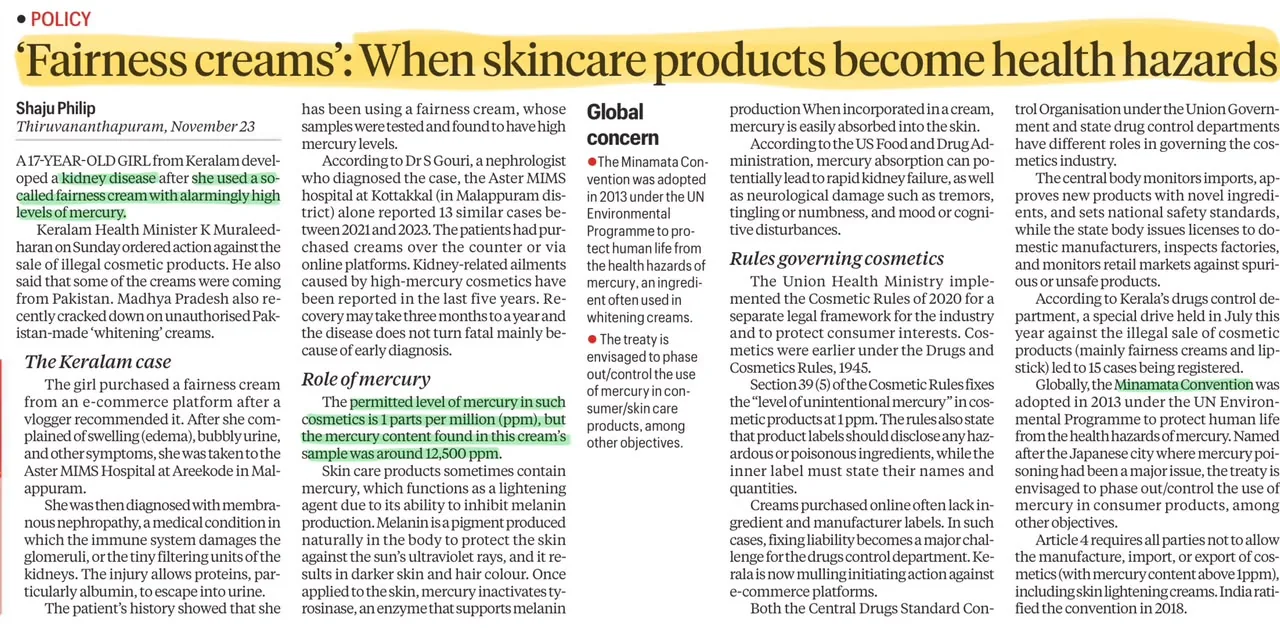
‘Fairness Creams’: When Skincare Products Become Health Hazards

Context: A 17-year-old girl in Kerala developed kidney disease after using a fairness cream with dangerously high levels of mercury, highlighting gaps in cosmetic safety and regulation.

Fairness creams: When skincare products become health hazards (The Indian Express)
Fairness creams: when skincare products become health hazards. Source: The Indian Express

The Kerala Case

Diagnosis
Membranous nephropathy – damage to the glomeruli (kidney filters).
Mercury level
About 12,500 ppm against a permitted limit of 1 ppm.
Pattern
13 similar cases at one Kerala hospital between 2021 and 2023.
Why mercury
It inhibits tyrosinase, reducing melanin; long use damages kidneys and nerves.

Regulatory Framework in India

Cosmetics Rules, 2020
Rule 39(5): unintentional mercury limit 1 ppm.
CDSCO
Regulates imports, new products and national standards.
State Drug Controllers
Licence manufacturers, inspect factories, check retail sales.
Gap
Unlabelled products sold online are hard to trace and regulate.

Minamata Convention on Mercury

Adoption
2013 under UNEP; in force since 2017.
India
Ratified in 2018.
Coverage
Mercury in products, emissions, trade and waste.
Name
After Minamata, Japan – industrial mercury poisoning.
Article 4
Bans making, import or export of cosmetics with mercury above 1 ppm.
Key Takeaway: The law is strict (1 ppm), but online sale of unlabelled imports defeats it. Enforcement on e-commerce and consumer awareness are the missing links.

Prelims Practice MCQ

+2 correct • −0.66 wrong

UPSC Prelims PYQ 2023: Consider the following statements regarding mercury pollution:
1. Gold mining activity is a source of mercury pollution in the world.
2. Coal-based thermal power plants cause mercury pollution.
3. There is no known safe level of exposure to mercury.
How many of the above statements are correct?

Explanation: Artisanal gold mining and coal burning are major sources of mercury pollution. UPSC’s official key does not accept statement 3, because the risk depends on the form, dose and duration of exposure.

UPSC Mains Question

GS2 • 10 Marks • 150 Words

Weak regulation of cosmetics sold online poses a public health risk. Examine with reference to mercury in fairness creams and suggest measures.

Attempt before opening the value-addition tab.
Accepted: JPG, JPEG, PNG, WEBP or PDF. The standalone file previews your answer locally; connect the API hook for real server submission.
Use after attempting the Mains answer
NEWS 5 GS2 • India–ASEAN Relations | GS3 • Maritime Security & Blue Economy Source: The Hindu

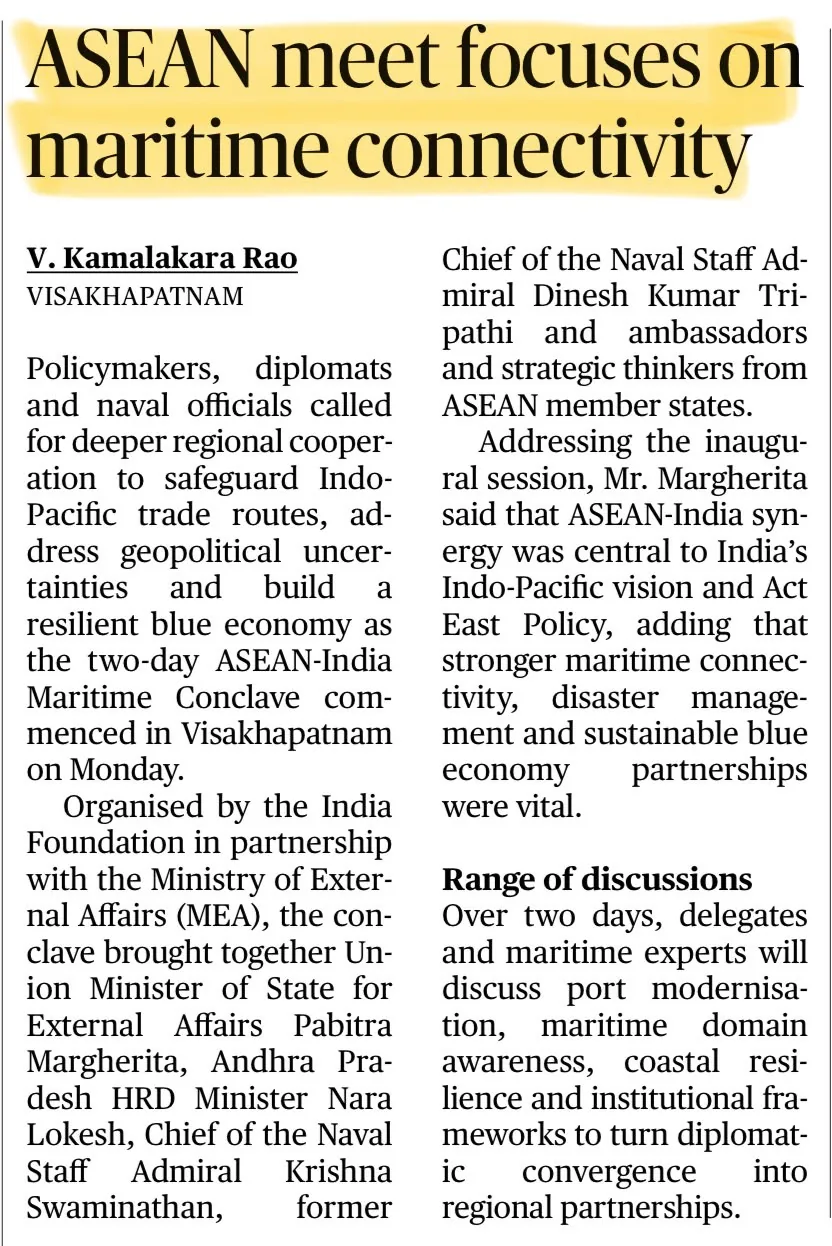
ASEAN–India Maritime Conclave Focuses on Maritime Connectivity

Context: The two-day ASEAN–India Maritime Conclave began in Visakhapatnam to strengthen regional cooperation, safeguard Indo-Pacific trade routes and build a resilient blue economy.

ASEAN meet focuses on maritime connectivity (The Hindu)
ASEAN meet focuses on maritime connectivity. Source: The Hindu

About the Conclave

Organisers
India Foundation with the Ministry of External Affairs.
Venue
Visakhapatnam – headquarters of the Eastern Naval Command.
Participants
MoS External Affairs Pabitra Margherita, AP Minister Nara Lokesh, Navy Chief Adm. Krishna Swaminathan and ASEAN envoys.

Key Focus Areas

Connectivity
Protect vital Indo-Pacific trade routes.
Maritime Domain Awareness
Better information-sharing on sea activity.
Ports
Port modernisation for trade and connectivity.
Coastal resilience
Cooperation in disaster management.
Blue economy
Sustainable use of ocean resources.

Significance for India

Act East Policy
Deeper strategic and economic ties with ASEAN.
Indo-Pacific vision
Secure, open sea lanes and regional stability.
Economic security
Uninterrupted trade flows.
Regional leadership
India as a first responder and maritime partner.
Key Takeaway: The conclave links Act East with the Indo-Pacific – turning diplomatic convergence with ASEAN into practical maritime cooperation.

Prelims Practice MCQ

+2 correct • −0.66 wrong

With reference to India–ASEAN relations, consider the following statements:
1. India’s ‘Act East Policy’ was announced in 2014.
2. India is a full member of ASEAN.
3. ASEAN–India relations were elevated to a Comprehensive Strategic Partnership in 2022.
Which of the statements given above are correct?

Explanation: The Act East Policy was announced in 2014, upgrading the Look East Policy, and ties became a Comprehensive Strategic Partnership in 2022. India is a dialogue partner of ASEAN, not a member.

UPSC Mains Question

GS2 • 15 Marks • 250 Words

Maritime cooperation is the most promising pillar of India–ASEAN relations. Discuss in the context of India’s Indo-Pacific vision.

Attempt before opening the value-addition tab.
Accepted: JPG, JPEG, PNG, WEBP or PDF. The standalone file previews your answer locally; connect the API hook for real server submission.
Use after attempting the Mains answer
  • Frameworks — SAGAR / MAHASAGAR, IPOI (2019), ASEAN Outlook on the Indo-Pacific (2019).
  • Exercises — AIME (ASEAN–India Maritime Exercise), first held in 2023.
  • Centres — IFC-IOR (Gurugram) for maritime domain awareness.
  • Keywords — freedom of navigation, UNCLOS, blue economy, HADR.
NEWS 6 GS3 • Science & Technology | AI & Technological Self-Reliance Source: The Indian Express

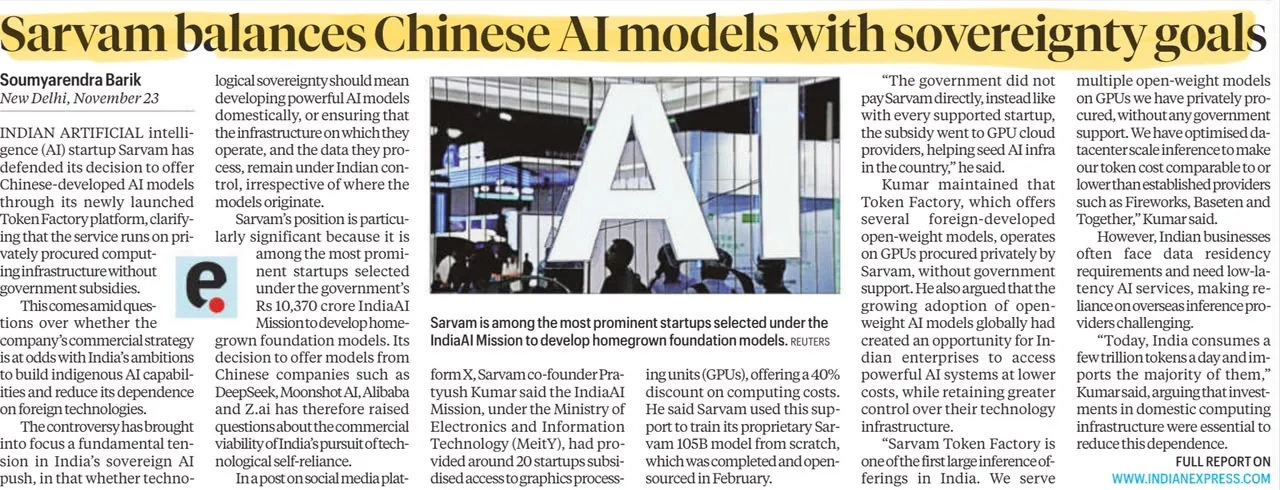
Sarvam: Balancing Foreign AI Models with India’s Sovereignty Goals

Context: Indian AI startup Sarvam has defended offering Chinese-developed AI models on its Token Factory platform. The debate: does AI sovereignty depend on where a model is built, or on who controls the infrastructure and data?

Sarvam balances Chinese AI models with sovereignty goals (The Indian Express)
Sarvam balances Chinese AI models with sovereignty goals. Source: The Indian Express

AI Models – Basics

AI model
A system trained on data to answer, generate, translate or analyse.
USA
OpenAI – GPT / ChatGPT; Google – Gemini.
China
DeepSeek; Alibaba – Qwen.
India
Sarvam AI – models built for Indian languages.

What Is AI Sovereignty?

Model sovereignty
Build domestic models; cut dependence on foreign technology.
Infrastructure sovereignty
Control over GPUs, data centres and cloud.
Data sovereignty
Data protected under domestic laws.
Origin vs control
Running DeepSeek on Indian-controlled servers gives control, but the model is still not indigenous.

What Is Sarvam Doing?

Token Factory
Offers open-weight models from DeepSeek, Moonshot AI, Alibaba and Z.ai.
Infrastructure
Runs on privately procured GPUs, without government subsidy.
Own model
Sarvam 105B trained from scratch, open-sourced in February.

IndiaAI Mission

Outlay
₹10,371.92 crore under MeitY.
Foundation models
Sarvam among startups selected to build indigenous models.
GPU support
About 20 startups got subsidised GPU access – around 40% cheaper.

Challenges and Way Forward

Foreign dependence
Build indigenous models and domestic compute.
Data security
Protect data under Indian law (DPDP Act, 2023).
Compute costs
Wider, affordable GPU access.
Collaboration
Use global open models while keeping strategic autonomy.
Key Takeaway: Hosting foreign open-weight models in India gives control over data and infrastructure, but true AI sovereignty also needs strong home-grown models.

Prelims Practice MCQ

+2 correct • −0.66 wrong

With reference to the IndiaAI Mission and AI models, consider the following statements:
1. The IndiaAI Mission is implemented by the Ministry of Electronics and Information Technology.
2. Under the Mission, selected startups have received subsidised access to GPUs.
3. An ‘open-weight’ AI model means its full training data is made public.
Which of the statements given above are correct?

Explanation: The IndiaAI Mission is run by MeitY and gives startups subsidised GPU access. ‘Open-weight’ means the trained model weights are released – not necessarily the training data or full code.

UPSC Mains Question

GS3 • 15 Marks • 250 Words

Does AI sovereignty depend on where a model is developed or on who controls its infrastructure and data? Discuss in the Indian context.

Attempt before opening the value-addition tab.
Accepted: JPG, JPEG, PNG, WEBP or PDF. The standalone file previews your answer locally; connect the API hook for real server submission.
Use after attempting the Mains answer
  • Initiatives — IndiaAI Mission, AIKosh, BharatGen, Bhashini.
  • Laws — DPDP Act 2023 (data protection), IT Act 2000.
  • Concepts — open-weight models, inference, compute sovereignty, data localisation.
  • Keywords — strategic autonomy, digital public infrastructure, AI for Bharat.

Copyright © 2026 USARAMBHA EDUCATION (UnderStand UPSC). All Rights Reserved.

MAD-X for UPSC Prelims 2027 – Batch 3 starts 7th December 2026
Batch 3 · Starts 7th Dec 2026

MAD-X for UPSC Prelims 2027

Online & Offline · Fee details + free counselling

Preferred Medium

🔒 Your details are kept confidential.

Call Now · 83770 72252