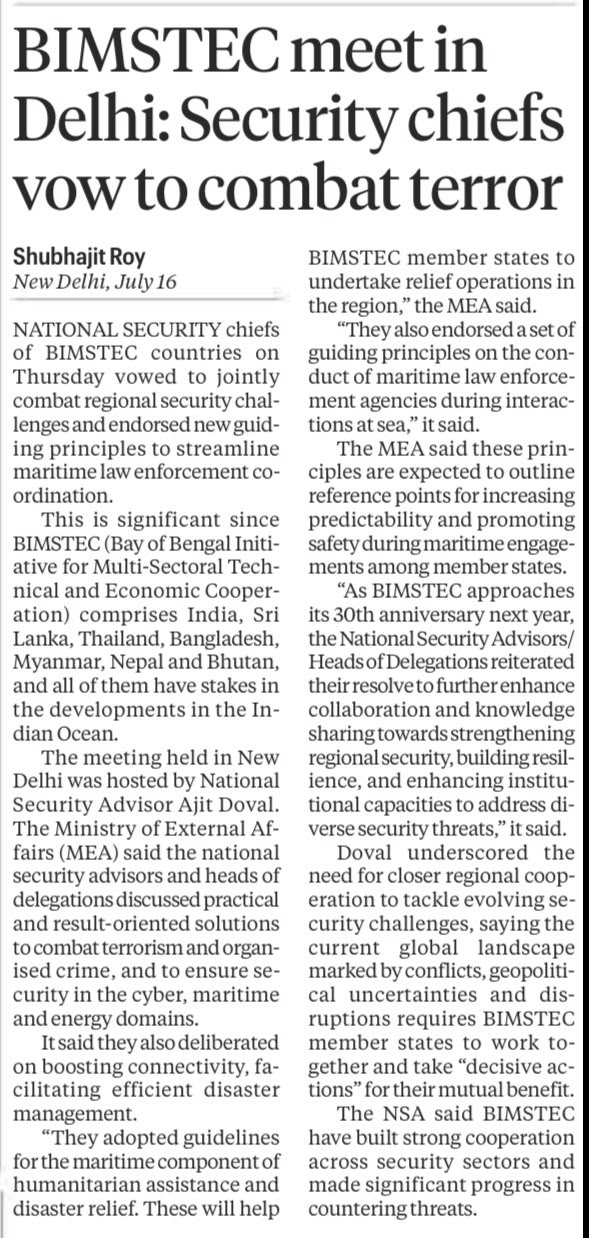
Context:BIMSTEC Security Chiefs Meeting
The National Security Advisers of BIMSTEC countries met in New Delhi, chaired by India’s NSA Ajit Doval.
They agreed to strengthen cooperation in:
- Counter-terrorism
- Cyber security
- Maritime security
- Disaster management
- Regional connectivity
They also adopted Guiding Principles for Maritime Law Enforcement and Maritime Humanitarian Assistance and Disaster Relief Guidelines.
BIMSTEC – Basics
Full Form
Bay of Bengal Initiative for Multi-Sectoral Technical and Economic Cooperation.
Established
1997 through the Bangkok Declaration.
Secretariat
Dhaka, Bangladesh.
Members
BIMSTEC has 7 members:
- Bangladesh
- Bhutan
- India
- Myanmar
- Nepal
- Sri Lanka
- Thailand
Priority Sectors
The 7 priority sectors are:
- Trade and Investment
- Security
- Connectivity
- Environment and Climate Change
- Agriculture and Food Security
- Science and Technology
- People-to-People Contact
Significance for India
1. Links South and Southeast Asia
BIMSTEC connects India’s neighbourhood with Southeast Asia.
2. Supports Key Policies
It supports:
- Neighbourhood First
- Act East Policy
- MAHASAGAR vision
3. Bay of Bengal Cooperation
It is a key platform for cooperation in the Bay of Bengal region.
Key Outcomes
1. Counter-Terrorism Cooperation
Members agreed to enhance cooperation against terrorism, organised crime and cyber threats.
2. Maritime Law Enforcement
Guiding principles were adopted to improve maritime law enforcement cooperation.
3. Maritime HADR
Maritime humanitarian assistance and disaster relief guidelines were approved.
4. Intelligence Sharing
Members agreed on greater intelligence sharing and institutional capacity building.
Key Takeaway
BIMSTEC is becoming important not only for economic cooperation but also for security, maritime governance and disaster-response coordination in the Bay of Bengal region.