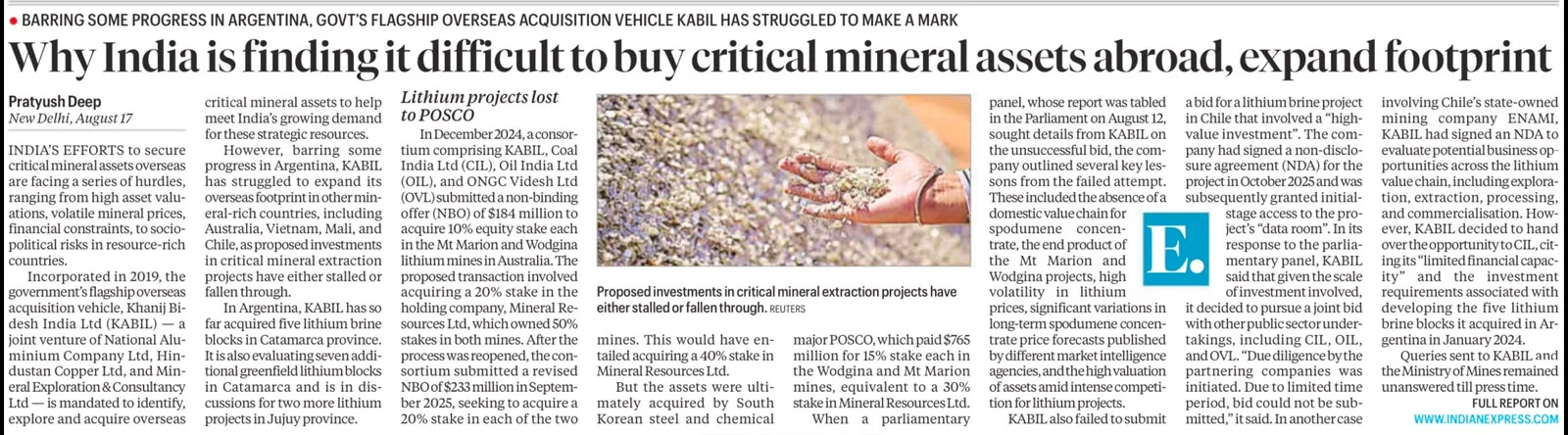
Context: Critical mineral assets abroad
India is seeking secure access to critical minerals required for EVs, batteries, renewable energy, electronics and defence, but acquiring overseas assets remains difficult due to high valuations, competition and geopolitical risks.
1. National Critical Mineral Mission and KABIL
National Critical Mineral Mission:
The National Critical Mineral Mission was approved in January 2025.
It aims to secure the entire critical-mineral value chain:
- Exploration
- Mining
- Beneficiation
- Processing
- Manufacturing
- Recycling
The mission focuses on both domestic development and overseas sourcing.
Khanij Bidesh India Limited:
KABIL was established in 2019 by:
- National Aluminium Company Limited
- Hindustan Copper Limited
- Mineral Exploration & Consultancy Limited
Its role is to identify, explore and acquire critical-mineral assets abroad.
KABIL’s role:
KABIL acts as India’s overseas mineral-acquisition arm, while NCMM provides the broader national framework for mineral security.
Progress:
KABIL has made progress in Argentina’s lithium sector, while attempts involving assets in Australia and Chile have faced commercial and strategic hurdles.
2. Why Overseas Acquisition Is Difficult
High valuations:
Rising global demand has made quality critical-mineral assets increasingly expensive.
High financial risk:
Mining requires large upfront capital, long gestation periods and uncertain returns, compounded by volatile mineral prices.
Global competition:
India competes with resource-rich countries and large corporations that have greater financial and technological capabilities.
Geopolitical and regulatory risks:
Resource nationalism, changing mining regulations and strategic control over minerals can complicate foreign investments.
Value-chain gap:
Acquiring a mine does not automatically secure supply.
India also needs:
- Processing
- Refining
- Technology
- Downstream manufacturing capacity
3. Way Forward
Diversify sources:
Build partnerships and acquire assets across multiple mineral-rich countries to reduce concentration risk.
Secure the entire chain:
Combine overseas mining rights with long-term offtake agreements, processing and refining arrangements.
Strengthen domestic ecosystem:
Use NCMM to accelerate exploration, beneficiation, processing, recycling and mineral substitution.
Leverage private capital:
Build PSU–private partnerships to combine strategic objectives with capital and technical expertise.
Strengthen mineral diplomacy:
Integrate critical minerals into India’s strategic partnerships, trade agreements and development cooperation.
Prelims Link
Which of the following statements about Rare Earth Elements and Critical Minerals is/are correct?
- Modern technological innovations including Artificial Intelligence, robotics and space exploration extensively utilise Rare Earth Elements.
- China has the highest share in mining of REEs followed by India.
- The Government of India launched the National Critical Mineral Mission in 2025 to establish a robust framework for self-reliance in the critical mineral sector.
- Rare Earth Elements are a set of 13 metallic elements.
Options:
(a) 1 and 3 only
(b) 3 only
(c) 1, 3 and 4
(d) 1, 2 and 4