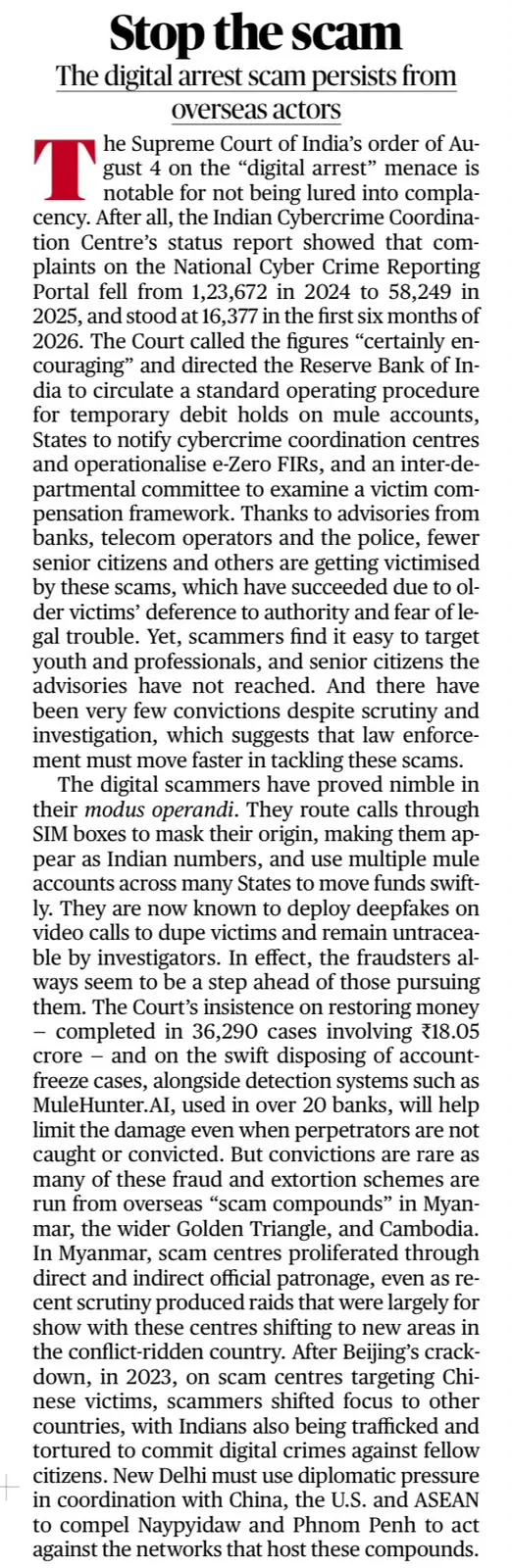
Context: Digital Arrest Scam Supreme Court
In In Re: Victims of Digital Arrest Related to Forged Documents, the Supreme Court directed the Union and States to create a coordinated institutional framework against digital arrest scams.
The focus is on preventive regulation, faster freezing of funds, victim protection and better inter-agency coordination.
Digital Arrest Scam
A digital arrest scam is a cyber fraud in which scammers impersonate police, investigation agencies or government officials.
They falsely accuse victims of crimes and keep them under pressure through video calls or phone calls.
Victims are then forced to transfer money to so-called “safe accounts” or “verification accounts”.
Why the Issue Is Serious
These scams often target senior citizens, professionals and vulnerable individuals.
Scammers use fear, fake legal documents, forged IDs and fake official language.
Many fraud networks operate through mule accounts, SIM boxes and cross-border scam compounds.
Supreme Court Directions
Financial Safeguards
The Court directed the Reserve Bank of India to frame a Standard Operating Procedure for immediate freezing of suspected mule accounts.
It also called for a mechanism for speedy recovery and restitution of money lost by victims.
Institutional Coordination
States were directed to operationalise electronic Zero FIRs for quick registration of cyber fraud cases.
The Court also called for stronger coordination among:
- Ministry of Home Affairs
- Indian Cyber Crime Coordination Centre
- Department of Telecommunications
- Reserve Bank of India
- Banks
- Law-enforcement agencies
Significance of the Judgment
Preventive Governance
The judgment shifts cyber fraud response from a purely reactive investigation model to a preventive management framework.
The idea is to intervene before the money is fully siphoned off.
Victim-Centric Justice
The judgment gives importance to recovery of victims’ money and compensation.
It does not limit the response only to criminal prosecution.
Institutional Accountability
The Court recognises cyber fraud as a whole-of-government challenge.
It clearly assigns responsibility to regulators, banks, telecom operators and enforcement agencies.
Way Forward
India should deploy AI-based fraud detection systems.
Real-time transaction monitoring must be strengthened.
KYC verification should be improved.
Cross-border cooperation is needed because several scam networks operate from outside India.
Conviction rates must improve.
Cyber awareness campaigns should be expanded, especially for senior citizens and first-time digital users.
Key Takeaway
Digital arrest scams show that cybercrime is no longer only a policing issue. India needs preventive regulation, faster fund freezing, coordinated institutions and victim-centric justice.