Context: Drone Warfare
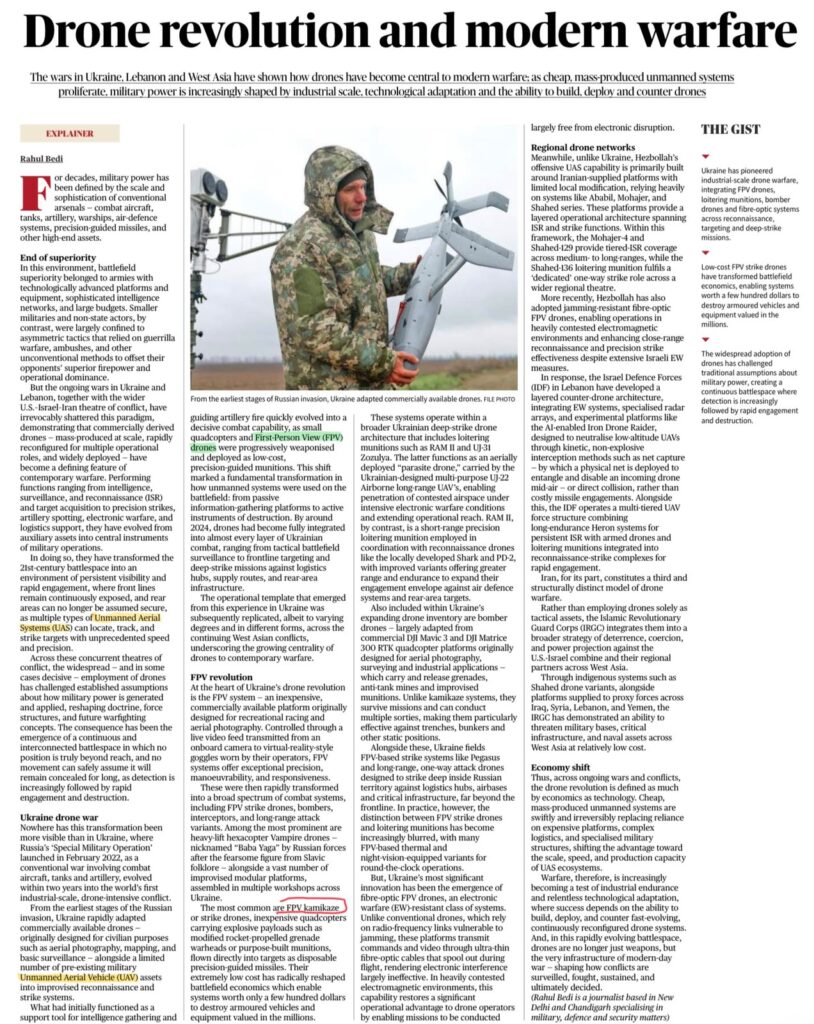
Recent wars in Ukraine, Lebanon and West Asia have shown that drones have become central to modern warfare. Cheap, mass-produced unmanned systems are reshaping military strategy, battlefield surveillance, targeting and precision strikes.
Unmanned Aerial Vehicle
Definition:
A powered aircraft that operates without a human pilot inside the aircraft and is controlled remotely or through onboard autonomous systems.
Examples
- MQ-9 Reaper — USA
- Heron — Israel
- TAPAS-BH-201 — India
Importance
Used for:
- Surveillance
- Reconnaissance
- Border monitoring
- Precision strikes
First-Person View Drone
Definition:
A type of UAV in which the operator receives a real-time video feed from the drone’s onboard camera, enabling navigation and targeting from the drone’s viewpoint.
Examples
- Ukrainian FPV kamikaze drones
- Russian FPV kamikaze drones
Importance
- Low-cost
- Highly accurate
- Difficult to detect
- Increasingly used for precision attacks in modern warfare
Strategic Significance
- Drones have lowered the cost of modern warfare.
- Small military actors can use drones to challenge larger forces.
- FPV drones are being used for battlefield strikes and targeting.
- Drone warfare demands counter-drone systems, electronic warfare and air-defence modernisation.