Context: EU AI Act India opportunity
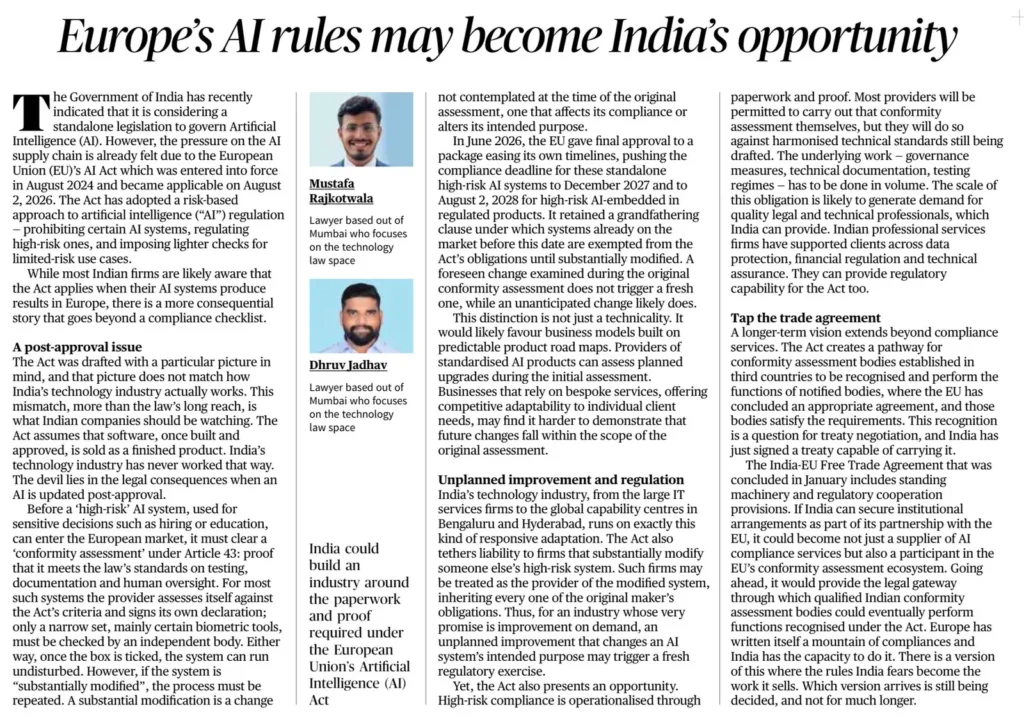
The European Union Artificial Intelligence Act is creating a new compliance ecosystem based on the risk level of AI systems. As India considers its own AI legislation, the EU framework could create an opportunity for India’s technology and professional-services sector.
What the EU AI Act changes
Risk-Based Regulation
The EU AI Act follows a risk-based approach.
Certain unacceptable AI practices are prohibited.
High-risk AI systems face stricter requirements.
Lower-risk AI applications face lighter obligations.
High-Risk Systems
Before entering the EU market, high-risk AI systems require conformity assessment.
This assessment covers:
- Risk management
- Data quality
- Documentation
- Traceability
- Transparency
- Human oversight
- Accuracy
- Cybersecurity
Post-Approval Changes
A major concern for Indian firms is substantial modification.
If an AI system or its intended purpose is substantially changed, a fresh conformity assessment may be required.
This is significant because Indian technology firms often continuously modify and improve software for individual clients.
Extended Timeline
The EU has extended the application of high-risk rules to:
- December 2027 for stand-alone systems
- August 2028 for AI embedded in products
This gives businesses more time to prepare.
Why this can become an opportunity for India
AI Compliance Services
Continuous regulatory requirements can create demand for:
- Testing
- Documentation
- Risk assessment
- Auditing
- Cybersecurity
- Technical assurance
India’s Existing Strength
India already has a large IT-services and professional-services ecosystem.
Major technology centres such as Bengaluru and Hyderabad can provide specialised AI-compliance services.
From Software Exporter to Compliance Hub
India can move beyond developing AI systems.
It can become a provider of:
- AI governance services
- Conformity assessment
- Regulatory-compliance services
- Technical assurance for global companies
Skilled Employment
This can create demand for professionals combining:
- Artificial Intelligence
- Law
- Cybersecurity
- Data governance
- Technical auditing
India–EU Regulatory Opportunity
The India–EU Free Trade Agreement, whose negotiations concluded in January 2026, includes a Working Group on Conformity Assessment.
This creates a possible institutional route for cooperation on conformity-assessment procedures.
India could seek recognition of competent Indian bodies so that AI-compliance assessments performed in India can gain acceptance in European markets.
Key Takeaway
The EU AI Act may create a new services opportunity for India. Indian firms can move from software development to AI governance, conformity assessment, auditing and compliance services for global markets.
10 Marks | 150 Words
The European Union’s Artificial Intelligence Act can create new opportunities for India’s technology and professionalservices sector. Discuss.
यूरोपीय संघ का आर्टिफिशियल इंटेलिजेंस अधिनियम भारत के प्रौद्योगिकी और पेशेवर सेवा क्षेत्र केलिए नए अवसर पैदा कर सकता है। चर्चाकीजिए।