
Context: I-2SEA submarine cable project
A consortium led by Tata Communications, Microsoft, Singtel and Lightstorm has unveiled the I-2SEA submarine cable project to enhance digital connectivity between India, Malaysia and Singapore.
The project will support the region’s growing AI and data-centre ecosystem.
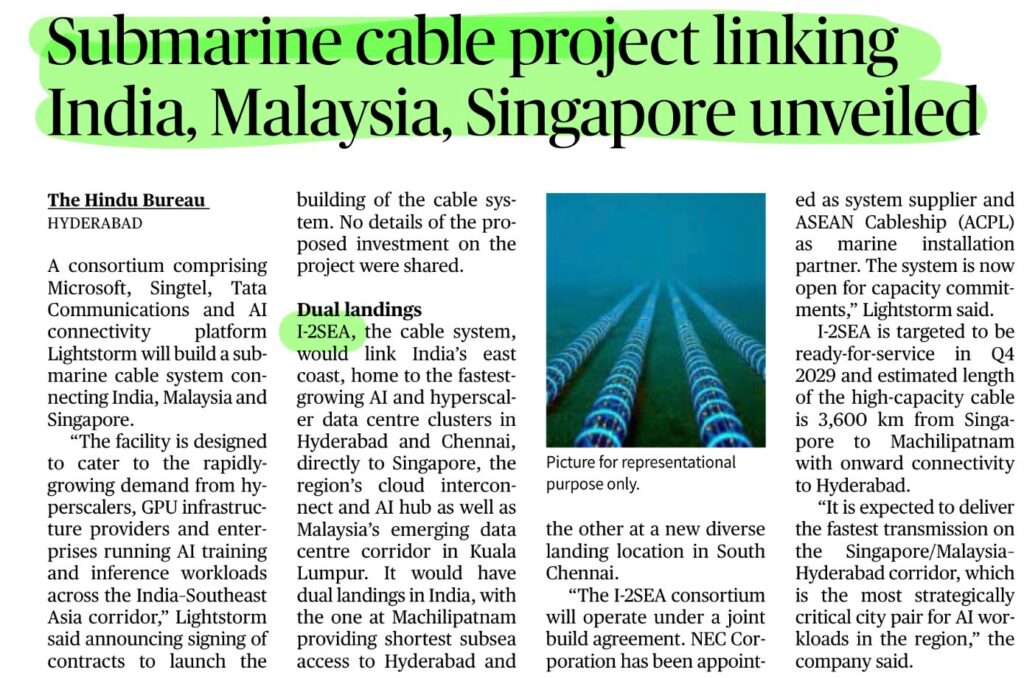
I-2SEA
Full Form
- India–Singapore–Malaysia
Type
- High-capacity submarine fibre-optic cable
Length
- Around 3,600 km
Route
- Machilipatnam to Singapore via Malaysia
Dual Landing Stations in India
- Machilipatnam
- South Chennai
Purpose of Dual Landing
Dual landing improves:
- Network resilience
- Redundancy
- Continuity of data flow
- Protection against outages
Expected Operational Timeline
- Q4 2029
Significance
1. Faster Data Transmission
Supports faster and more secure international data movement.
2. AI and Cloud Infrastructure
Supports:
- Artificial Intelligence
- Cloud computing
- Hyperscale data centres
- Digital economy growth
3. India–Southeast Asia Connectivity
Strengthens India’s digital connectivity with Southeast Asia.
4. Act East Policy
The project supports India’s broader Act East Policy by improving digital infrastructure links with ASEAN economies.
5. Strategic Digital Infrastructure
Submarine cables are critical infrastructure for:
- Internet connectivity
- Financial transactions
- Cloud services
- Defence communications
- Global data flows
Challenges
- Cybersecurity risks
- Physical vulnerability of undersea cables
- High project cost
- Geopolitical risks
- Need for redundancy and repair capacity
Key Takeaway
I-2SEA will strengthen India’s digital infrastructure, improve connectivity with Southeast Asia and support the future growth of AI, cloud computing and data-centre ecosystems.







