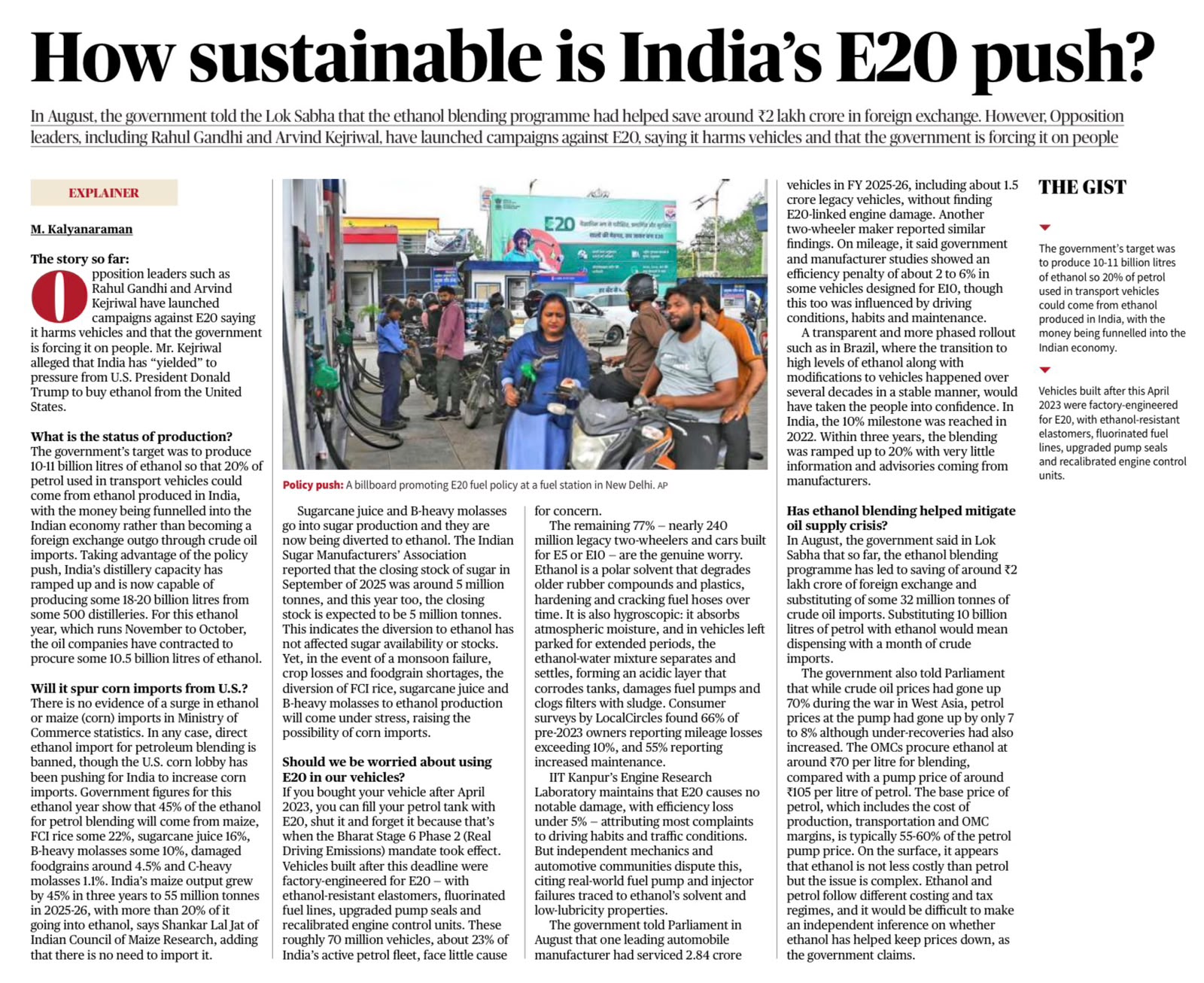
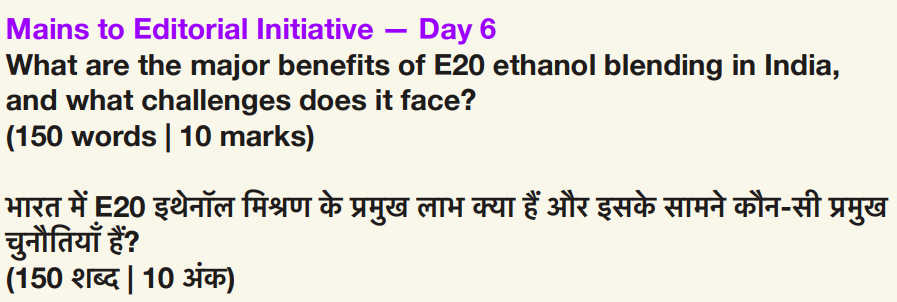
Context: India E20 Ethanol Sustainability
India has achieved 20% ethanol blending with petrol, or E20, in 2025–26, five years ahead of the earlier 2030 target. The Ethanol Blended Petrol Programme aims to reduce crude-oil dependence, save foreign exchange, support farmers and lower emissions. However, its long-term sustainability depends on balancing energy, food, water and consumer interests.
E20: Why India Is Pursuing It
Energy Security
India imports around 88.5% of its crude oil.
Ethanol substitutes a part of petroleum demand.
This reduces India’s exposure to global oil-price volatility and geopolitical shocks.
Economic Gains
Since Ethanol Supply Year 2014–15, ethanol blending has reportedly enabled:
- More than ₹1.9 lakh crore in foreign-exchange savings
- Substitution of about 310 lakh metric tonnes of crude oil
- More than ₹1.6 lakh crore in farmer payments
Capacity Expansion
Ethanol production capacity increased from 421 crore litres in 2014 to nearly 2,000 crore litres in 2026.
This makes the E20 mandate technically more feasible.
The Core Challenge: Food, Water and Fuel
Feedstock
Ethanol is produced from sugarcane, maize, rice and other feedstocks.
Greater dependence on food crops can create a food-versus-fuel trade-off.
Cropping Pattern
Assured demand for maize can encourage farmers to shift land away from pulses and oilseeds.
This may increase future import dependence for these essential crops.
Water
Sugarcane is water-intensive.
Therefore, ethanol expansion needs to account for regional water stress and sustainable cropping patterns.
Diversification
Second-generation ethanol, or 2G ethanol, is produced from agricultural residues and other non-food biomass.
It can reduce competition with food production.
Vehicle and Consumer Dimension
Compatibility
Vehicles manufactured after April 2023 are designed for E20.
However, a large legacy E5/E10 fleet remains in use.
Mileage
Ethanol has lower energy density than petrol.
Studies indicate around 2–6% lower fuel efficiency in some vehicles designed for E10.
Transition
E20 requires a gradual vehicle transition.
Consumers need transparent information on:
- Compatibility
- Mileage
- Maintenance
- Testing of older vehicles
Economic and Global Dimension
Cost
Ethanol is not automatically cheaper than petrol.
For example, the government’s procurement price for maize-based ethanol is about ₹71.86 per litre, before taxes and logistics.
United States
The United States has a large corn-ethanol industry.
However, India has clarified that it has made no commitment to import U.S. ethanol for fuel blending under ongoing trade talks.
India’s E20 requirement is intended to be met through domestic production.
Energy Transition
E20 should complement, not replace:
- Electric mobility
- Public transport
- Green hydrogen
- Other low-carbon transport options
Making E20 Sustainable
Feedstock Diversification
India should expand 2G ethanol and agricultural-residue-based production instead of relying excessively on food crops.
Food-Energy Balance
Ethanol policy must not undermine pulses, oilseeds, food availability or water security.
Consumer Protection
India must ensure E20-compatible vehicles, transparent mileage information and safeguards for the legacy vehicle fleet.
Evidence-Based Expansion
Future increases beyond E20 should follow:
- Scientific testing
- Feedstock availability assessment
- Lifecycle environmental assessment
Blending targets alone should not guide future expansion.
Key Takeaway
India’s E20 push supports energy security, farmer payments and foreign-exchange savings, but its sustainability depends on feedstock diversification, water management, consumer protection and evidence-based expansion.