Context: India UK trade deal 2026
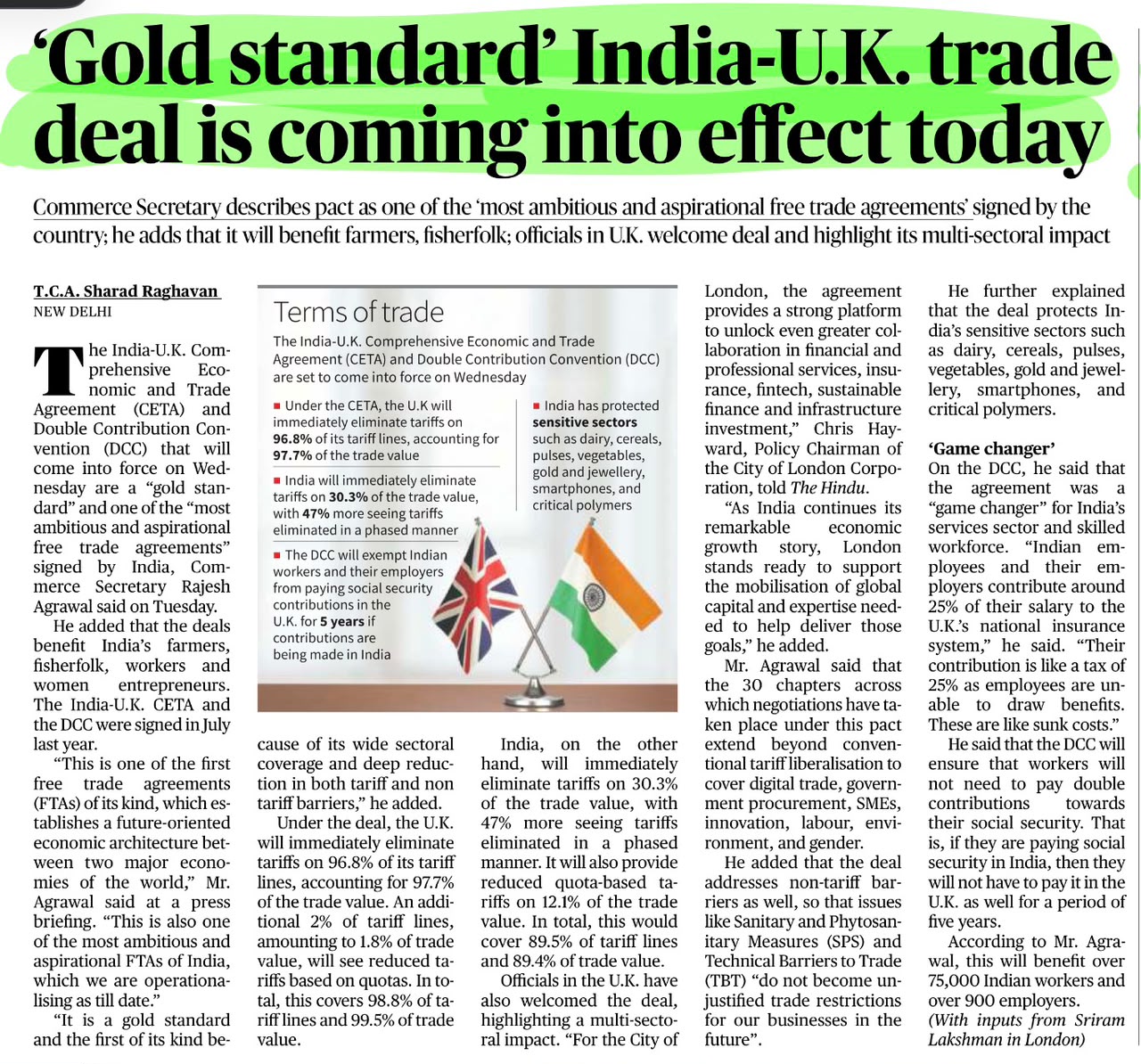
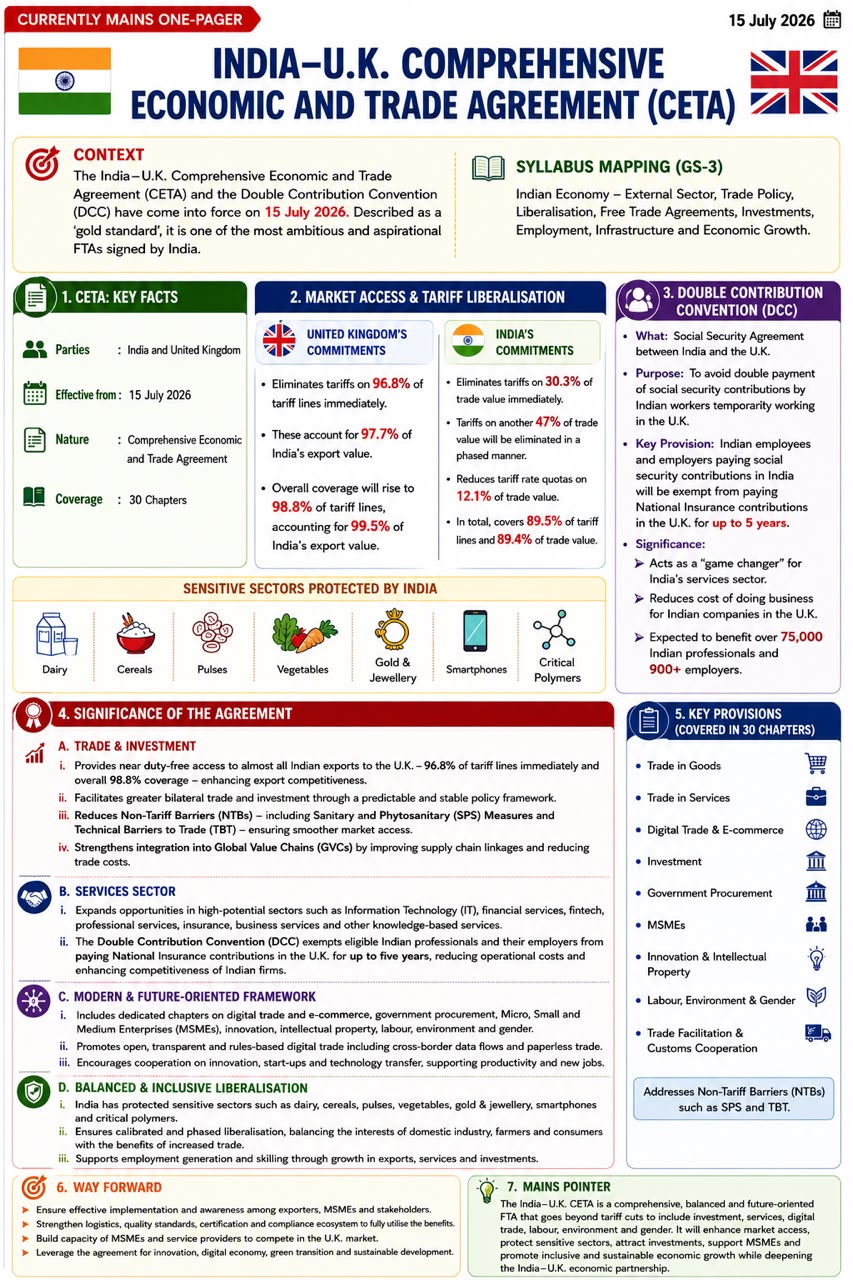
The India–U.K. Comprehensive Economic and Trade Agreement and the Double Contribution Convention have come into force from 15 July 2026.
It is described as a “gold standard” agreement and one of the most ambitious FTAs signed by India.
India–U.K. CETA
Full Form
- Comprehensive Economic and Trade Agreement
Parties
- India
- United Kingdom
Effective From
- 15 July 2026
Coverage
- 30 chapters
Market Access and Tariff Liberalisation
United Kingdom’s Commitments
The U.K. will eliminate tariffs on 96.8% of tariff lines immediately.
These account for around 97.7% of India’s export value.
Overall coverage will rise to 98.8% of tariff lines, covering around 99.5% of India’s export value.
India’s Commitments
India will eliminate tariffs on 30.3% of trade value immediately.
Tariffs on another 47% of trade value will be eliminated in a phased manner.
India will reduce tariff rates on 12.1% of trade value.
Overall, India will cover around 89.5% of tariff lines and 89.4% of trade value.
Sensitive Sectors Protected by India
India has protected sensitive sectors such as:
- Dairy
- Cereals
- Pulses
- Vegetables
- Gold and jewellery
- Smartphones
- Critical polymers
Double Contribution Convention
The Double Contribution Convention is a social security agreement between India and the U.K.
Purpose
To avoid double payment of social security contributions by Indian workers temporarily working in the U.K.
Key Provision
Indian employees and employers paying social security contributions in India will be exempt from National Insurance contributions in the U.K. for up to 5 years.
Significance
- Reduces cost of doing business.
- Benefits Indian companies in the U.K.
- Expected to benefit more than 75,000 Indian professionals and over 900 employers.
Key Provisions of CETA
The agreement covers:
- Trade in Goods
- Trade in Services
- Digital Trade and E-commerce
- Investment
- Government Procurement
- MSMEs
- Innovation and Intellectual Property
- Labour, Environment and Gender
- Trade Facilitation and Customs Cooperation
Significance for India
1. Trade and Investment
Provides near duty-free access to Indian exports in the U.K. market.
2. Services Sector
Expands opportunities in:
- Information Technology
- Financial services
- Fintech
- Professional services
- Insurance
- Business services
3. Supply Chains
Helps integrate India into global value chains.
4. Non-Tariff Barriers
Addresses issues such as:
- Sanitary and Phytosanitary Measures
- Technical Barriers to Trade
5. Employment
Supports job creation through exports, services and investment.
Key Takeaway
The India–U.K. CETA is significant because it combines tariff liberalisation, services access, social security relief and modern trade rules.