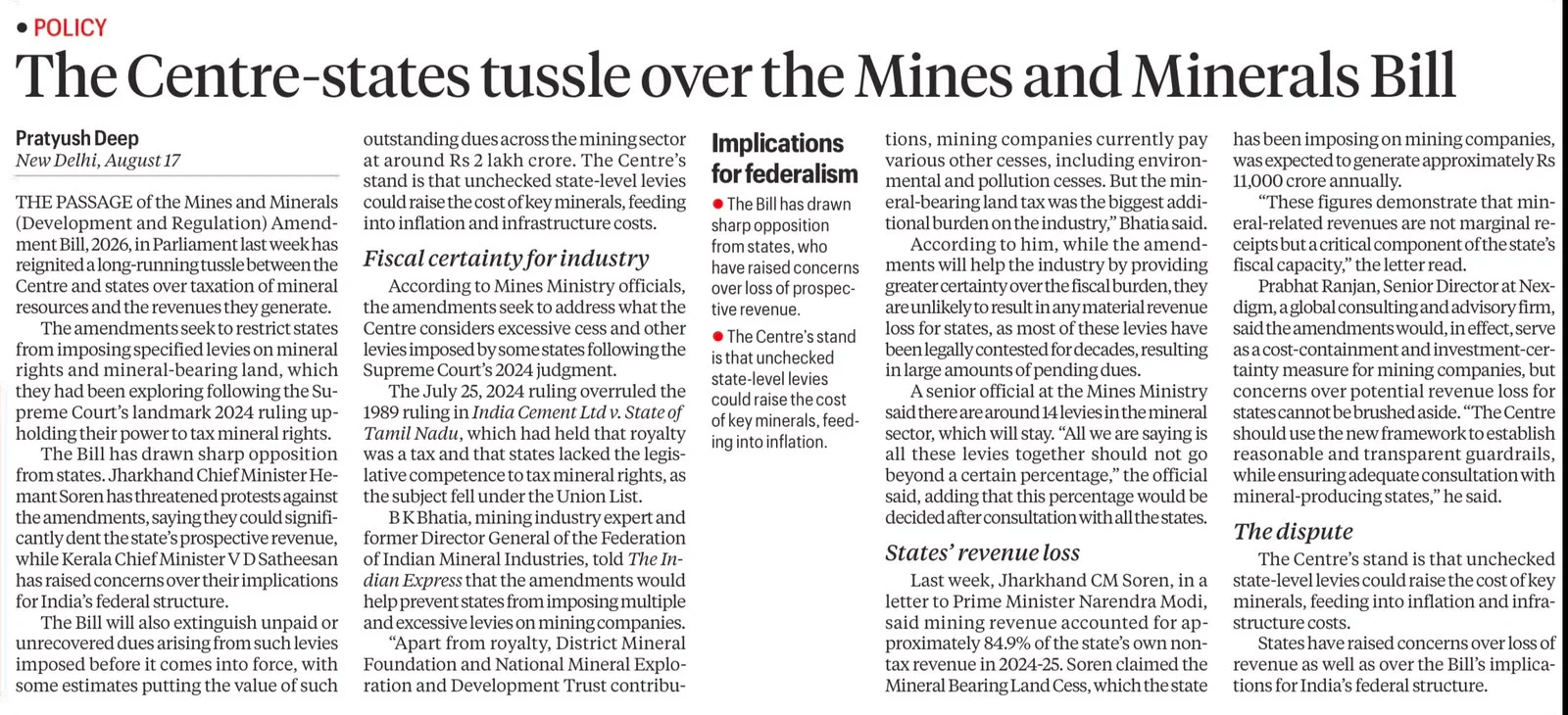
Context: Mines and Minerals Bill 2026
The Mines and Minerals (Development and Regulation) Amendment Bill, 2026 seeks to restrict specified State levies on mineral rights, following the Supreme Court’s 2024 ruling affirming States’ power to tax mineral rights.
1. Mines and Minerals (Development and Regulation) Act, 1957
The Mines and Minerals (Development and Regulation) Act, 1957 is the principal Central law governing the development and regulation of mines and minerals.
Entry 54, Union List:
Parliament can regulate mines and mineral development in the public interest.
Entry 23, State List:
States have a role in mines and mineral development, subject to Union control.
States administer mining leases and receive mineral-related revenues, including royalty under Section 9.
2. Mineral Area Development Authority v. Steel Authority of India Ltd. — Supreme Court, 2024
Royalty is not tax:
Royalty under the MMDR Act is not a tax.
State taxing power:
States can tax mineral rights under Entry 50, State List.
Parliamentary power:
Entry 50 allows Parliament to impose limitations on State taxation of mineral rights through a law relating to mineral development.
Core implication:
The judgment recognised State taxing power while simultaneously recognising Parliament’s constitutional power to limit it.
3. What Has Parliament Changed in 2026?
Restriction on State levies:
The amendment restricts specified taxes, cesses and other levies on mineral rights and mineral-bearing land, bringing them within a more uniform framework.
Past dues:
It provides for dealing with certain unpaid or unrecovered dues arising from such State-level levies.
Investment certainty:
By reducing multiple and unpredictable charges, the Centre seeks to make mining projects more financially predictable and investment-friendly.
National mineral market:
A uniform framework is intended to prevent different State levies from creating different mineral costs across India.
Strategic rationale:
Lower and predictable mineral costs are important for:
- Manufacturing
- Infrastructure
- Energy transition
- Critical-mineral security
4. Why Are States Concerned?
Fiscal autonomy:
States argue that taxation of mineral rights is a constitutionally recognised State power under Entry 50.
Revenue:
Mineral-rich States could lose an important source of potential own-source revenue.
Local externalities:
Mining States bear the costs of:
- Displacement
- Environmental degradation
- Rehabilitation
- Infrastructure pressure
Federal balance:
Extensive restrictions on State taxation may increase centralisation and weaken fiscal federalism.
5. Way Forward
Cooperative federalism:
Institutionalise Centre–State consultation before determining limits on State mineral levies.
Predictability with autonomy:
Create a uniform and investment-friendly regime while retaining a reasonable State fiscal role.
Benefit-sharing:
Ensure mineral-producing States and affected communities receive adequate benefits from resource extraction.
Strengthen District Mineral Foundation:
Use mining revenues effectively for local development and rehabilitation.
Balance:
National mineral security + investment certainty + State fiscal autonomy.
Editorial to Mains Answer Initiative — Day 9
GS2 / GS3 — 15 Marks — 250 Words
“The recent changes in the Mines and Minerals (Development and Regulation) framework have reignited the debate over Centre–State relations.” Discuss the key issues relating to State fiscal autonomy, national mineral security and investment certainty, and suggest a way forward based on cooperative federalism.
“खनिज एवं खनिज (विकास एवं विनियमन) व्यवस्था में हालिया बदलावों ने केंद्र–राज्य संबंधों पर बहस को फिर से तेज कर दिया है।” राज्य की राजकोषीय स्वायत्तता, राष्ट्रीय खनिज सुरक्षा और निवेश सुनिश्चितता से जुड़े प्रमुख मुद्दों की चर्चा करते हुए सहकारी संघवाद पर आधारित आगे की राह सुझाइए।