Context
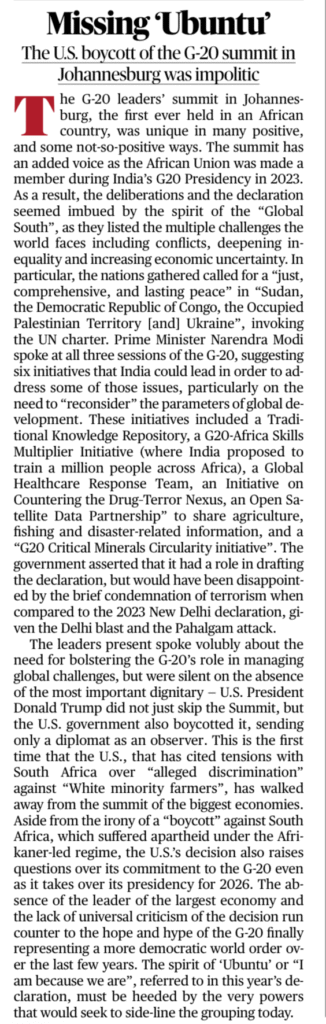
• Editorial discusses the U.S. boycott of the G-20 Summit at Johannesburg.
• Highlights implications for Global South solidarity, multilateralism, and future G-20 leadership.
Key Points
1. Significance of the Summit
• First G-20 summit held in Africa.
• African Union participated as a new G-20 member (announced in India’s 2023 Presidency).
• Focus on Global South issues: conflicts, inequality, economic uncertainty.
2. India’s Role
India proposed six initiatives:
• Traditional Knowledge Repository
• G20–Africa Skills Multiplier
• Global Healthcare Response Team
• Anti Drug-Terror Nexus initiative
• Open Satellite Data Partnership
• Critical Minerals Circularity Initiative
Shows India projecting itself as a leader of Global South.
3. U.S. Boycott
• President Donald Trump skipped the summit.
• The U.S. government boycotted, sending only an observer.
• First such boycott of a G-20 summit by the U.S.
4. Implications of U.S. Absence
• Questions the U.S.’s commitment to the G-20, especially as it takes 2026 Presidency.
• Undermines G-20’s push toward a more democratic global order.
• Contradiction: U.S. justifies tensions with South Africa but chooses to boycott an Africa-hosted summit.
5. Editorial Argument
• U.S. decision weakens multilateral cooperation at a time global challenges need unity.
• Violates the spirit of “Ubuntu” (“I am because we are”).
• Collective values must be upheld by big powers, not sidelined.