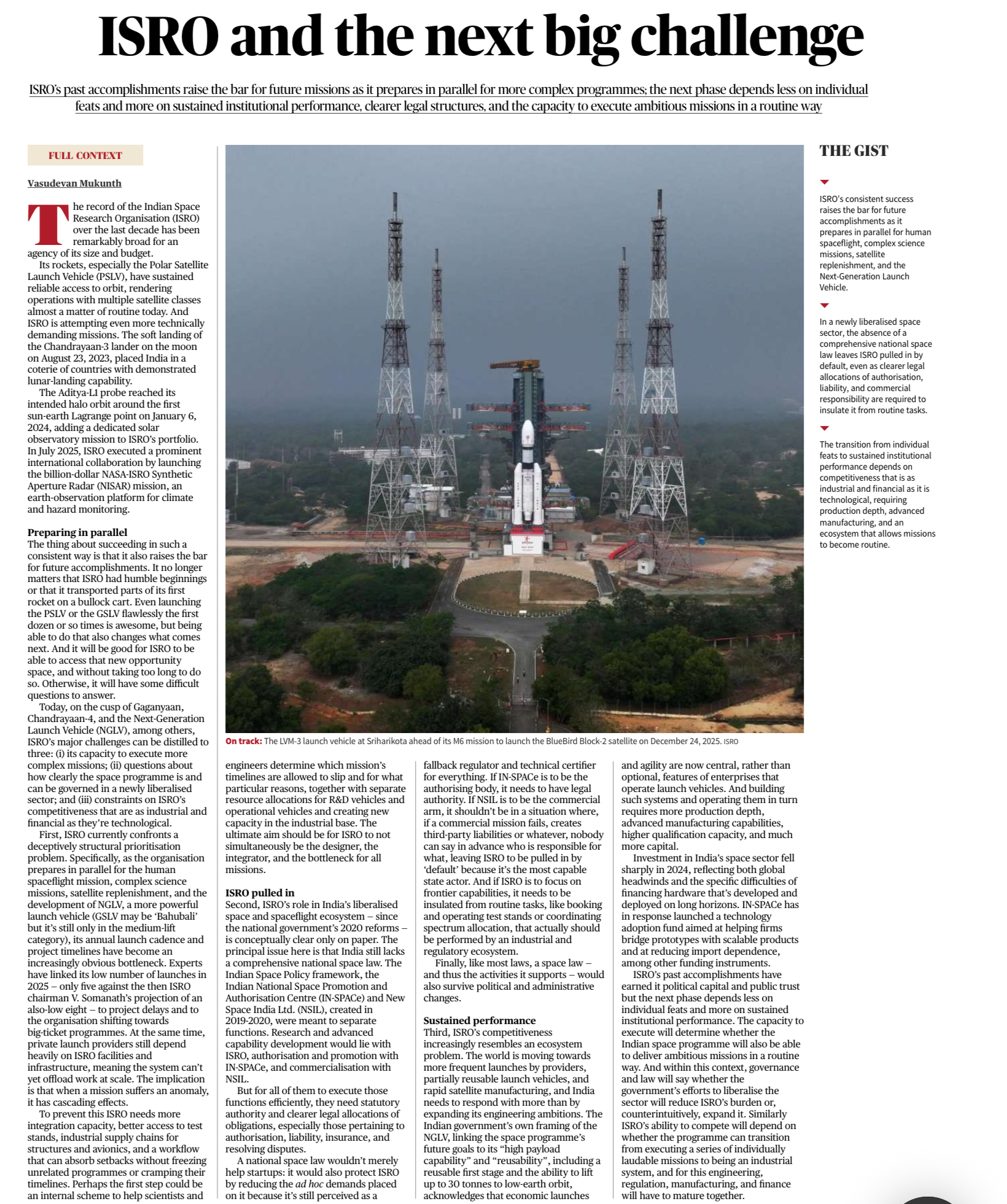
ISRO & Launch Vehicles
• ISRO has achieved repeated mission successes, but the key challenge now is shifting from one-time achievements to routine, large-scale execution.
• Future success depends on institutional capacity, legal and regulatory clarity, manufacturing depth, and private sector participation, not only technology.
• Focus areas ahead include human spaceflight, Next Generation Launch Vehicle (NGLV), and handling multiple complex missions simultaneously.
Launch Vehicles
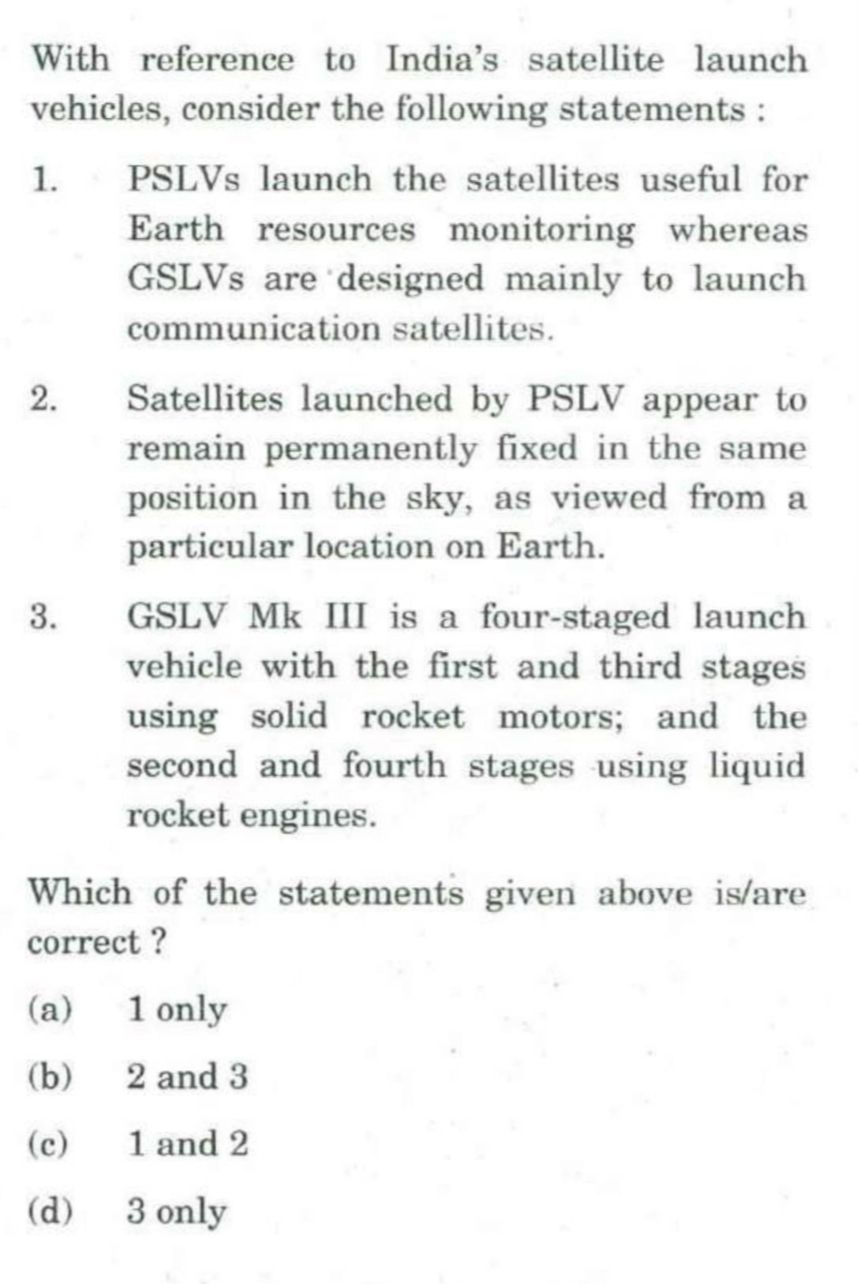
PSLV (Polar Satellite Launch Vehicle)
• Stages: 4
• Fuel: Solid → Liquid → Solid → Liquid
• Orbit: LEO / Polar / Sun-synchronous
• Payload: Light–medium
• Role: Earth-observation, commercial launches
• Key trait: Highly reliable, no cryogenic stage
GSLV
• Stages: 3
• Fuel: Solid core → Liquid → Cryogenic
• Orbit: Geosynchronous (GTO)
• Payload: Heavy
• Role: Communication satellites
• Key trait: Cryogenic engine enables heavy-lift capability
NGLV (Next Generation Launch Vehicle)
• Stages (proposed): 3
• Fuel: Liquid → Liquid → Cryogenic
• Purpose: Heavy-lift, reusable, cost-efficient launches
• Role: Human spaceflight, space station modules, deep-space missions
• Significance: Future backbone of India’s space programme