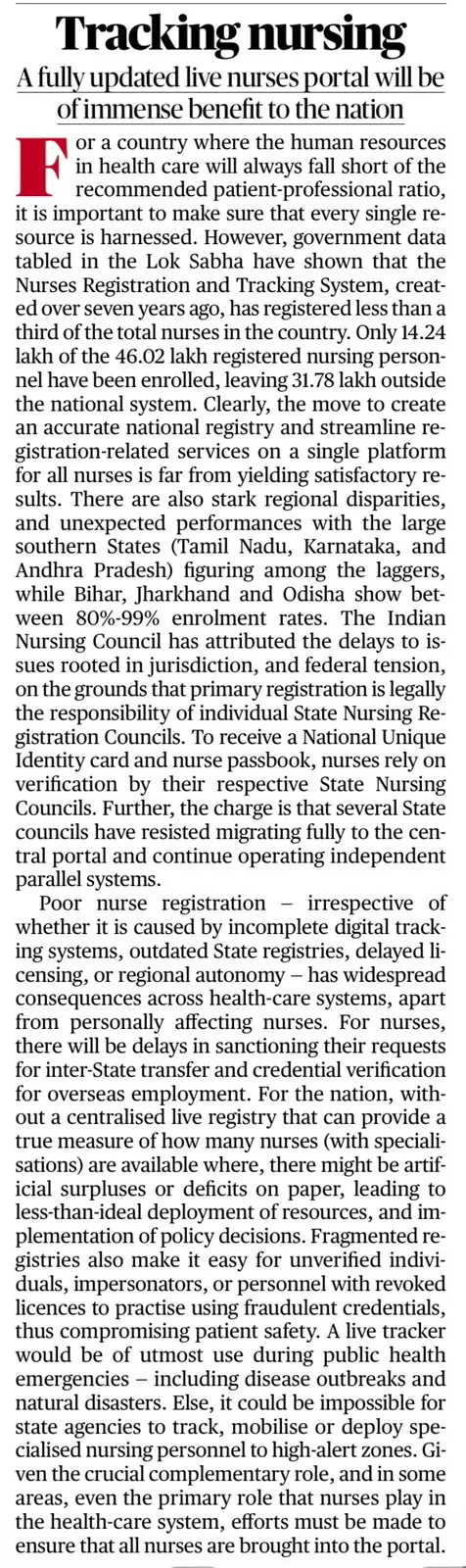
Context: Nursing Registration Tracking System
India lacks an accurate live national database of nurses.
This weakens workforce planning, professional mobility, patient safety and emergency response. The Nurses Registration and Tracking System, or NRTS, was launched over seven years ago, but coverage remains incomplete.
Nurses Registration and Tracking System
The NRTS was created to build a national live registry of nursing personnel.
It aims to provide updated data on nurses across the country.
Current Status
India has 46.02 lakh registered nursing personnel.
Only 14.24 lakh are enrolled on the NRTS.
This means around 31.78 lakh nurses remain outside the national system.
In percentage terms, only about 31% nurses are on NRTS, while around 69% remain outside it.
Why a Live Nursing Registry Matters
Workforce Mapping
Real-time data on number, location, qualification and specialisation can help identify actual shortages and surpluses.
This can improve nurse deployment across regions.
Patient Safety
Centralised verification can prevent fake credentials, impersonation and practice by nurses with revoked licences.
This protects patients and improves trust in the health system.
Emergency Response
A live database can help rapidly mobilise specialised nurses during disease outbreaks, pandemics and natural disasters.
Professional Mobility
Unified registration can make inter-State transfers easier.
It can also speed up credential verification for overseas employment.
Gaps in the Present System
Low Coverage
Only 14.24 lakh out of 46.02 lakh nurses are on NRTS.
This leaves a large majority outside the system.
Regional Disparity
Bihar, Jharkhand and Odisha reportedly show 80–99% enrolment.
Tamil Nadu, Karnataka and Andhra Pradesh are among the lagging States.
Fragmented Registries
Primary registration remains with State Nursing Councils.
Several councils continue parallel systems instead of fully migrating to the central portal.
Federal and Jurisdictional Issues
Verification for the National Unique Identity Card and nurse passbook depends on State Nursing Councils.
This creates delays and coordination problems.
Way Forward
India needs one interoperable nursing registry.
State Nursing Council databases should be integrated with NRTS.
Parallel records should be eliminated.
The database must be updated regularly for:
- Registration
- Renewal
- Qualifications
- Specialisation
- Employment status
- Licence status
The registry should be used for data-driven deployment according to regional health needs.
Centre-State coordination should improve through common standards and interoperable technology.
Key Takeaway
A live nursing registry is essential for patient safety, workforce planning and emergency response. India needs updated, interoperable and nationally integrated nursing data.