Context: Operation Sindoor transparency debate
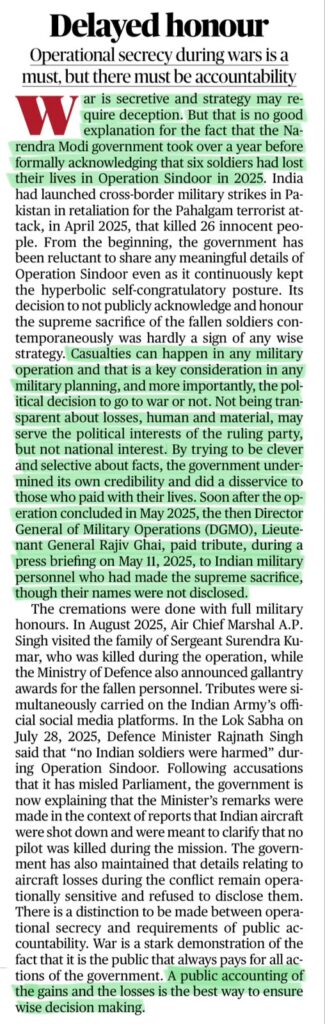
The editorial discusses the delayed disclosure of military casualties during Operation Sindoor and argues that operational secrecy during war may be necessary, but democratic accountability cannot be permanently denied.
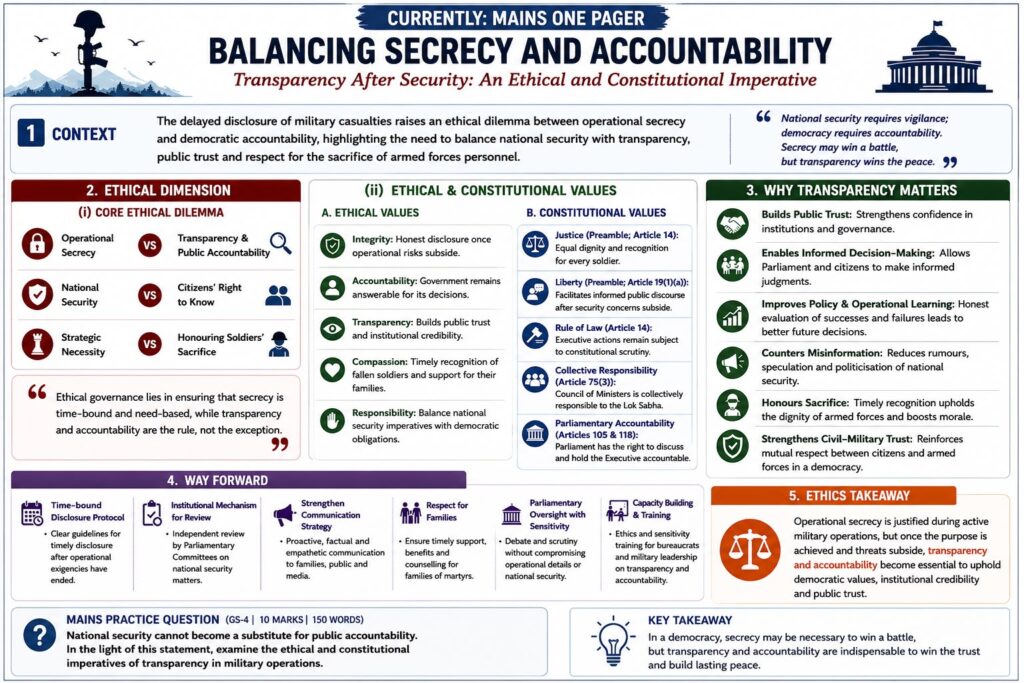
Core Ethical Issue
The issue reflects a tension between:
- Operational secrecy
- National security
- Public accountability
- Citizens’ right to know
- Honour of sacrifice
- Democratic transparency
Ethical Dimensions
1. Operational Secrecy vs Public Accountability
During military operations, secrecy may be needed to protect strategy, personnel and national security.
However, once operational risks reduce, the State has a duty to disclose relevant information.
2. National Security vs Citizens’ Right to Know
National security cannot become a permanent excuse for withholding information from citizens.
In a democracy, citizens must be able to trust official information.
3. Strategic Necessity vs Honouring Sacrifice
If soldiers make the supreme sacrifice, their service deserves timely recognition and institutional respect.
Delayed acknowledgement may weaken public trust.
Constitutional and Ethical Values
Article 19(1)(a)
Freedom of speech and expression includes the citizens’ right to receive information.
Article 14
Equality before law includes non-arbitrariness in State action.
Article 21
Right to life and dignity also supports the dignified recognition of sacrifice.
Parliamentary Accountability
In a parliamentary democracy, the executive is accountable to Parliament and, through Parliament, to the people.
Why Transparency Matters
Transparency:
- Builds public trust
- Honours soldiers’ sacrifice
- Counters misinformation
- Strengthens civil-military trust
- Improves policy and operational learning
- Allows informed democratic debate
Way Forward
1. Time-bound Disclosure Protocol
Clear guidelines should specify when and how casualties and sensitive operational information can be disclosed after risk assessment.
2. Institutional Mechanism
A structured system should exist for informing families, Parliament and the public.
3. Respect for Families
Families of fallen personnel must receive timely information, counselling and honour.
4. Parliamentary Oversight
Sensitive briefings may be given to relevant parliamentary committees.
5. Balance Between Security and Accountability
The State must protect national security while ensuring democratic transparency after immediate operational risks have passed.
GS4 Value Addition
This example can be used in answers on:
- Accountability
- Transparency
- Probity in governance
- Civil-military relations
- Ethical governance
- Duty-based ethics
- Public trust
- National security and democracy
Ethics Takeaway
Operational secrecy may be justified during active military operations, but once the purpose is achieved and threats reduce, transparency and accountability become essential to uphold democratic values and institutional credibility.