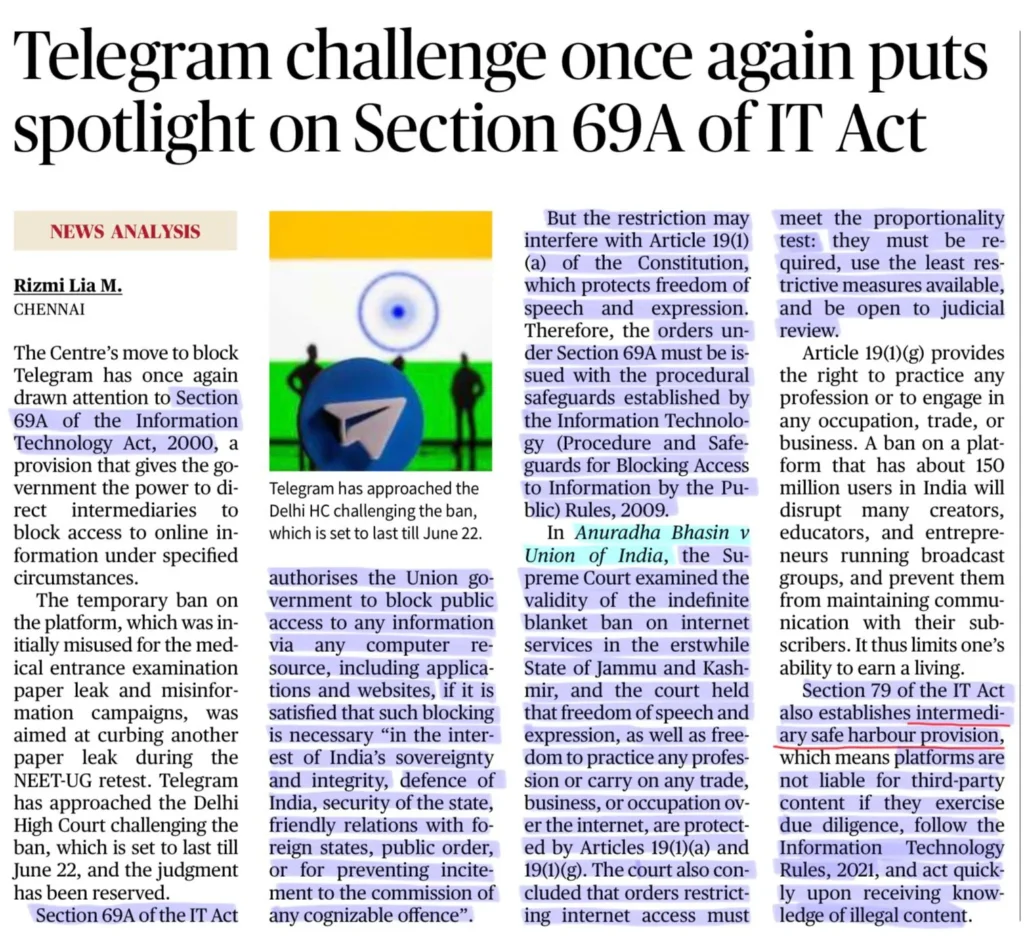
Source: The Hindu | Page: 14 | Tags: 19 June 2026, Digital Governance, Freedom of Speech & Intermediary Liability, Governance, GS2
Context: Section 69A IT Act
The Centre’s action against Telegram over the NEET paper leak and misinformation has revived the debate on balancing national security and public order with digital rights and freedom of expression.
Section 69A, Information Technology Act, 2000
Section 69A allows the Central Government to block online content on specific grounds.
Grounds for Blocking
- Sovereignty and integrity of India
- Defence of India
- Security of the State
- Friendly relations with foreign States
- Public order
- Incitement to cognizable offence
Rights Involved
Article 19(1)(a)
- Freedom of speech and expression
- Freedom to practise any profession, occupation, trade or business
Section 79: Safe Harbour Protection
Section 79 provides safe harbour protection to intermediaries.
This means intermediaries are not liable for third-party content if they follow due diligence.
Due Diligence Includes
- Appointment of grievance officer
- Compliance with legal orders
- Cooperation with law enforcement agencies
- Following Information Technology Rules
Important Supreme Court Judgments
Shreya Singhal v. Union of India, 2015
- Supreme Court upheld Section 69A.
- Supreme Court struck down Section 66A.
Anuradha Bhasin v. Union of India, 2020
- Restrictions on internet access must be:
- Necessary
- Proportionate
- Least restrictive
Key Governance Issue
The core issue is how to regulate digital platforms without creating excessive censorship.
Mains Significance
This topic can be used in answers on:
- Digital governance
- Freedom of speech
- Platform regulation
- National security
- Public order
- Intermediary liability
- Proportionality doctrine
- Internet shutdowns and content blocking