Context: Section 85 BNS Live-in Relationships
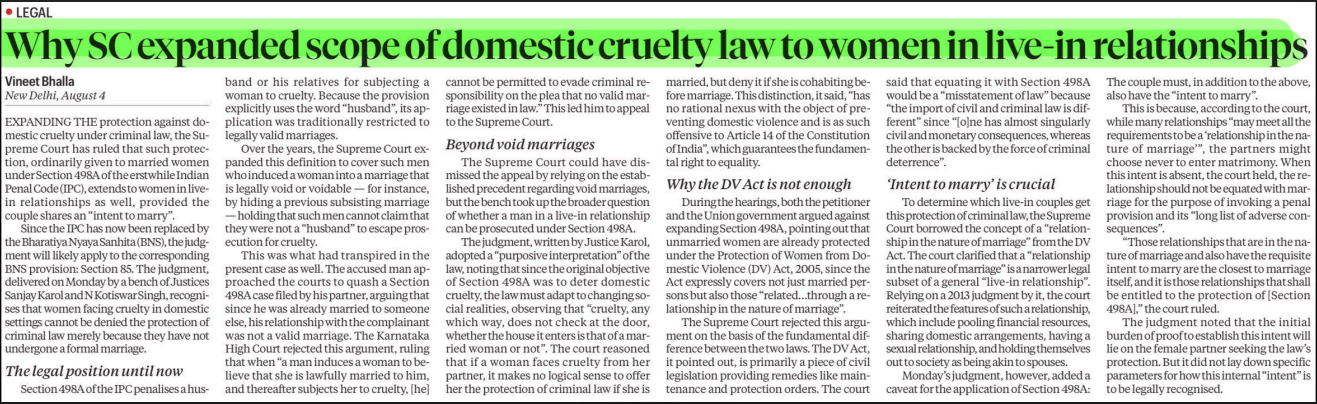
In X v. State of Karnataka, 2026, the Supreme Court held that the offence of cruelty by husband or his relatives under Section 85 of the Bharatiya Nyaya Sanhita, 2023 can extend to women in live-in relationships that are in the nature of marriage.
However, this protection applies only when the relationship satisfies judicial tests laid down by the Court.
Earlier Legal Position
Section 85 of the Bharatiya Nyaya Sanhita, 2023 is the successor to Section 498A of the Indian Penal Code.
Traditionally, this provision was invoked in legally recognised marriages.
Women in live-in relationships mainly relied on the Protection of Women from Domestic Violence Act, 2005, which provides civil remedies.
What Did the Supreme Court Hold?
The Court said Section 85 must receive a purposive interpretation.
The purpose of the law is to punish domestic cruelty, not merely to protect formally valid marriages.
A person cannot escape criminal liability by claiming that the marriage was void, voidable or never legally solemnised after inducing a woman into a marriage-like relationship.
However, criminal protection is not available to all live-in relationships.
It applies only to relationships in the nature of marriage.
Conditions for Protection
The relationship must show:
- Relationship in the nature of marriage
- Intent to marry
- Long-term cohabitation
- Shared domestic life
This ensures that genuine marriage-like relationships are protected while preventing misuse.
Protection of Women from Domestic Violence Act, 2005
The Domestic Violence Act is a civil legislation.
It protects women from domestic violence in both marital and marriage-like relationships.
It provides:
- Protection orders
- Residence rights
- Monetary relief
- Custody-related relief
- Compensation
What Is New in This Judgment?
The judgment clarifies that relief under the Domestic Violence Act cannot replace criminal prosecution under Section 85 of the BNS.
It extends criminal-law protection against domestic cruelty to eligible live-in relationships.
It bridges the gap between civil remedies and criminal liability.
It also aligns criminal law with changing family structures while limiting protection to genuine marriage-like relationships.
Key Takeaway
The judgment expands protection for women facing domestic cruelty in genuine marriage-like live-in relationships, while carefully restricting it to relationships that satisfy judicial tests.