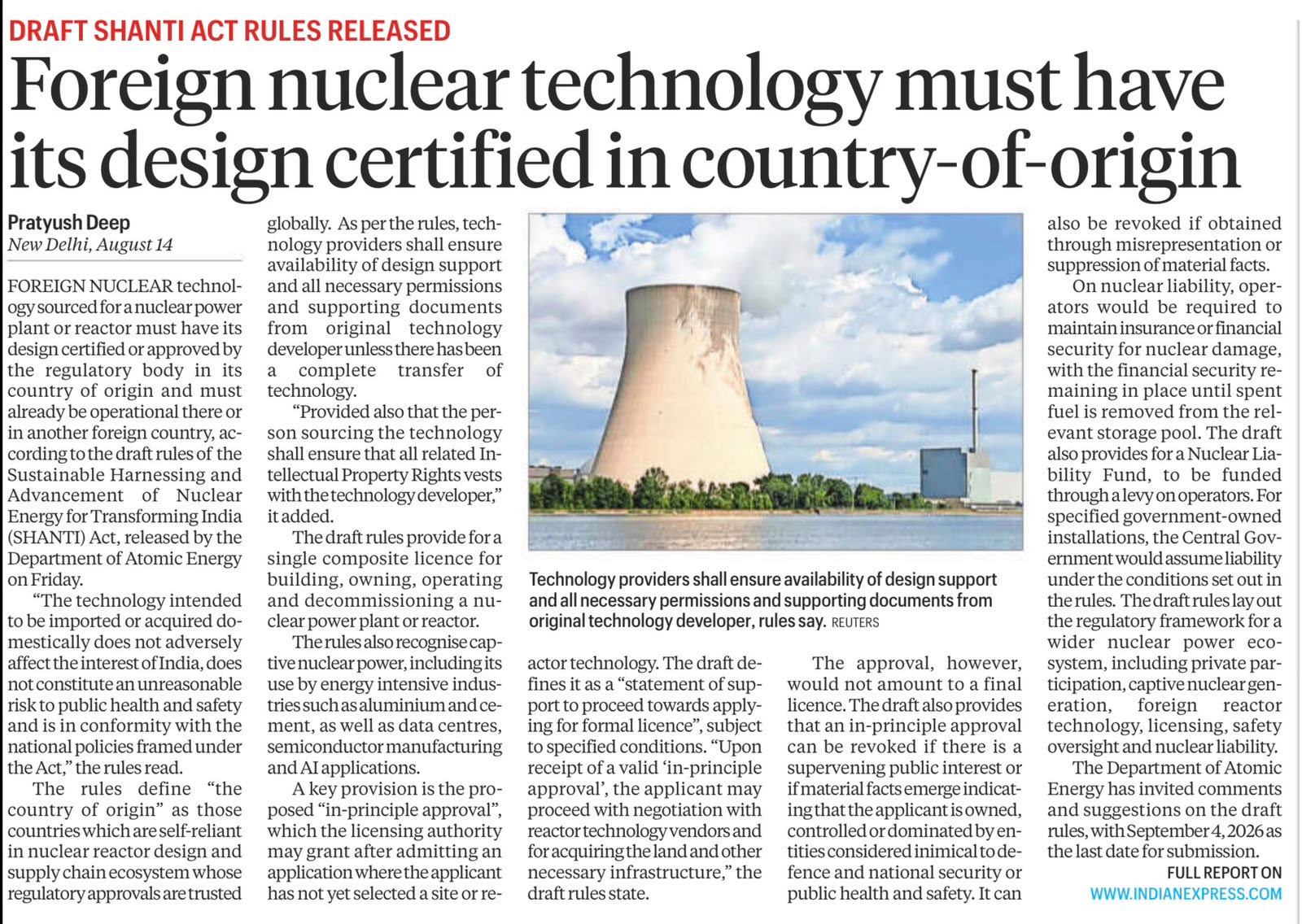
Context: SHANTI Act 2025
The Department of Atomic Energy has released draft SHANTI Rules, 2026 to operationalise the SHANTI Act, 2025. The SHANTI Act replaced the Atomic Energy Act, 1962 and the Civil Liability for Nuclear Damage Act, 2010. The reform aims to expand nuclear power through greater private participation while retaining strong regulatory and strategic safeguards.
SHANTI Act, 2025
SHANTI stands for Sustainable Harnessing and Advancement of Nuclear Energy for Transforming India.
Private Participation
Indian private companies and joint ventures can seek licences to:
- Build nuclear power plants/reactors
- Own nuclear power plants/reactors
- Operate nuclear power plants/reactors
- Decommission nuclear power plants/reactors
This will be subject to government permission and safety regulation.
Regulation
The Atomic Energy Regulatory Board, or AERB, receives statutory recognition.
It is responsible for:
- Nuclear safety
- Radiation safety
- Licensing
- Inspections
- Enforcement
Strategic Control
Opening nuclear power to private players does not mean opening the entire nuclear fuel cycle.
Sensitive strategic activities remain under Central Government control.
Nuclear Liability
The Act replaces the earlier liability framework with a graded operator-liability system.
Liability is linked to the category or capacity of the nuclear installation.
Operators must maintain insurance or financial security.
The Act also provides for a Nuclear Damage Claims Commission for adjudication of claims.
What the Draft SHANTI Rules, 2026 add
Foreign Reactor Technology
Foreign reactor technology must have its design certified or approved by the regulatory authority in the country of origin.
It must already be operational in that country or another foreign country.
Technology Assurance
Foreign technology providers must provide necessary:
- Design support
- Permissions
- Technical documentation
These must come from the original technology developer unless technology transfer is complete.
Single Composite Licence
The draft rules propose a single composite licence for:
- Construction
- Ownership
- Operation
- Decommissioning
This applies to a nuclear plant or reactor.
In-Principle Approval
An initial approval can allow an applicant to proceed with negotiations for:
- Technology
- Land
- Infrastructure
However, it does not amount to a final operating licence.
It can also be revoked under specified circumstances.
Safety and Financial Protection
Operators must maintain adequate financial security for nuclear damage.
The rules also provide for a Nuclear Liability Fund financed through a levy on operators.
Why it matters
The framework enables private capital, foreign technology and domestic expertise to participate in India’s nuclear expansion.
It supports India’s ambition of 100 GW nuclear capacity by 2047.
Nuclear power can become an important source of reliable, low-carbon electricity.
The framework attempts to balance:
- Investment
- Faster deployment
- Nuclear safety
- Public compensation
- Regulatory oversight
- Strategic autonomy
Key Takeaway
The SHANTI framework seeks to open nuclear power to private and foreign technology participation while keeping safety, liability, regulatory oversight and strategic control at the centre.