Source: Indian Express (Explained) | Pg. 9 | Tags: 10 June 2026, GS3, Science & Technology, Space Technology
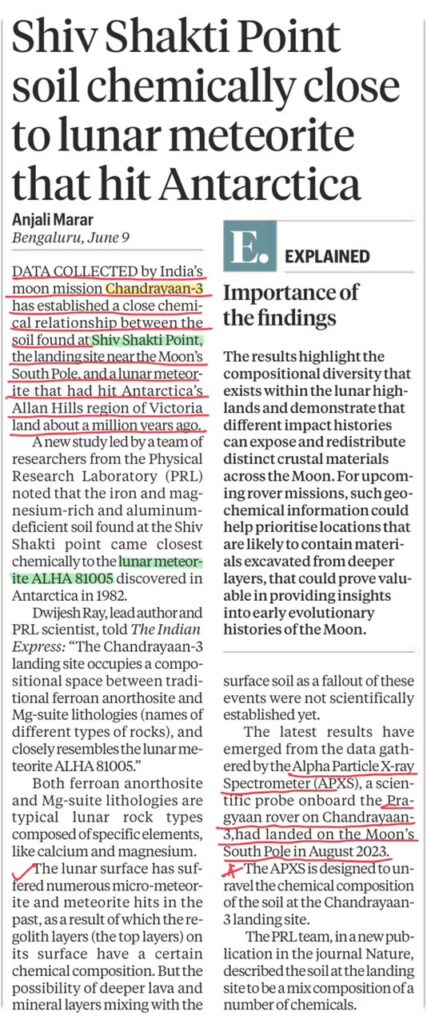
Context: Shiv Shakti Point soil chemically close to lunar meteorite that hit Antarctica
Chandrayaan-3 data has shown that soil at Shiv Shakti Point, the landing site near the Moon’s South Pole, is chemically similar to lunar meteorite ALHA 81005, discovered in Antarctica.
Chandrayaan Missions
Chandrayaan-1, 2008
- India’s first lunar mission.
- Confirmed presence of water molecules on the Moon.
Chandrayaan-2, 2019
- Orbiter + Vikram Lander + Pragyan Rover.
- Lander failed soft landing.
- Orbiter remains operational.
Chandrayaan-3, 2023
- Successful soft landing near Moon’s South Pole.
- Comprised Vikram Lander and Pragyan Rover.
Chandrayaan-3 Key Terms
Vikram Lander
- Performed India’s first successful soft landing on the Moon.
Pragyan Rover
- Six-wheeled rover deployed from Vikram for in-situ exploration of lunar surface.
Alpha Particle X-ray Spectrometer
- Instrument onboard Pragyan.
- Determines the elemental and chemical composition of lunar soil and rocks.
Shiv Shakti Point
- Official name of Chandrayaan-3 landing site near the Moon’s South Pole.
ALHA 81005
- Lunar meteorite discovered in Allan Hills, Antarctica, in 1982.
- Used by scientists to study lunar geology.
Key Finding and Importance
Finding
- Soil at Shiv Shakti Point is Iron-rich, Magnesium-rich and Aluminium-deficient.
- It closely resembles lunar meteorite ALHA 81005.
What it suggests
- The landing site lies between Ferroan Anorthosite and Magnesium-suite rock regions.
- This indicates diverse lunar crustal materials.
Importance
- Improves understanding of the Moon’s crustal evolution.
- Helps study impact history and mineral distribution.
- Helps identify future landing and exploration sites with scientifically valuable deep-layer materials.