Context
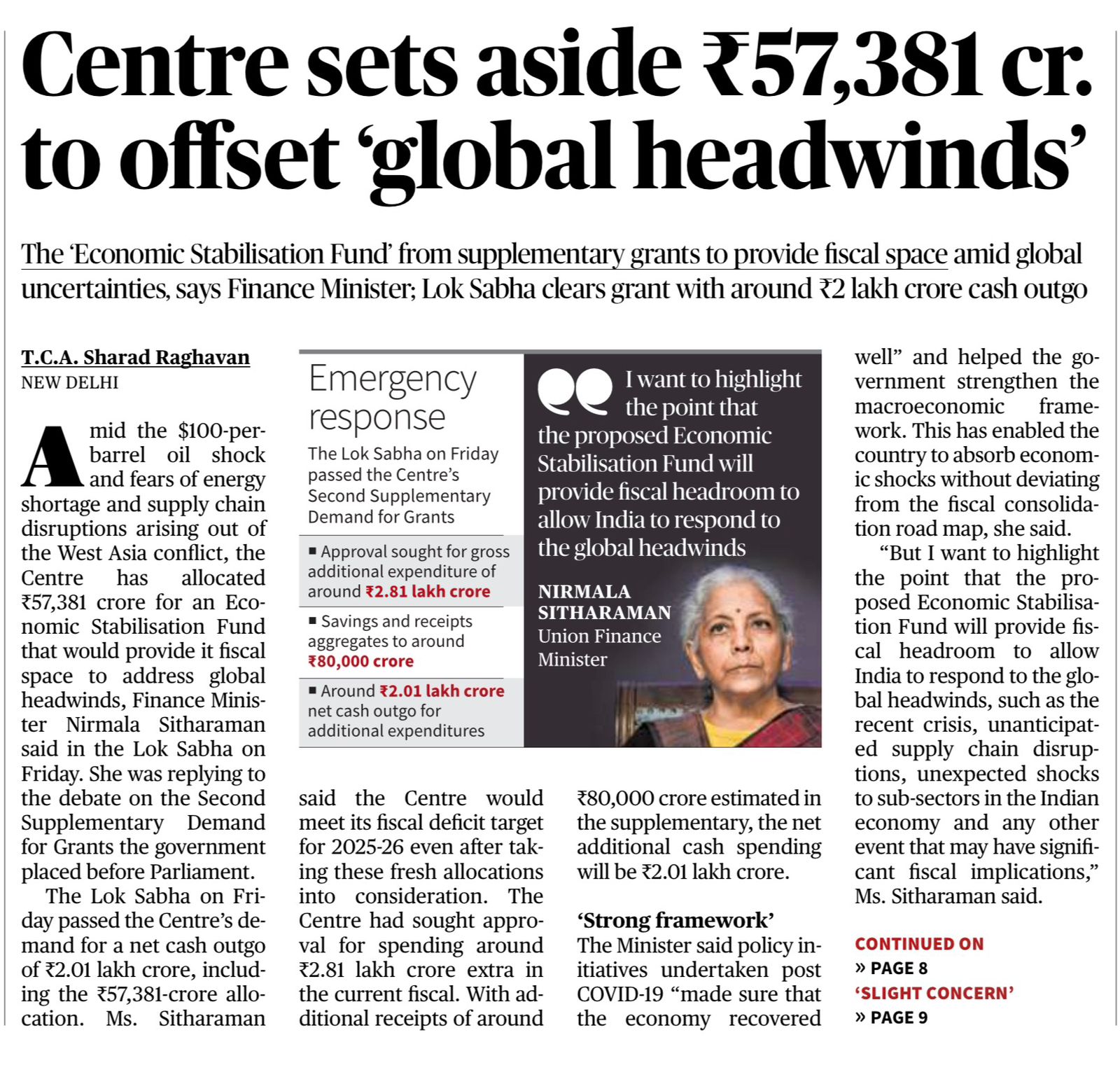
Amid rising crude prices and West Asia-linked disruptions, the Centre created an Economic Stabilisation Fund (₹57,381 crore) through the Second Supplementary Demand for Grants to maintain fiscal flexibility against external shocks.
Constitutional Angle
Article 115 — Types of Grants (with examples)
Supplementary Grant
- Extra funds for an existing service when allocation falls short.
Example:
Fertiliser subsidy rises from ₹10,000 crore to ₹13,000 crore due to price surge.
Additional Grant
- Funds for a completely new service not included in the Budget.
Example:
New emergency evacuation mission abroad not earlier planned.
Excess Grant
- Post-facto approval when spending exceeds sanctioned amount.
Example:
Defence overspends ₹5,000 crore beyond approved outlay.
Why this case
Treated as a Supplementary Grant since spending expands existing fiscal heads
(energy, stabilisation, macro-management), not a wholly new service.
Key Points
- Gross additional spending sought: ~₹2.81 lakh crore
- Savings/receipts: ~₹80,000 crore
- Net outgo: ~₹2.01 lakh crore
Purpose of the fund:
- Cushion energy volatility
- Manage supply-chain stress
- Address sectoral shocks
Government maintains alignment with FY 2025–26 fiscal deficit target.