Context: UPI MDR service charge debate
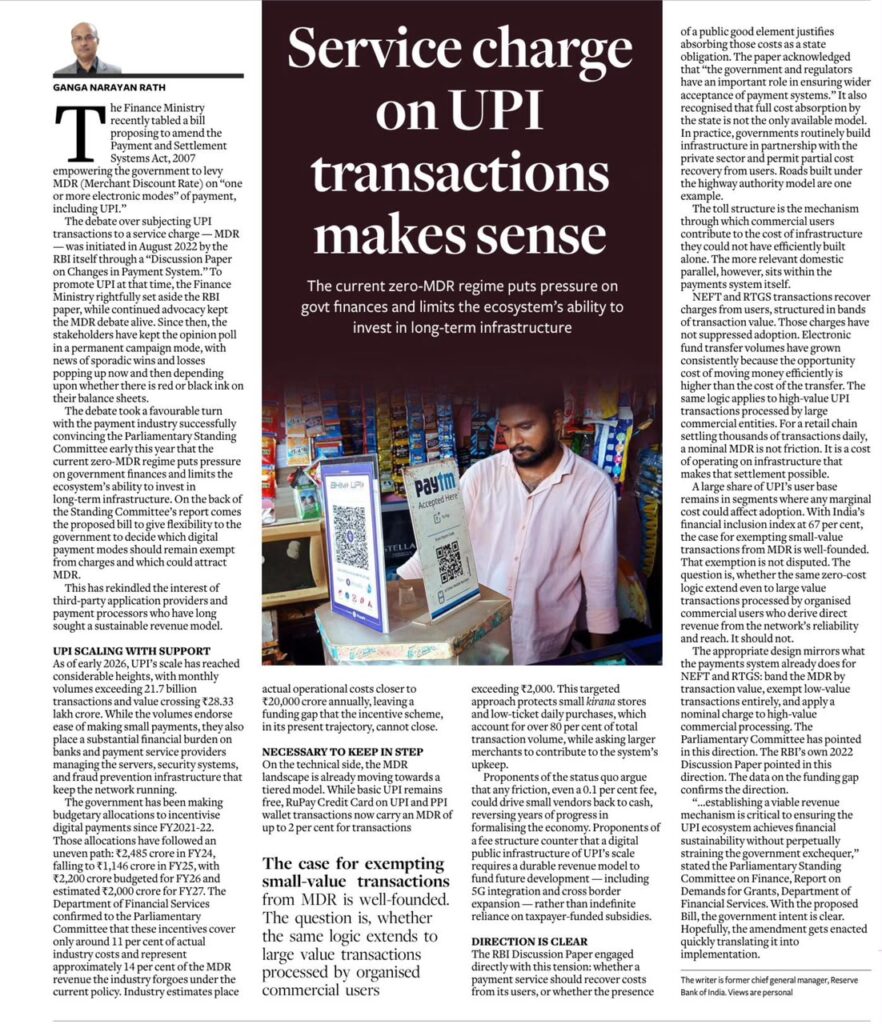
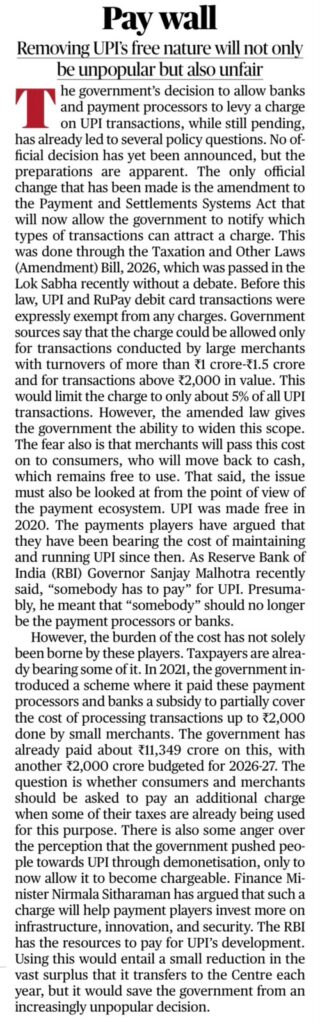
A proposed amendment to the Payment and Settlement Systems Act, 2007 seeks to empower the government to notify electronic payment transactions that may attract charges.
This has revived debate over whether the current zero-Merchant Discount Rate regime on UPI is financially sustainable for banks and payment processors.
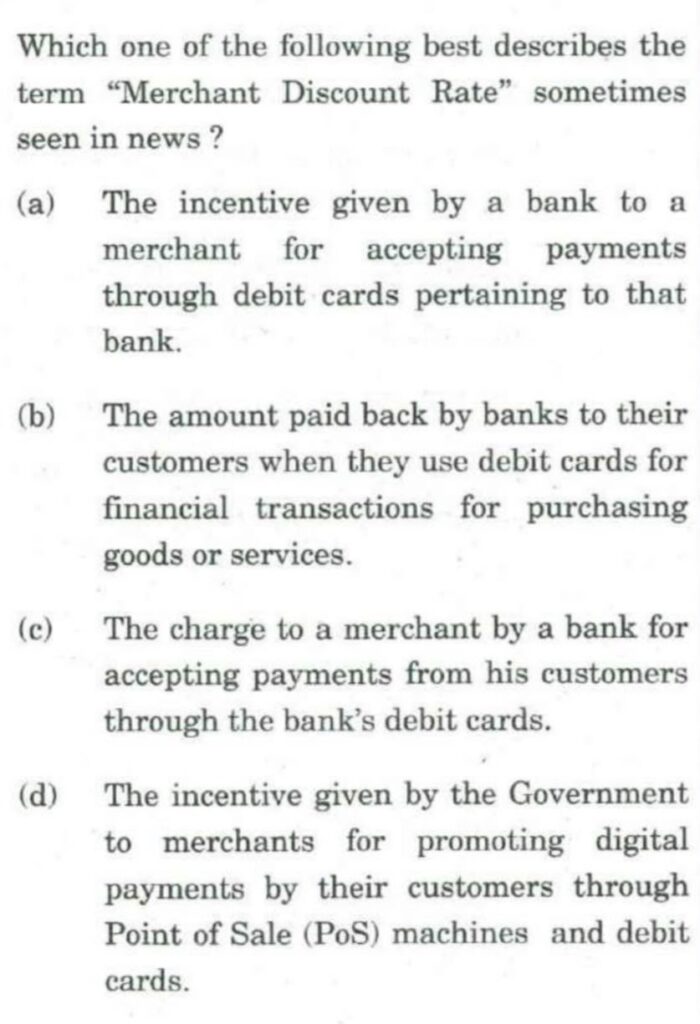
Merchant Discount Rate
Merchant Discount Rate, or MDR, is the fee paid by a merchant to banks or payment processors for processing digital payments.
It is a cost linked to digital payment infrastructure.
Unified Payments Interface
UPI is a real-time bank-to-bank digital payment system.
It has become one of India’s most successful digital public infrastructure platforms.
Current Regime
At present, UPI transactions carry zero MDR.
This means merchants do not pay a processing charge for UPI transactions.
The cost of maintaining the ecosystem is partly supported through government incentives.
Why the Debate Has Emerged
The zero-MDR model has helped UPI adoption.
But it also puts financial pressure on banks and payment service providers.
They still have to invest in:
- Infrastructure
- Cybersecurity
- Fraud prevention
- Innovation
- System reliability
- Transaction processing capacity
The concern is that a completely free model may limit long-term investment in UPI infrastructure.
Proposal Under Consideration
A limited MDR may be considered for UPI transactions above ₹2,000 made by large merchants.
The charge may potentially remain below 0.5%.
Small merchants and consumers are expected to remain exempt.
This is still under consideration and is not yet a final notified policy.
Positive Aspects
Sustainability
A limited service charge can create revenue for maintaining and expanding UPI infrastructure.
Investment
It can support investment in cybersecurity, innovation and technological upgrades.
Lower Fiscal Burden
It can reduce dependence on government incentives.
Fair Cost-Sharing
Large commercial users who heavily use UPI infrastructure may contribute to its cost.
Negative Aspects
Cost Pass-Through
Large merchants may indirectly pass the MDR cost to consumers.
Cash Revival
If digital payments become costly, some users may return to cash.
Digital Inclusion Concerns
If charges are expanded too widely, small merchants and low-value users may be discouraged.
Public-Good Concern
UPI’s success is based on simplicity, affordability and frictionless use.
Any charge must not weaken mass adoption.
Core Argument
The issue is not simply MDR vs zero MDR.
The real question is how to make UPI financially sustainable without damaging its affordability and mass adoption.
The best approach may be to keep small-value transactions and small merchants free, while allowing a limited MDR on high-value transactions of large merchants.
Key Takeaway
UPI needs a sustainable funding model, but charges must be carefully designed. Small users should remain protected while large commercial users may share infrastructure costs.