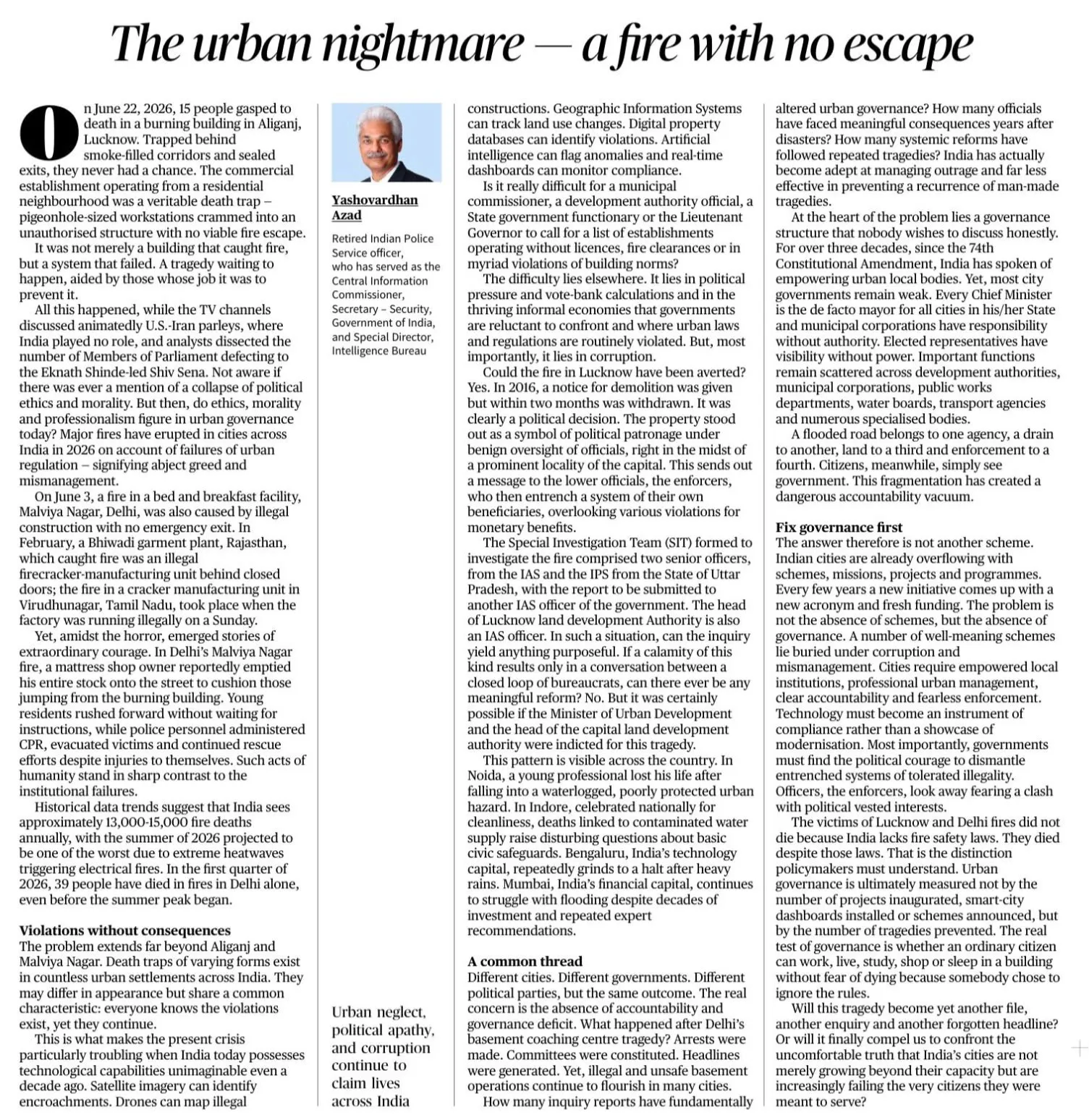
Context: Urban fire governance failures
After a series of fatal urban fire incidents, the article argues that India’s real problem is not the absence of fire safety laws.
The deeper issue is systemic failure in urban governance, including illegal construction, weak enforcement, fragmented responsibilities, political interference and poor accountability.
Core Issue
Urban fires are often preventable.
However, they become deadly because of unsafe buildings, illegal land use and weak enforcement.
The problem is not just technical. It is institutional and governance-related.
Why Such Urban Disasters Recur
1. Illegal Urban Development
Many buildings are used for purposes for which they were not approved.
Examples include commercial activity inside residential buildings or unsafe industrial activity in dense localities.
Violations often include:
- Blocked exits
- Narrow staircases
- Unsafe electrical wiring
- Poor ventilation
- No fire escape routes
- Illegal construction
2. Weak Enforcement
Even when fire and building laws exist, inspection and compliance are weak.
Political interference, corruption and administrative apathy often allow violations to continue.
3. Fragmented Urban Governance
Multiple agencies manage different parts of urban governance.
These include municipal bodies, development authorities, utility agencies, fire departments and local administration.
Overlapping responsibilities create confusion and reduce accountability.
Governance Challenges
Urban Local Bodies often lack adequate funds, functions and functionaries.
Inquiry committees are formed after disasters, but their recommendations rarely lead to deep structural reform.
There is more focus on post-disaster relief than prevention.
Role of Technology
Technology can help detect violations early.
Possible tools include:
- GIS mapping
- Digital property records
- AI-based compliance monitoring
- Real-time dashboards
- Building safety audits
But technology is useful only when political and administrative accountability exists.
Way Forward
Urban Local Bodies must be empowered with adequate finances and authority.
Regular audits and inspections must be made mandatory.
Responsibility of each agency should be clearly defined.
Officials must be held accountable for preventable violations.
Citizen participation and transparency should be strengthened.
Governance must shift from reaction after tragedy to prevention before disaster.
Key Takeaway
Urban fire disasters are not only accidents. They are governance failures. Indian cities need stronger enforcement, empowered local bodies and a prevention-first urban safety culture.