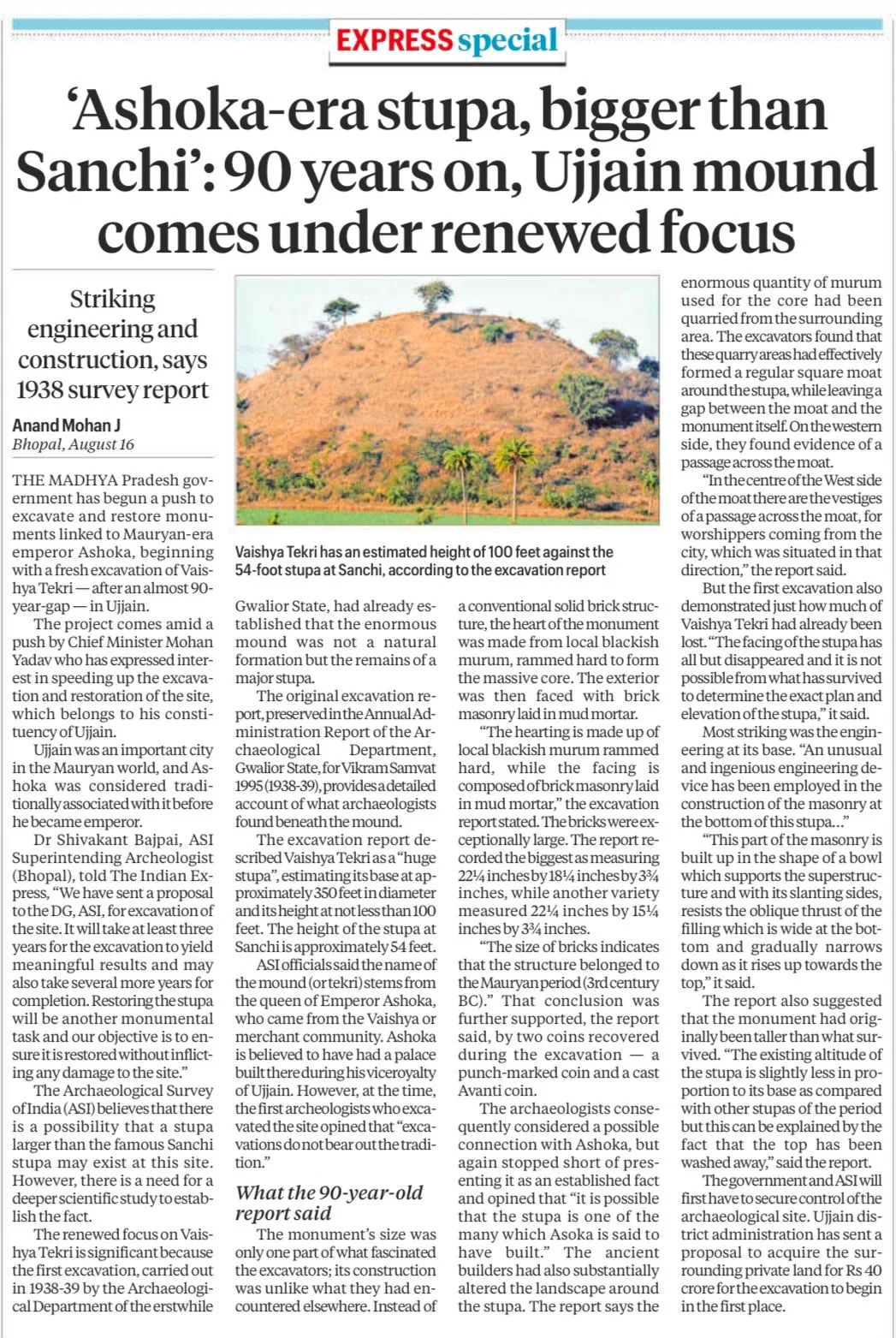
Context: Vaishya Tekri stupa Ujjain
The Madhya Pradesh government and the Archaeological Survey of India are reviving excavation at Vaishya Tekri in Ujjain, where a 1938–39 excavation identified a massive Mauryan-period stupa that may have been larger than Sanchi.
1. Vaishya Tekri: What the 1938–39 Excavation Revealed
Location:
Vaishya Tekri is located in Ujjain, Madhya Pradesh.
Ujjain was an important city in the Mauryan period and is traditionally associated with Ashoka’s early career.
Scale:
The old report estimated the stupa at around 350 ft diameter and at least 100 ft high.
This is compared with the approximately 54-ft height of Sanchi’s Great Stupa.
Dating:
Large bricks and two recovered coins supported its attribution to the Mauryan period, around the 3rd century BCE.
The coins included:
- A punch-marked coin
- A cast Avanti coin
Engineering:
The stupa’s core used rammed blackish murum.
It was faced with brick masonry.
A bowl-shaped foundation helped resist the outward thrust of the massive superstructure.
Landscape planning:
Excavation revealed a square moat created from quarrying material for the stupa.
There was also evidence of a western passage for worshippers coming from the city.
2. Why the Site Matters
Mauryan architecture:
The site provides evidence of large-scale construction techniques and engineering during the 3rd century BCE.
Buddhist heritage:
It adds to the understanding of the spread of Buddhist architecture and patronage in central India.
Archaeological value:
The mound has survived despite the loss of much of its original brick facing.
This makes systematic excavation important.
Heritage conservation:
The renewed excavation is expected to take at least three years to yield meaningful results, followed by restoration.
Surrounding private land also needs to be acquired.
The district administration has proposed ₹40 crore for this purpose.
Prelims Link
Which of the following statements on the Amaravati Stupa and its relief sculpture is/are correct?
- It was located in the lower Krishna valley.
- In India, it was next only to the Sanchi Stupa in size.
- The Amaravati school of sculpture made a lasting impact on later South Indian sculpture, and its products were carried to Sri Lanka and South-east Asia.
Options:
(a) 1 only
(b) 1 and 3 only
(c) 2 and 3 only
(d) 1, 2 and 3