Context: WPI inflation July 2026
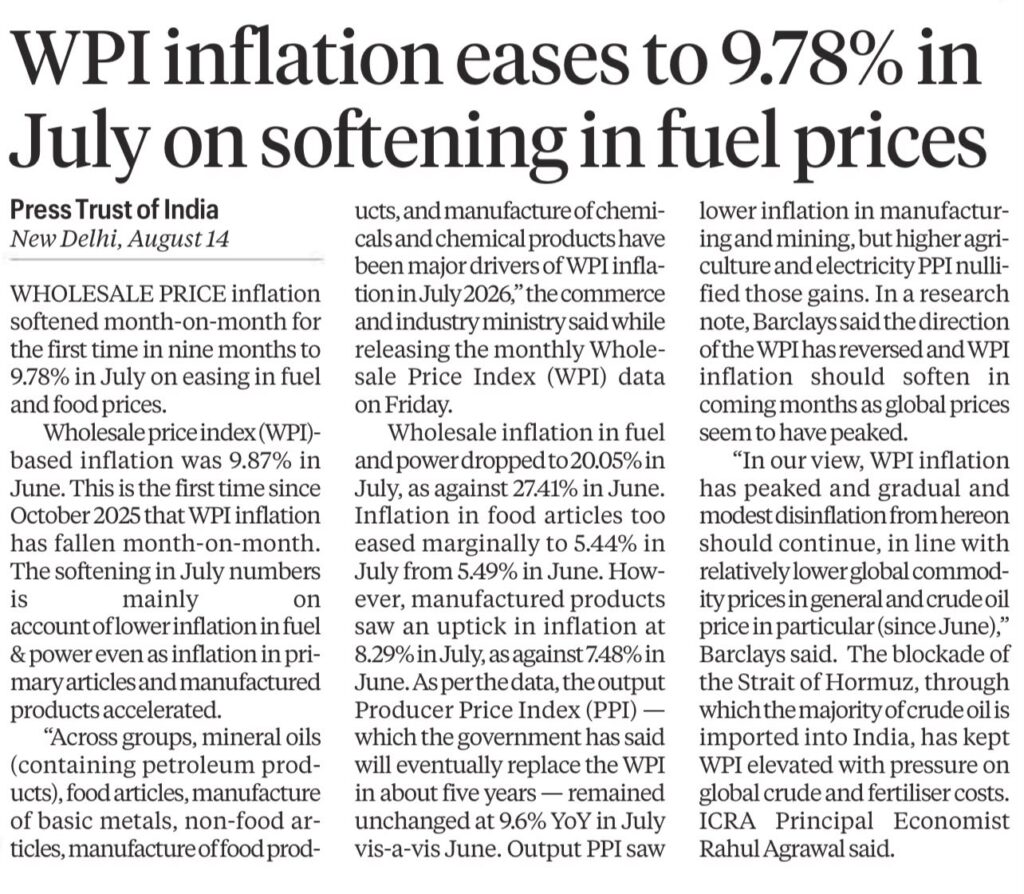
India’s Wholesale Price Index-based inflation moderated marginally from 9.87% in June to 9.78% in July 2026. The easing was mainly due to slower inflation in Fuel & Power, although price pressure remained elevated in manufactured products.
What drove July inflation?
Fuel & Power
Inflation in Fuel & Power fell sharply from 27.41% to 20.05%.
This does not mean fuel prices became cheaper.
It means fuel prices increased more slowly than they had a year earlier.
This is known as disinflation.
Food Articles
Inflation in food articles eased slightly from 5.49% to 5.44%.
This shows some moderation in food-related wholesale price pressure.
Manufactured Products
Inflation in manufactured products increased from 7.48% to 8.29%.
This indicates continued price pressure in the production and manufacturing sector.
WPI: Basic Understanding
Wholesale Price Index
The Wholesale Price Index, or WPI, measures changes in prices of goods at the wholesale level before they reach consumers.
It is different from CPI, which measures retail-level prices paid by households.
Major Groups in WPI
WPI mainly includes:
- Primary Articles
- Fuel & Power
- Manufactured Products
Compiling Authority
WPI is compiled by the Office of the Economic Adviser, under the Department for Promotion of Industry and Internal Trade, Ministry of Commerce and Industry.
Base Year
The new WPI series uses 2022–23 as the base year.
It replaces the earlier 2011–12 base year.
New WPI–PPI System
India has introduced Producer Price Indices, or PPI, alongside the revised WPI series.
Output Producer Price Index
The Output PPI measures the prices producers receive for their output.
Input Producer Price Index
The Input PPI tracks the prices producers pay for inputs.
It is currently a trial index.
Service PPI
The Service PPI measures producer prices in selected services.
Transition Period
The Government will continue publishing WPI alongside PPI for five years.
This will allow users to gradually shift towards the PPI system.
Why move towards PPI?
WPI captures wholesale price movements.
PPI gives a more direct picture of the prices received by producers.
It also helps track how input costs are transmitted into output prices.
Key Takeaway
The fall in WPI inflation reflects slower fuel-price inflation, but rising manufactured-product inflation shows that production-side cost pressures remain important. The move towards PPI will make India’s price-measurement system more producer-focused and globally aligned.