🚨 ONLY 2 DAYS LEFT! | FREE UPSC OFFLINE MEETUP 2028/29 REGISTER NOW →

19 Dec 2025 | Daily Current Affairs

Indians in Russian Armed Forces: Official Data Explained

Context
Amid the Russia–Ukraine war, cases of Indian nationals being fraudulently or coercively recruited into the Russian armed forces were raised in the Rajya Sabha, following which the Ministry of External Affairs placed official details on record.

Content
• Since 2022, 202 Indians were recruited into the Russian armed forces.
• 119 were discharged early after Indian diplomatic intervention.
• 26 Indians have reportedly died, and 7 remain missing.
• Efforts continue for early discharge of the remaining individuals.
• At least two deceased Indians were cremated in Russia, as per the Ministry of External Affairs.
• Recruitment was linked to illegal or forced employment during the war.

Indians in Russian armed forces

India Russia Logistics Agreement: Arctic & Indo-Pacific Focus

Context
India and Russia have concluded a Reciprocal Exchange of Logistics Support (RELOS) agreement after President Vladimir Putin’s visit to India. The pact formalises military logistics cooperation and aligns with India’s Arctic interests and Indo-Pacific strategy, while sustaining the India–Russia defence partnership.

What RELOS Provides
• Mutual logistics support for armed forces.
• Access to ports, airfields, refuelling, repairs, maintenance and supplies.
• Applicable during exercises, training, humanitarian assistance and disaster relief, and other agreed situations.

Strategic Significance

  1. Extends India’s operational military reach beyond its immediate region.
  2. Facilitates India’s Arctic engagement amid emerging routes and resources.
  3. Supports India’s Indo-Pacific operations using Russian infrastructure.
  4. Enables reciprocal access for Russian forces to Indian facilities.
  5. Institutionalises India–Russia defence cooperation in a rules-based manner.
India Russia logistics agreement

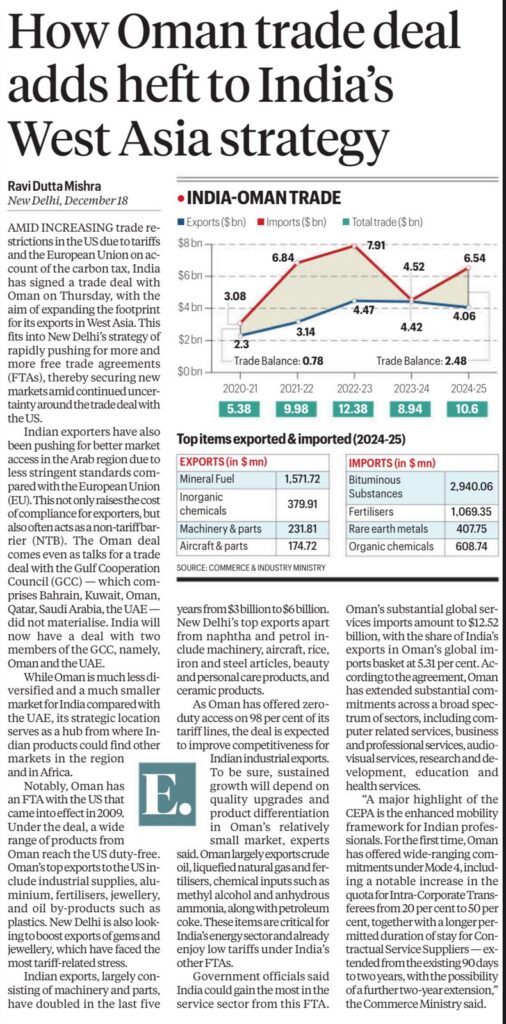
India Oman West Asia Strategy: Strategic Impact of Trade Deal

India–Oman CEPA: Strategic Importance and Limitations

I. Strategic Importance

  1. Diversifies India’s export markets amid rising protectionism in the US and Europe.
  2. Strengthens India’s economic engagement with West Asia through bilateral trade diplomacy.
  3. Builds on the India–UAE CEPA, signalling sustained Gulf outreach.
  4. Leverages Oman’s role as a gateway to West Asia and Africa.
  5. Enhances competitiveness of Indian exports through predictable market access.
  6. Advances India’s services-led trade strategy.
  7. Improves mobility of Indian professionals, aligning with India’s labour advantage.
  8. Expands India–Oman ties beyond hydrocarbons to a comprehensive economic partnership.

II. Limitations

  1. Oman’s small and less diversified economy limits the scale of gains.
  2. Trade benefits are not automatic and depend on quality upgradation and competitiveness.
  3. Export gains may remain sector-specific rather than economy-wide.
  4. Absence of an India–GCC FTA restricts broader regional spillover.
  5. Strategic impact is likely to be gradual rather than immediate.
India Oman West Asia strategy

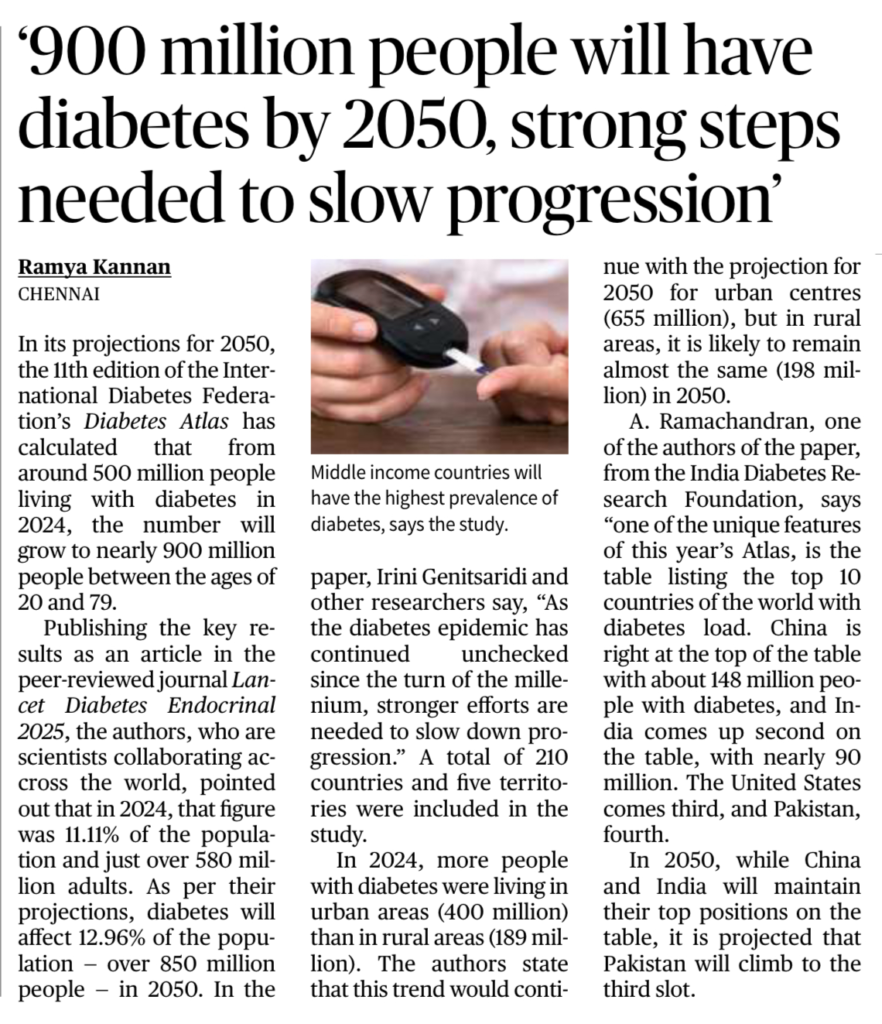
Global Diabetes Burden: 900 Million by 2050

Context
The rising burden of diabetes as a non-communicable disease has prompted global health agencies to project future trends, warning that without strong preventive action, diabetes will pose a major public health challenge by mid-century, particularly for middle-income and urbanising countries.

Important Data

Global diabetics (2024):
• About 500 million people.

Projected by 2050:
• About 900 million people in the age group of 20–79 years.

Share of population:
• 2024: 11.11%.
• 2050: 12.96%, equivalent to over 850 million people.

Urban–Rural distribution (2024):
• Urban: about 400 million.
• Rural: about 189 million.

Urban–Rural projection (2050):
• Urban: about 655 million.
• Rural: about 198 million.

Countries with highest diabetes burden:
• China: about 148 million, the highest.
• India: about 90 million, the second highest.
• United States: third.
• Pakistan: fourth.

2050 outlook:
• China and India remain the top two.
• Pakistan is projected to move to third place.

Source
• 11th International Diabetes Federation Diabetes Atlas.
• Published in The Lancet Diabetes and Endocrinology.
• Coverage includes 210 countries and five territories.

global diabetes burden

India Oman Trade Pact: Duty-Free Exports & Strategic Gains

Context
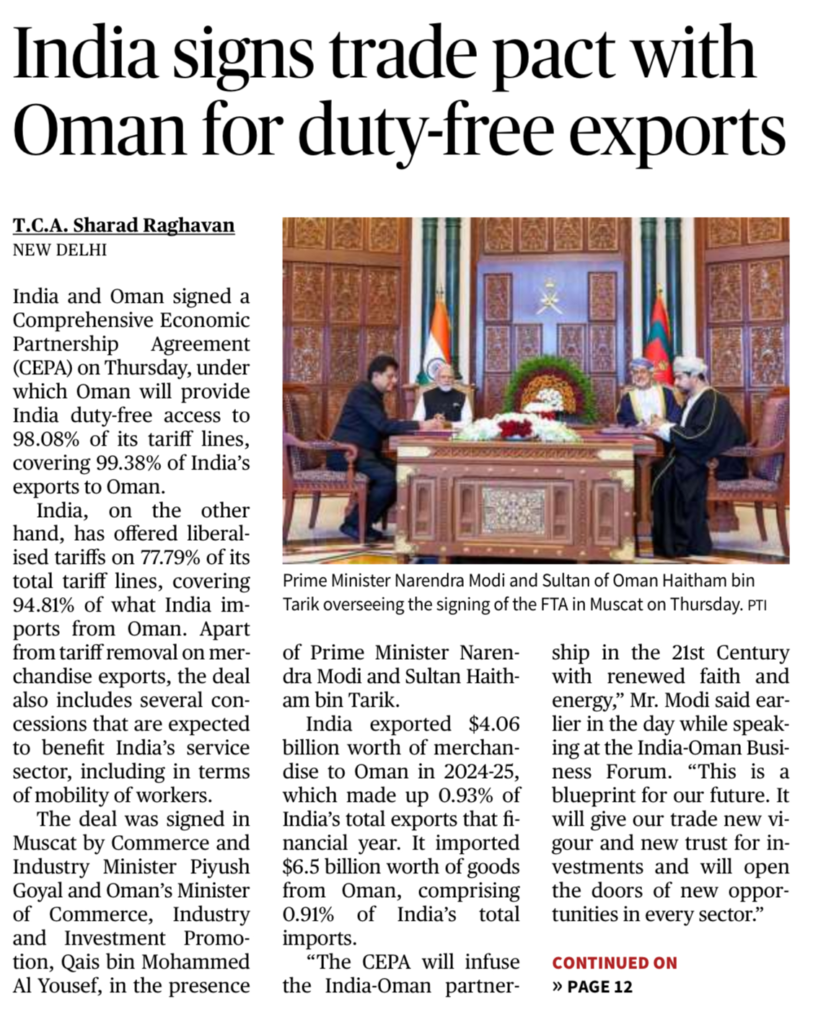
India and Oman have signed a Comprehensive Economic Partnership Agreement (CEPA) in Muscat. The agreement is part of India’s strategy to deepen economic engagement with the Gulf region, building on the India–UAE CEPA (2022), and aims to expand trade, services, investment and labour mobility.

What is CEPA?
• CEPA is a deep trade agreement, broader than a normal Free Trade Agreement.
• It covers trade, services, investment and mobility.

Market Access and Tariff Provisions

Oman’s commitment to India:
• Duty-free access on 98.08% of tariff lines.
• Covers 99.38% of India’s exports to Oman.

India’s commitment to Oman:
• Liberalised tariffs on 77.79% of tariff lines.
• Covers 94.81% of India’s imports from Oman.

Services and Mobility
• Beyond goods trade, CEPA includes concessions in services.

Expected benefits:
• Improved mobility of Indian professionals and workers.
• Boost to India’s services sector, a key strength of the Indian economy.

Trade Data (2024–25)

India’s exports to Oman:
• USD 4.06 billion.
• About 0.93% of India’s total exports.

India’s imports from Oman:
• USD 6.5 billion.
• About 0.91% of India’s total imports.

India Oman trade pact

Copyright © 2026 USARAMBHA EDUCATION (UnderStand UPSC). All Rights Reserved.

Offline Meetup

Reserve Your Meetup Seat