🚨 ONLY 2 DAYS LEFT! | FREE UPSC OFFLINE MEETUP 2028/29 REGISTER NOW →

27 Nov 2025

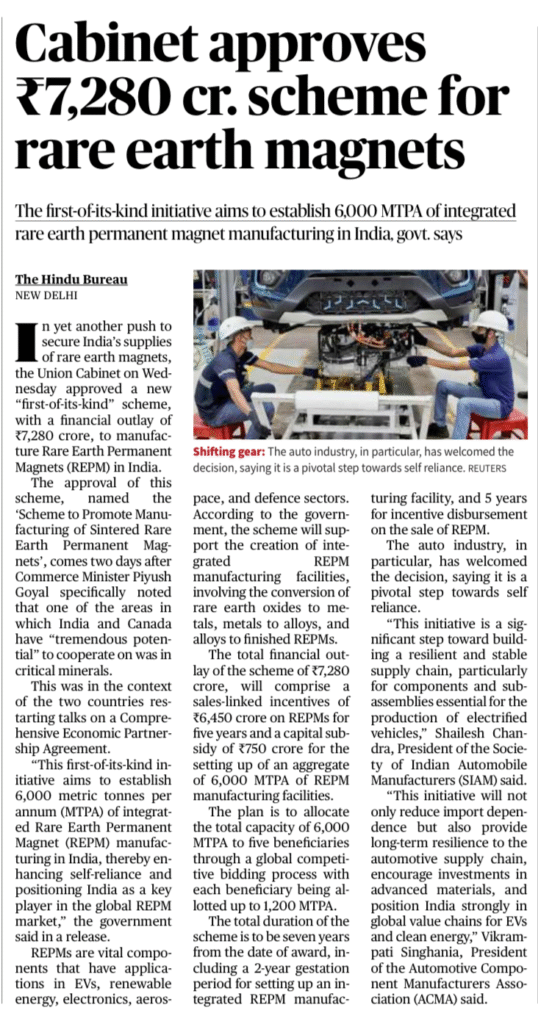
Cabinet Approves ₹7,280 Cr Scheme for Rare Earth Magnets | Government Schemes for UPSC

1. Context

Union Cabinet approved a ₹7,280 crore scheme to boost domestic manufacturing of Rare Earth Permanent Magnets (REPMs).
• Aimed at reducing dependence on imports, strengthening supply chains, and positioning India in the global REPM market.
• Comes after India–Canada discussions on cooperation in critical minerals.

2. Objectives

• Establish 6,000 MTPA of integrated REPM manufacturing capacity in India.
• Enhance self-reliance in critical components used in clean energy and high-tech sectors.
• Support EV supply chains, renewable energy systems, aerospace, defence, and electronics.
• Build a stable, resilient value chain for magnet-based components.
8 2

CJI Hints at Reviving NJAC: What It Means for Judicial Appointments | UPSC Current Affairs

Context

CJI has said the Supreme Court will consider a plea to revive NJAC and end the Collegium system. To understand this, the core constitutional background is:

Article 124 (2) – The Root

• Judges of SC are appointed by the President after consultation with CJI & other judges.
• Debate: What does consultation mean?
• Executive primacy?
• Judicial primacy?
This ambiguity gave rise to the four Judges Cases.

Consultation vs Concurrence

Consultation:
The president seeks views of the judiciary; not binding.
→ Executive has primacy.

Concurrence:
The President must agree with the judiciary’s recommendation; binding.
→ Judiciary has primacy.

The shift from “consultation → concurrence” is the story of judicial appointments in India.

FOUR JUDGES CASES

First Judges Case (1981 – S.P. Gupta)

• Consultation ≠ concurrence.
• Executive primacy in appointments.
• Collegium did not exist.

Second Judges Case (1993)

• Overruled First Case.
• Judicial primacy established.
• “Consultation” = concurrence of CJI.
• Birth of the Collegium (CJI + 2 judges).

Third Judges Case (1998 – Presidential Reference)

• Expanded Collegium to CJI + 4 senior-most judges.
• Finalised the procedure → Present Collegium.

Fourth Judges Case (2015 – NJAC Judgment)

• Struck down NJAC (99th Amendment + NJAC Act).
• Reason: Violates Basic Structure – independence of judiciary.
• Collegium revived.

TDF

0 4

Mars Crater Named After Geologist M.S. Krishnan: Key Facts for UPSC

Krishnan Crater (Mars)

1. What happened?
• A 3.5-billion-year-old crater on Mars has been named “Krishnan Crater” by the International Astronomical Union (IAU).

2. Why this name?
• Named after M.S. Krishnan
• Pioneering Indian geologist
• First Indian Director, Geological Society of India

3. What is a crater?
• A circular depression on a planetary surface.
• Usually formed by impact of a meteorite/asteroid.
• Common on Mars, Moon, Mercury.

5 3

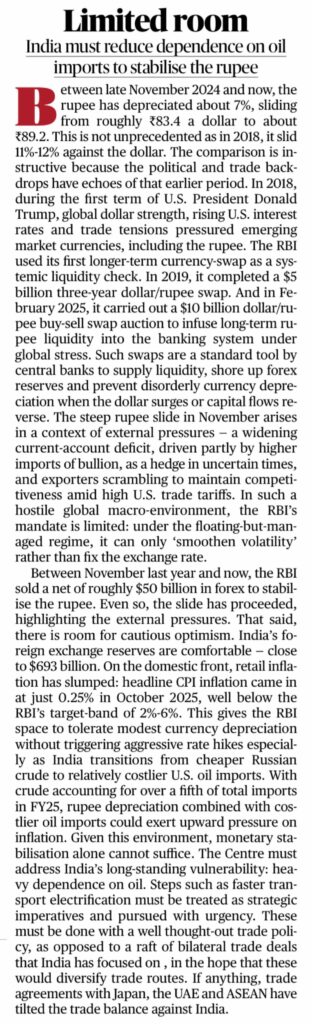
Rupee Depreciation & Oil Import Concerns Explained | Economy Editorial for UPSC

Summary

  1. Rupee Depreciation: Since Nov 2024, rupee has fallen ~7% (₹83.4 → ~₹89.2), similar to the 2018 global-stress phase.
  2. External Pressures: Strong U.S. dollar, widening CAD, higher bullion imports, and exporters facing high U.S. tariffs.
  3. RBI’s Limited Role: Under a floating-but-managed regime, RBI can only smooth volatility. It sold ~$50 bn forex, yet rupee weakness persists.
  4. Policy Tools Used Earlier: RBI has previously used large dollar/rupee swaps (2019; Feb 2025) to inject liquidity during global stress.
  5. Macro Cushion: FX reserves remain comfortable (~$693 bn) and inflation is low (0.25%), allowing tolerance of modest depreciation.
  6. Core Vulnerability: India’s heavy dependence on crude imports — now shifting from cheaper Russian oil to costlier U.S. oil — risks pushing inflation up.
  7. Needed Response: Monetary policy alone cannot stabilise the rupee. India must reduce oil dependence, accelerate transport electrification, and adopt a coherent long-term trade strategy.
  8. Trade Issues: Recent trade deals (Japan, UAE, ASEAN) have tilted India’s trade balance unfavourably.
6

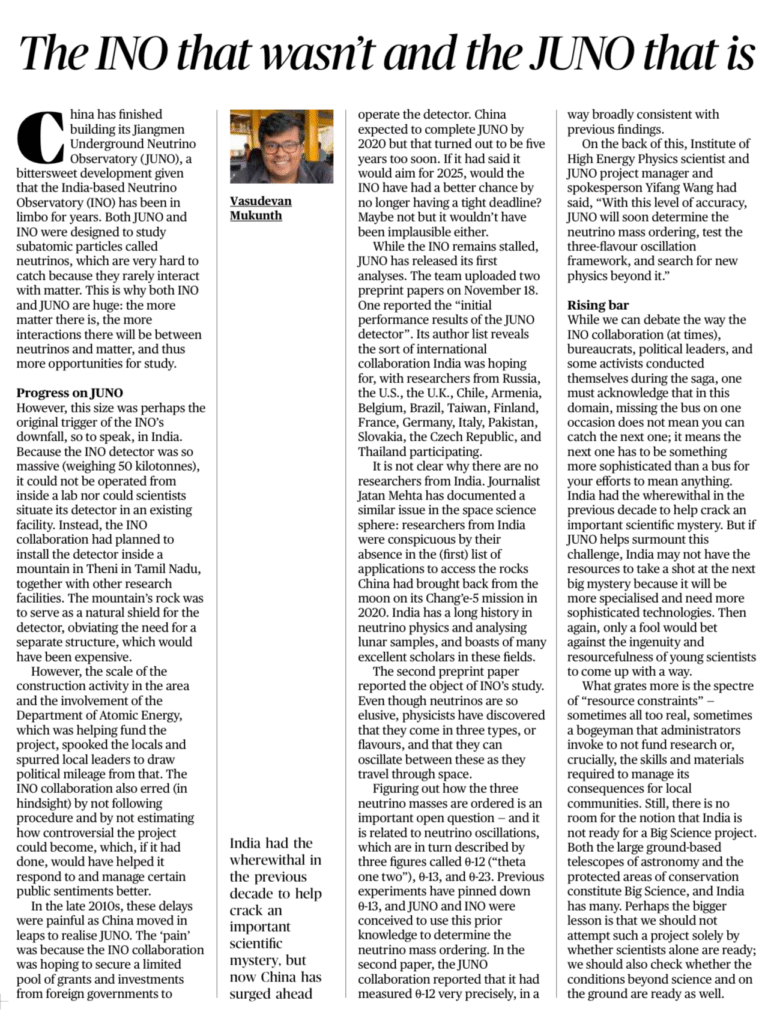
INO Project Stalled, JUNO Advances: Science & Tech Update for UPSC

Prelims — INO vs JUNO

1. Neutrino — Key Facts
• Subatomic particle with no electric charge and tiny mass.
• Interacts very weakly with matter → hard to detect.
• Produced in sun, cosmic rays, nuclear reactors, supernovae.

2. India’s Project: INO (India-based Neutrino Observatory)
• Planned underground neutrino detector in Theni district, Tamil Nadu.
• Detector type: ICAL (Iron Calorimeter), ~50 kiloton.
• Aim: study atmospheric neutrinos and determine neutrino mass ordering.
• Status: Stalled for years.
• Reasons: environmental clearance delays, local protests, political resistance, poor project communication.

3. China’s Project: JUNO (Jiangmen Underground Neutrino Observatory)
• Location: Jiangmen, China.
• Detector: 20,000-ton.
• Purpose: high-precision measurement of neutrino oscillation and mass ordering.
• Status: Completed; first scientific results released.
• Large international collaboration (US, UK, Russia, France, Germany, India, Pakistan, Taiwan, etc.).

4. Key Contrast
• JUNO finished → producing results.
• INO stuck → no construction begun.
• India lost early lead in neutrino research; China moved faster with funding and execution.

7 2

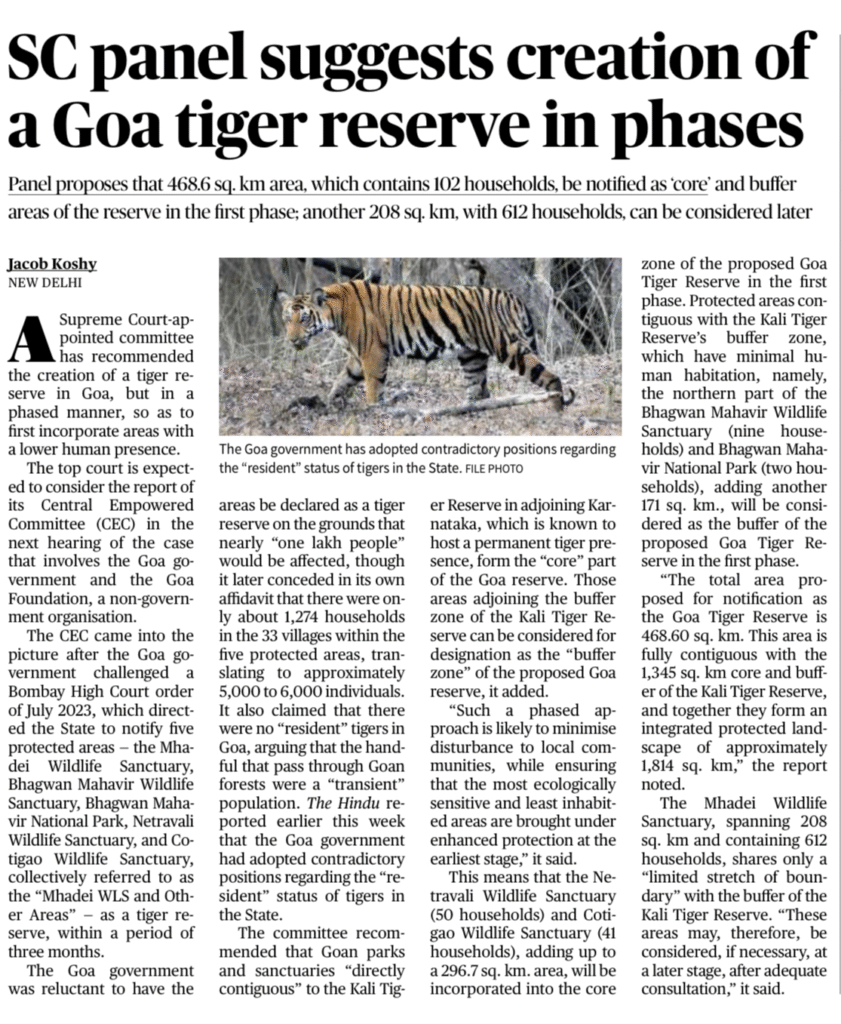
SC panel suggests creatioSC Panel Recommends Goa Tiger Reserve: Environment Update for UPSCn of a Goa Tiger Reserve in phases

Context

A Supreme Court–appointed Central Empowered Committee (CEC) has recommended creating a Goa Tiger Reserve in phases.

Phase 1: 468.6 sq. km, covering areas with minimal human habitation (102 households).
Phase 2: Additional 208 sq. km (612 households), to be added after consultation.
• The aim is to protect tiger movement corridors linking Goa’s forests with the Kali Tiger Reserve in Karnataka.
• Goa government earlier gave conflicting positions about the “resident” status of tigers in the State.

9 1

Copyright © 2026 USARAMBHA EDUCATION (UnderStand UPSC). All Rights Reserved.

Offline Meetup

Reserve Your Meetup Seat