🚨 ONLY 2 DAYS LEFT! | FREE UPSC OFFLINE MEETUP 2028/29 REGISTER NOW →

29 Dec 2025 | Daily Current Affairs

India Global Leadership | Governance and International Image | UPSC GS-2

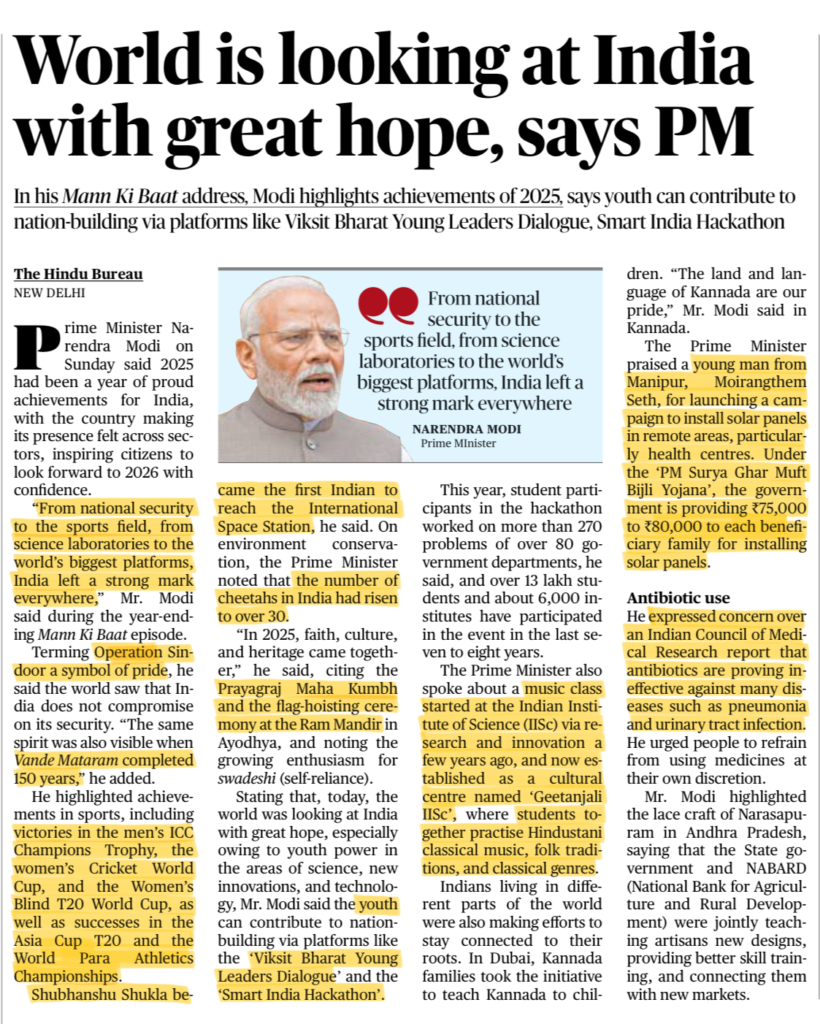
Narendra Modi (Mann Ki Baat) highlighted 2025 as a year of national achievements

Security

Science and Space

Environment

  • Cheetah population crossed 30 in India

Culture and Heritage

  • Prayagraj Maha Kumbh
  • Ram Mandir flag-hoisting at Ayodhya
  • Vande Mataram completed 150 years

Sports

  • Men’s ICC Champions Trophy
  • Women’s Cricket World Cup
  • Women’s Blind T20 World Cup
  • Asia Cup T20
  • World Para Athletics Championships

Youth and Innovation

  • Viksit Bharat Young Leaders’ Dialogue
  • Smart India Hackathon
    • 270+ problems
    • 80+ departments
    • 13 lakh+ students
    • ~6,000 institutes

Renewable Energy

Health

  • ICMR report flagged rising antibiotic resistance (pneumonia, UTIs)
  • Warning against self-medication

Education and Culture

  • ‘Geetanjali IISc’ cultural centre for classical and folk music
India global leadership

Myanmar Elections After Military Coup | Democracy Issues | UPSC GS-2

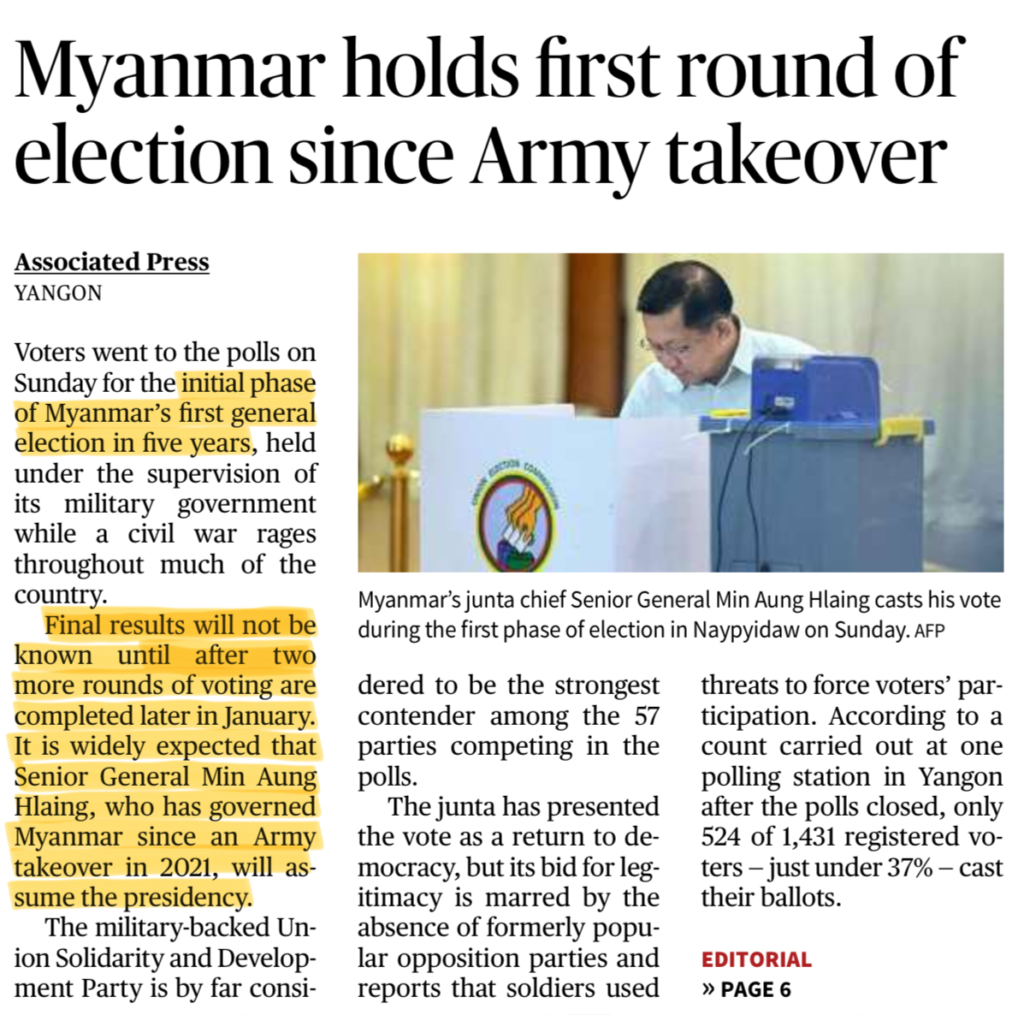
  • Myanmar conducted the first phase of elections since the 2021 military coup
  • Polls held under junta supervision amid ongoing civil conflict
  • Two more rounds pending; final results after January
  • Junta chief Min Aung Hlaing expected to become President
  • Vote projected as return to democracy, but
    • Major opposition excluded
    • Low turnout reported (≈ 37% at a Yangon booth)
Myanmar elections
Myanmar elections

India Iran Relations | Strategic Partnership and Civilisational Links | UPSC GS-2

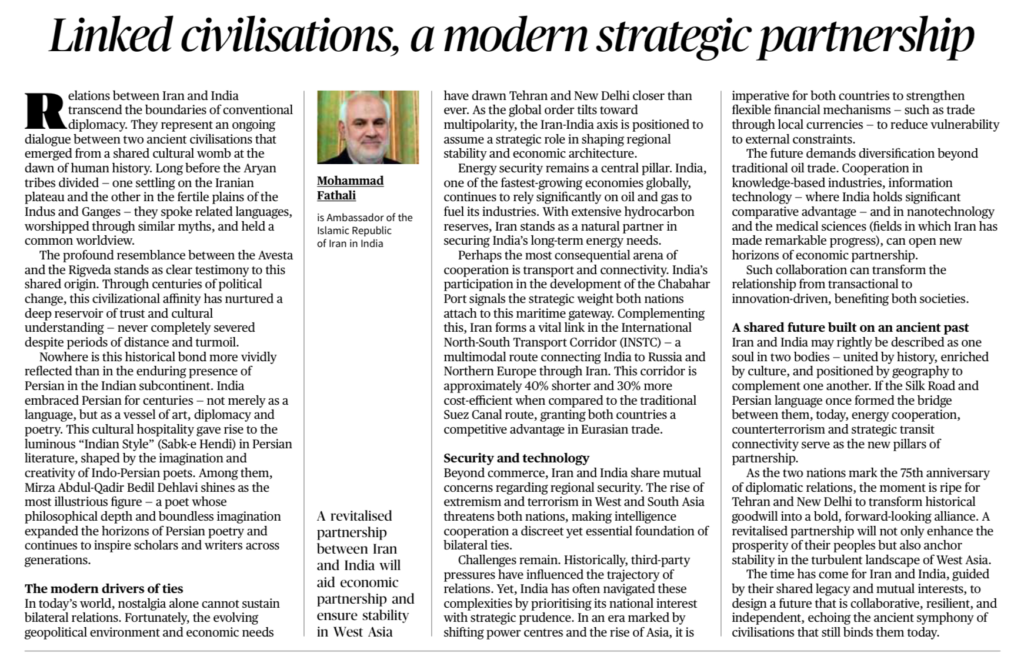
Civilisational Basis

  • India and Iran share ancient civilisational links
  • Cultural connections via language, literature, religion and trade
  • Presence of Persian culture in India reflects deep historical continuity

Strategic Relevance Today

  • India–Iran ties go beyond symbolism and are a strategic necessity
  • As global order shifts towards multipolarity, both gain from cooperation
  • Partnership contributes to regional stability in West Asia

Energy Security

  • Iran’s vast oil and gas reserves make it a natural partner
  • India’s growing economy requires diversified and secure energy sources
  • Energy remains a core pillar of the relationship

Connectivity and Trade

  • Chabahar Port – India’s gateway to Central Asia
  • International North–South Transport Corridor (INSTC)
    • Links India to Russia and Europe via Iran
    • ~40% shorter and ~30% cheaper than the Suez route
    • Enhances India’s Eurasian trade access

Security and Technology Cooperation

  • Shared concerns over terrorism and extremism
  • Need for intelligence cooperation
  • Scope for collaboration in
    • IT and knowledge industries (India’s strength)
    • Nanotechnology and medical sciences (Iran’s strength)

Challenges and Way Forward

  • Relations affected by third-party pressures and sanctions
  • Need for
    • Local-currency trade mechanisms
    • Diversification beyond oil
    • Long-term strategic autonomy
India Iran relations

Rare Earth Elements | Strategic Minerals and Global Importance | UPSC GS-3

What are Rare Earth Metals (REMs)?

  • Group of 17 elements = 15 lanthanides + scandium + yttrium
  • Not rare in the Earth’s crust, but rarely found in concentrated, separable form
  • Chemically similar, making separation and refining difficult

Why are Rare Earth Metals Important?

  • Essential for permanent magnets (EV motors, wind turbines)
  • Used in electronics, lasers, fibre optics and defence systems
  • Enable energy use, motion and efficiency (not storage)
  • Neodymium-based magnets are most critical

Rare Earth Metals vs Clean Energy Elements

  • Rare earth metals
    • Fixed group of 17 elements
    • Used mainly for magnets, motors and high-tech hardware
  • Clean energy elements
    • No fixed group (lithium, cobalt, nickel, copper, graphite, silicon)
    • Used for energy storage, generation and transmission
  • Rare earth constraint – processing and refining dominance
  • Clean energy constraint – mining location and reserve concentration
  • Rare earths enable energy use; clean energy elements store and move energy

Global Distribution of Rare Earth Metals

  • China – ~44 million tonnes
  • Vietnam – ~22 million tonnes
  • Brazil – ~21 million tonnes
  • Russia – ~10 million tonnes
  • India – ~6.9 million tonnes
  • Key insight – reserves are globally spread, but processing and refining are highly concentrated, mainly in China

Venezuela Resource Curse | Economy and Natural Resources | UPSC GS-3

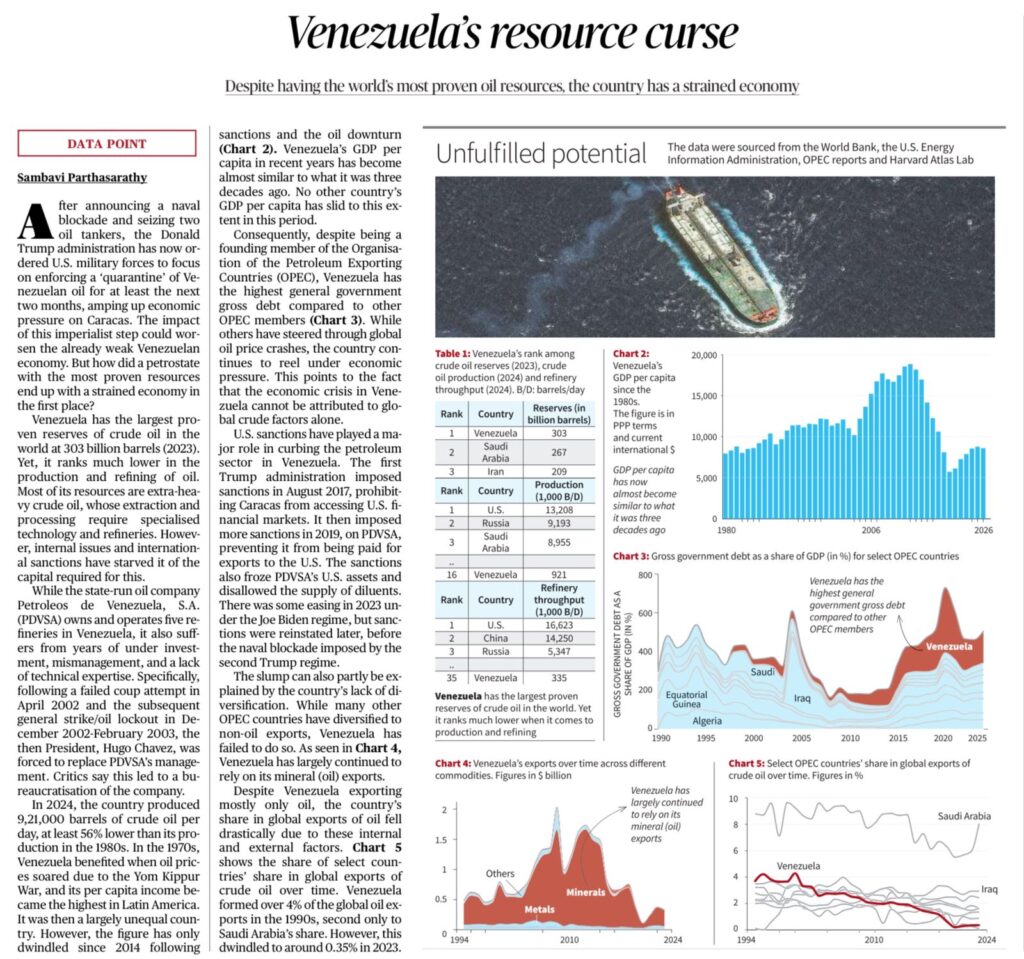
Top 3 Countries – Highest Proven Oil Reserves

  • Venezuela – ~303 billion barrels (Rank 1)
  • Saudi Arabia – ~267 billion barrels
  • Iran – ~209 billion barrels

Oil Production (Top Producers – Contrast Chart)

  • United States – ~12–13 million barrels/day (Rank 1)
  • Saudi Arabia – ~9–10 million barrels/day
  • Russia – ~9–10 million barrels/day
  • Venezuela – only ~0.9 million barrels/day (despite Rank-1 reserves)

Refining / Downstream (Top Reference from Chart)

  • Venezuela refinery throughput – ~0.33 million barrels/day
  • Shows very weak refining capacity compared to reserves

OPEC

Venezuela resource curse

Copyright © 2026 USARAMBHA EDUCATION (UnderStand UPSC). All Rights Reserved.

Offline Meetup

Reserve Your Meetup Seat