Context
In the April 2026 special session, the government introduced a legislative package to overhaul India’s electoral map.
• Two instruments:
- Constitution (131st Amendment) Bill, 2026 → to change constitutional rules
- Delimitation Bill, 2026 → to execute delimitation
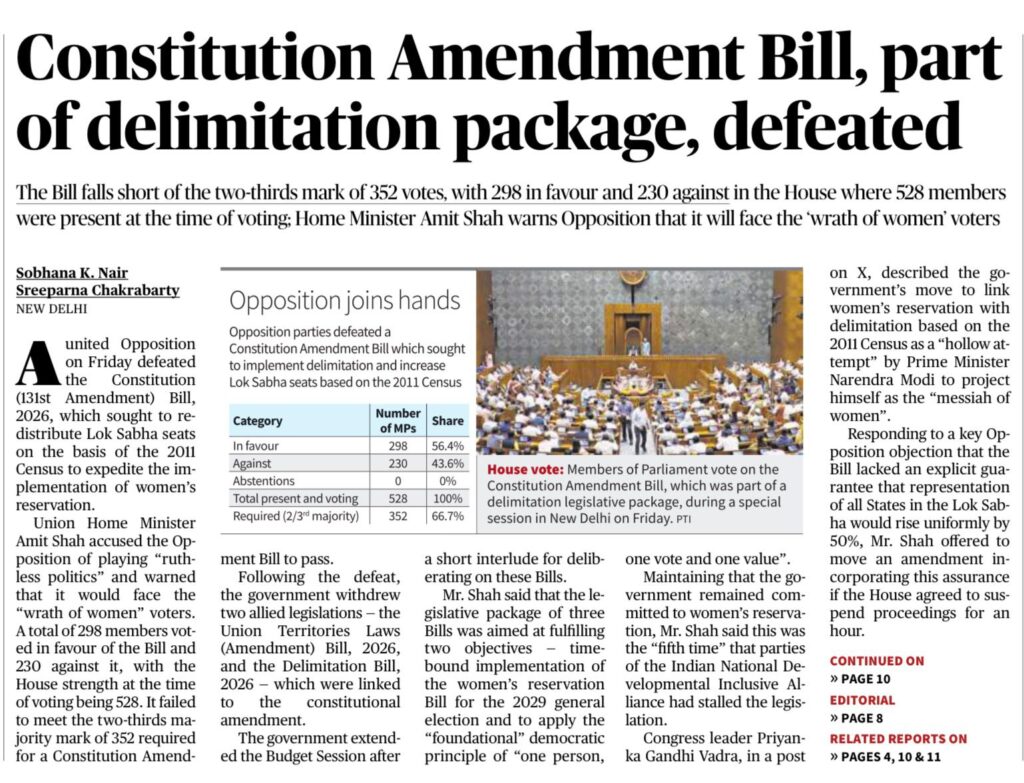
• Outcome: 131st Amendment Bill failed (no special majority) → Delimitation Bill withdrawn
• Core issue: Immediate delimitation + advancing women’s reservation vs delay/federal concerns
Constitution (131st Amendment) Bill, 2026 — Key Proposals
A. Article 81 (Lok Sabha strength)
• Increase maximum strength: 550 → 850 seats
• 815 (States) + 35 (UTs)
B. Article 82 (Delimitation trigger)
• Remove constitutional freeze (till post-2026 Census)
• Shift power: Parliament can decide which Census data to use
→ Enables use of 2011 Census
C. Article 170 (State Assemblies)
• Similar changes for State Legislative Assemblies
• Allows resizing based on updated population data
D. Article 334A (Women’s Reservation)
• De-linked reservation from future Census
• Proposal: implement immediately after 2026 delimitation
Delimitation Bill, 2026 — Operational Framework
A. Delimitation Commission
• Head: Sitting/retired Supreme Court Judge
• Members: Chief Election Commissioner + State Election Commissioners
B. Associate Members
• 10 per state (5 MPs + 5 MLAs)
• Advisory role → no voting power
C. Operational Rule
• Use 2011 Census for:
• Redrawing constituencies
• Allocating 850 seats among states
Friction Points (Govt vs Opposition)
A. Timing of Women’s Reservation
• Govt: Immediate via delimitation (de-link from Census)
• Opposition: Earlier law (2023) made it conditional → confusion + policy inconsistency
B. Census basis (2011 vs fresh Census)
• Govt: Use 2011 data for speed
• Opposition: Outdated → distorts representation
C. Federal imbalance
• Southern states fear seat loss due to population-based redistribution
• Debate: population vs performance (population control)
D. Expansion of Lok Sabha (850 seats)
• Govt: Needed for better representation
• Opposition: May alter political balance significantly
Article 368 — Why the Amendment Bill failed
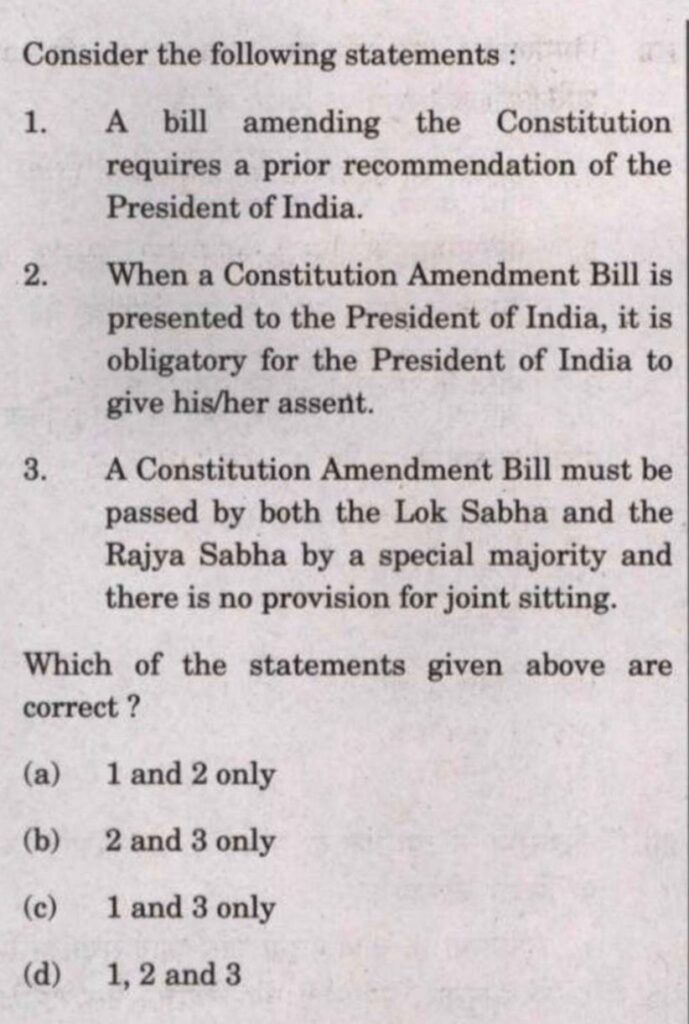
Textual requirement (Special Majority):
A Constitution Amendment Bill must be passed by:
- Majority of total membership of the House, and
- Not less than two-thirds of members present and voting
Application here:
• Required (2/3rd): 352
• Votes in favour: 298 → insufficient
→ 131st Amendment Bill failed
Result:
• Constitutional changes could not be made
• Hence, Delimitation Bill lost legal basis → withdrawn