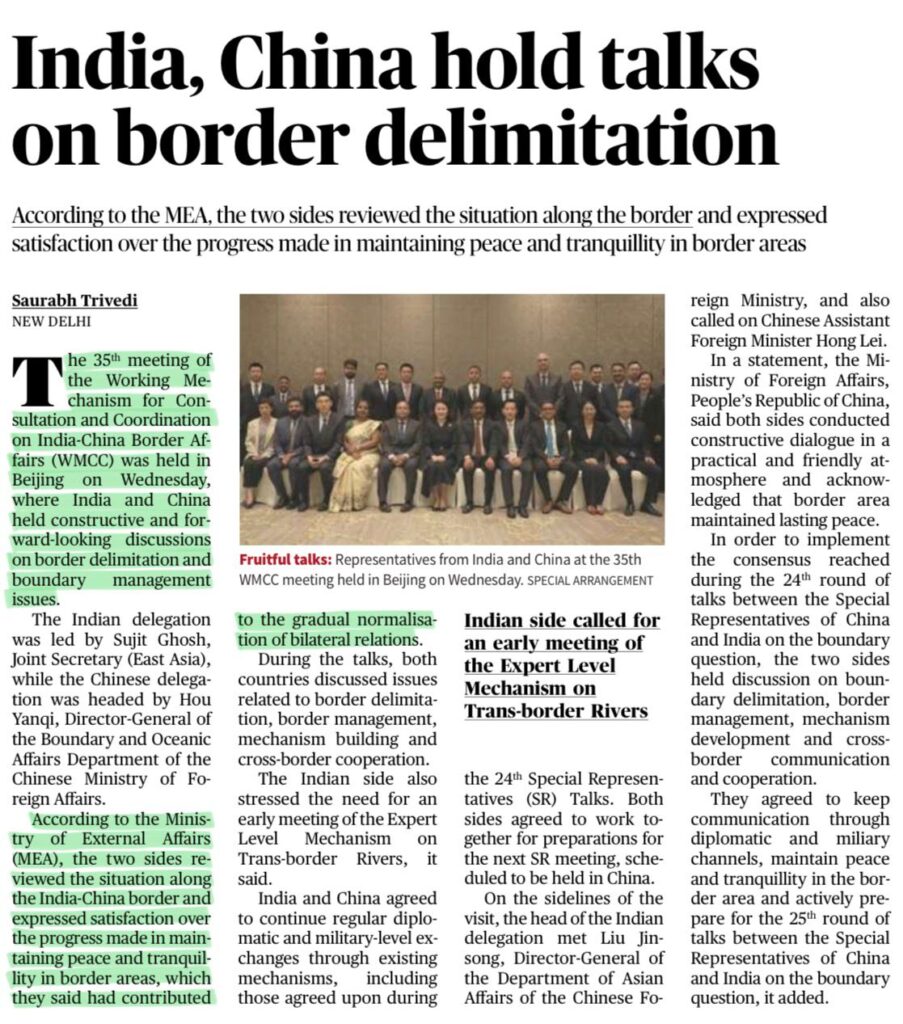
Context: India China Border Dispute
At the 35th Working Mechanism for Consultation and Coordination on India-China Border Affairs meeting in Beijing, India and China reviewed the border situation, discussed border delimitation, border management and cross-border cooperation, and agreed to maintain peace and tranquillity along the border.
Key Outcomes
- Reviewed progress in maintaining peace along border areas.
- Discussed border delimitation and boundary-management issues.
- Agreed to continue diplomatic and military-level communication.
- India called for an early meeting of the Expert Level Mechanism on Trans-Border Rivers.
- Preparations initiated for the 25th Special Representatives Talks.
India–China Boundary Dispute — Basics
- Total disputed boundary: about 3,488 km, according to Indian estimate.
- China does not formally accept this figure.
- Boundary is divided into Western, Middle and Eastern Sectors.
Boundary Sectors
Western Sector
- Ladakh–Aksai Chin
- Largest dispute
Middle Sector
- Himachal Pradesh–Uttarakhand
- Least disputed
Eastern Sector
- Arunachal Pradesh
- Claimed by China as “South Tibet”
Line of Actual Control
- De facto military boundary between India and China.
- Not a mutually agreed international boundary.
- Emerged after the 1962 India-China War.
- Differing perceptions of the LAC are the primary cause of face-offs and patrol clashes.
Important Agreements
- 1993: Agreement on Maintenance of Peace and Tranquillity along the LAC
- 1996: Confidence Building Measures Agreement
- 2005: Political Parameters and Guiding Principles Agreement
- 2013: Border Defence Cooperation Agreement
Border Management Mechanisms
Special Representatives Talks, 2003
- Political-level mechanism for boundary settlement.
Working Mechanism for Consultation and Coordination, 2012
- Diplomatic mechanism for managing border issues and communication.
Military Commander-level talks
- Used for disengagement and de-escalation.
Prelims Pointers
- Aksai Chin is controlled by China and claimed by India as part of Ladakh.
- Arunachal Pradesh is claimed by China as “South Tibet”.
- Major friction points include Depsang, Demchok, Galwan, Hot Springs and Pangong Tso.