Source: The Indian Express (Explained) | Date: 18 June | Tags: 19 June 2026, Balance of Payments (BoP), banking, Economy, External Sector, GS3
Context: NRE FCNR Deposit Rules
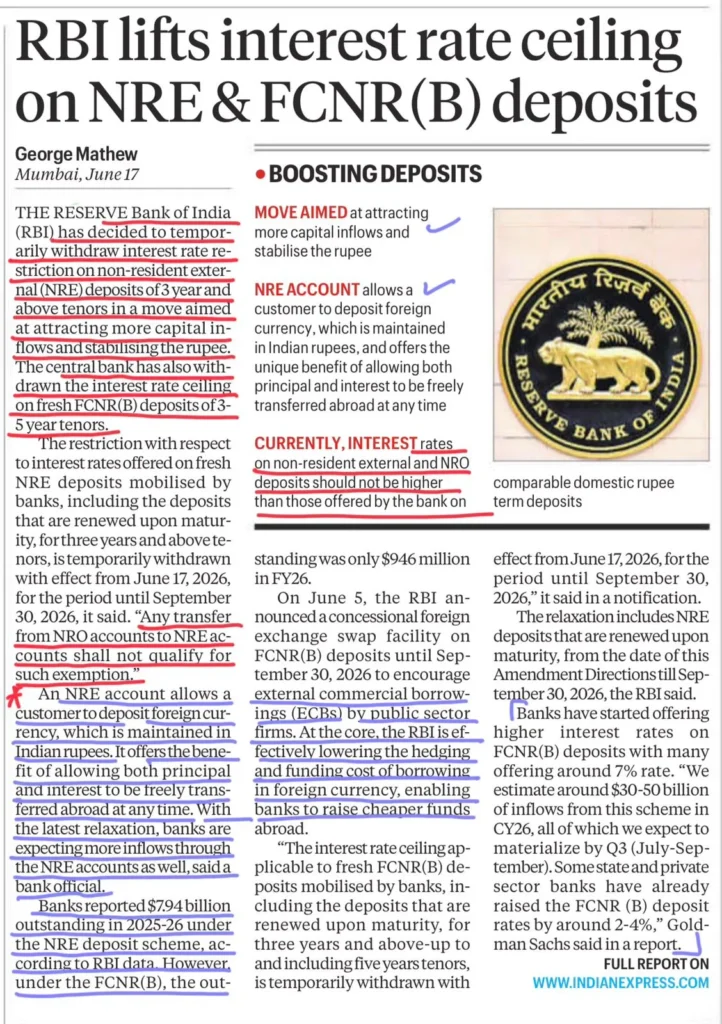
RBI has relaxed interest rate regulations on select NRI deposits to attract higher foreign currency inflows, strengthen forex reserves and improve external sector stability.
NRI Deposit Accounts
Non-Resident External Account
- Foreign currency deposited by an NRI is converted into Indian Rupees.
- Fully repatriable.
- Exchange rate risk is borne by the depositor.
Foreign Currency Non-Resident Bank Account
FCNR(B) Account
- Deposit is maintained in foreign currency itself.
- Currencies include USD, Euro, GBP, Yen and others.
- Fully repatriable.
- No exchange rate risk for depositor.
Non-Resident Ordinary Account
- Used for income earned in India.
- Examples: rent, pension, dividend.
- Maintained in Indian Rupees.
- Repatriation is subject to prescribed conditions.
Prelims Fact
- FCNR(A) was discontinued in 1993.
- Only FCNR(B) is operational.
RBI Relaxation and BoP Linkage
Earlier
NRE Deposits
- Interest rates were linked to comparable domestic term deposit rates.
FCNR(B) Deposits
- Interest rates were capped with reference to international benchmark rates such as SOFR and related benchmarks plus a prescribed spread.
Now, Till 30 September 2026
- Interest rate ceiling removed on NRE deposits of 3 years and above.
- Interest rate ceiling removed on FCNR(B) deposits of 3–5 years.
Significance
- Higher NRI deposit mobilisation.
- Greater foreign exchange inflows.
- Stronger forex reserves.
- Improved external sector stability.
- Helps manage Balance of Payments pressure.
PYQ Link
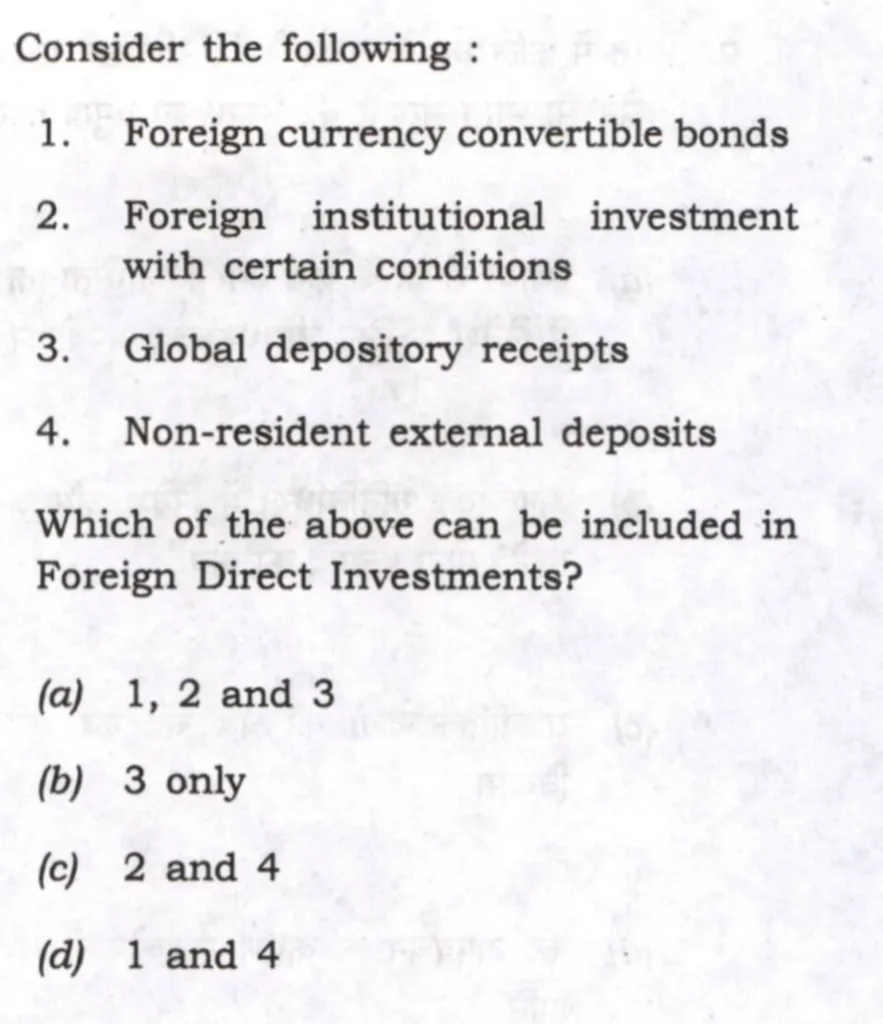
Non-Resident External deposits are not Foreign Direct Investment.