First Constitutional Amendment Act 1951 at 75 Years

Context: First Constitutional Amendment Act 1951
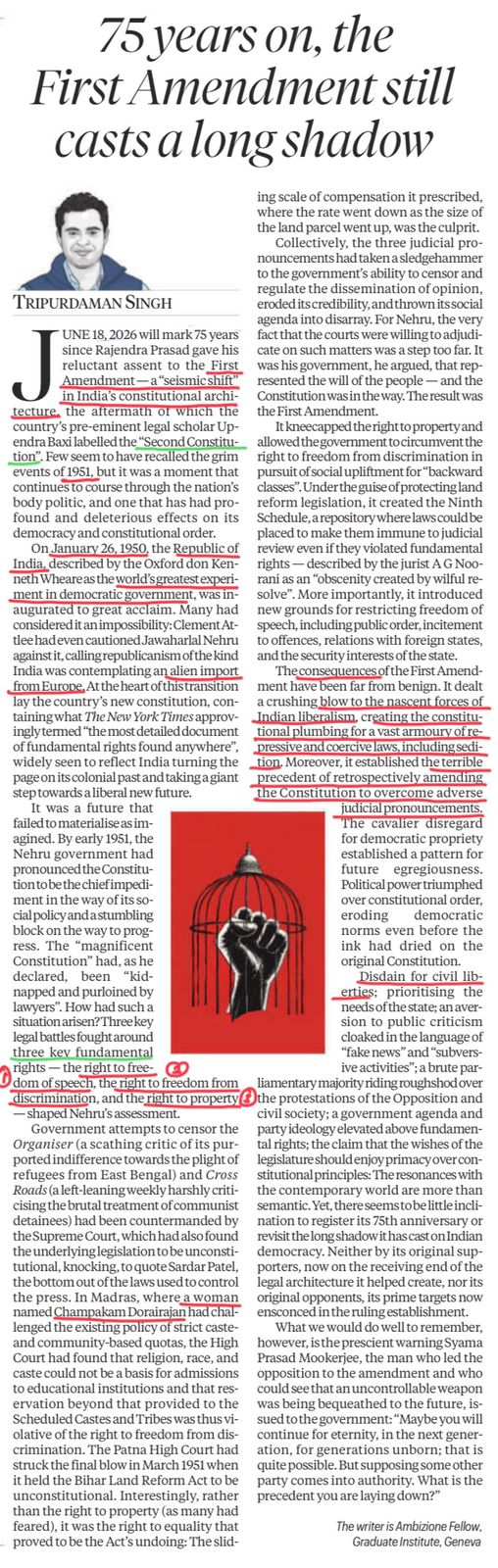
The First Constitutional Amendment Act was enacted on 18 June 1951. It was Parliament’s response to early Supreme Court judgments on free speech, reservations and land reforms.

Upendra Baxi described it as India’s “Second Constitution” because of its transformative impact.

Key Triggers and Constitutional Response

1. Freedom of Speech — Article 19(1)(a)

Cases

  • Romesh Thappar v. State of Madras, 1950
  • Brij Bhushan v. State of Delhi, 1950

Response

Article 19(2) was amended.

Grounds Added

  • Public Order
  • Friendly Relations with Foreign States
  • Incitement to an Offence

2. Reservations and Equality — Article 15

Case

  • State of Madras v. Champakam Dorairajan, 1951

Response

Article 15(4) was inserted.

Outcome

It created a constitutional basis for reservations for:

  • Socially and Educationally Backward Classes
  • Scheduled Castes
  • Scheduled Tribes

3. Land Reforms and Right to Property — Article 31

Issue

Zamindari abolition and agrarian reforms were challenged before courts.

Response

Inserted:

  • Article 31A
  • Article 31B
  • Ninth Schedule

Outcome

Land reform laws were protected from judicial challenge.

Why the First Amendment Is Still Debated

Supporters’ Argument

  • Protected land reforms and abolition of zamindari.
  • Enabled affirmative action through Article 15(4).
  • Strengthened the welfare-state vision.
  • Supported socio-economic transformation.
  • Ensured judicial interpretation did not obstruct democratic reforms.

Critics’ Argument

  • Expanded State power over civil liberties through Article 19(2).
  • Introduced the Ninth Schedule, reducing judicial scrutiny.
  • Set a precedent for constitutional amendments to overcome court rulings.
  • Raised concerns about constitutional checks and balances.

Constitutional Voices

Jawaharlal Nehru

  • Constitution should serve as an instrument of social transformation and not become an obstacle to reform.

Syama Prasad Mookerjee

  • Excessive concentration of State power may undermine democratic freedoms and individual liberty.

Upendra Baxi

  • Described the First Constitutional Amendment as India’s “Second Constitution” because it fundamentally altered the constitutional balance.

A.G. Noorani

  • Criticised the Ninth Schedule for insulating laws from constitutional scrutiny and weakening judicial review.
Subscribe
Notify of
guest
0 Comments
Oldest
Newest Most Voted

First Constitutional Amendment Act 1951 at 75 Years

About the UPSC Civil Services Examination (UPSC CSE)

The UPSC Civil Services Examination (CSE) is one of the most competitive and esteemed examinations in India, conducted by the Union Public Service Commission to recruit officers for services such as the Indian Administrative Service (IAS), Indian Police Service (IPS), Indian Foreign Service (IFS), and others. The exam comprises three stages — Prelims, Mains, and the Personality Test (Interview) — designed to test a candidate’s knowledge, aptitude, decision-making, and leadership skills.


How to Prepare Effectively for UPSC CSE

Cracking the UPSC CSE requires a deep understanding of the syllabus, consistent revision, structured answer writing, and smart test-taking strategies. The Prelims test analytical and conceptual clarity, the Mains focuses on critical thinking, articulation, and subject mastery, while the Interview assesses presence of mind, ethical judgment, and personality traits relevant to public service.

At UnderStand UPSC, we empower aspirants with a personalized and focused approach to each stage of the exam.


Why Choose UnderStand UPSC?

UnderStand UPSC is a mentorship-driven platform offering a clear, clutter-free strategy to tackle the Civil Services Examination. Our programs like Transform (for beginners and intermediate learners) and Conquer (for advanced mains preparation) provide structured study plans, syllabus-wise video content, interactive live sessions, and answer writing support.

We emphasize:

  • Concept clarity through topic-wise lectures

  • Test series designed around real UPSC standards

  • Personalized mentorship in small groups

  • Regular performance tracking and peer benchmarking

  • Doubt-clearing sessions, current affairs analysis, and monthly magazines


Join the UnderStand UPSC Learning Community

Our mission is to make UPSC preparation less overwhelming and more strategic. We combine mentorship, discipline, and academic rigor to help you clear CSE with confidence. Whether you’re preparing from Delhi, Mumbai, Bangalore, or a remote village — our online-first model ensures quality guidance reaches every corner of India.

Join the thousands of aspirants who trust UnderStand UPSC to guide their journey toward becoming civil servants.

Stay connected with us through our Telegram, YouTube, and Instagram channels for daily tips, strategies, and updates.

Copyright © 2026 USARAMBHA EDUCATION (UnderStand UPSC). All Rights Reserved.

Fill out the form

If you have any queries related to
Conquer 2026 & CAD 2026.


0
Would love your thoughts, please comment.x
()
x