
Table of Contents
If you are using AI for UPSC preparation, you are probably using it wrong. If you are not using it, you may be making an even bigger mistake.
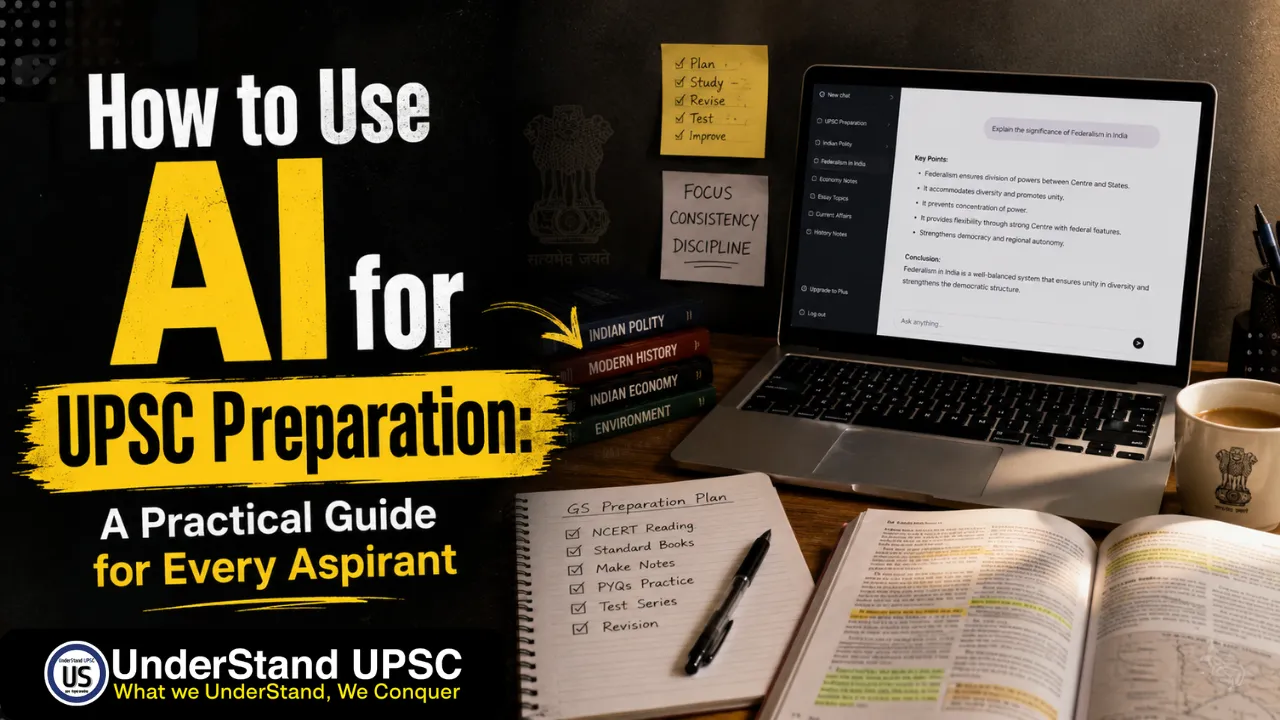
The problem is whether AI replaces your thinking or strengthens it.
Most aspirants use AI to generate “complete notes,” model answers, predicted questions, and summaries. That feels productive because output appears instantly. But UPSC tests whether you can recall, connect, eliminate, analyse, and write under pressure.
Use AI for four jobs: testing, comparison, evaluation, and compression.
1. Do Not Ask AI to Make Complete Notes
The worst prompt is: “Make complete notes on Indian Parliament.”
ChatGPT may produce six polished pages, but you have not read Laxmikanth carefully, recalled provisions, or understood parliamentary committees. You have only created another document to revise later.
Use AI after studying from a standard source.
Suppose you finish the chapter on parliamentary committees. Close the book and write what you remember about the Public Accounts Committee, Estimates Committee, and Committee on Public Undertakings. Then use this prompt:
“Create fifteen UPSC-style statements only from my recall sheet. Mix membership, chairmanship, reports examined, powers, and limitations. Do not reveal the answers until I attempt all fifteen. Quote the supporting line while explaining each answer.”
Now AI is testing preparation instead of replacing it.
2. Use AI to Separate Similar Topics
UPSC frequently tests related concepts that aspirants confuse.
After revising Spectrum, create your own comparison of the Swadeshi Movement, Non-Cooperation Movement, and Civil Disobedience Movement under six headings: trigger, leadership, social base, methods, geographical spread, and reason for withdrawal.
Fill the table from memory first. Then ask Gemini or ChatGPT:
“Check this comparison for missing distinctions. Do not rewrite the full table. Point out only factual gaps, oversimplifications, and areas treated as identical.”
Use the same method for fundamental rights versus directive principles, money bill versus finance bill, and El Niño versus La Niña.
Reading an AI-generated table creates familiarity, not mastery.
3. Use Source-Restricted AI for Reports
Reports such as the Second Administrative Reforms Commission, Economic Survey, and parliamentary committee reports contain useful material, but unguided reading wastes time.
Upload selected chapters to NotebookLM and ask:
“Using only these sources, identify five implementation failures in disaster management. For each, mention the responsible institution, evidence, one Indian example, and one practical GS III reform.”
Do not upload twenty reports together. A larger source pile makes revision priorities unclear.
Open every cited passage before adding it to your notes. Source-restricted AI still cannot eliminate poor interpretation.
4. Make AI Evaluate Answers, Not Write Them
Write a 150-word answer on: “The office of the Governor has become a source of friction in Indian federalism.”
Then ask:
“Check whether I addressed the word ‘friction’. Identify irrelevant lines, missing constitutional provisions, one absent judicial principle, one counterargument, and one weak transition. Do not rewrite my answer.”
After receiving feedback, rewrite the answer yourself in seven minutes.
For ethics, write your response to a case involving demolition of illegal houses before the monsoon without rehabilitation. Ask AI to identify missing stakeholders, conflicting values, legal constraints, and unintended consequences. Your final decision must remain yours.
If AI writes the improved answer, AI is practising. You are only reading.
5. Use AI to Analyse Test Mistakes
Do not upload a mock test and ask, “Why did I score low?”
Create a mistake log with four categories: knowledge gap, misreading, elimination failure, and reckless guessing. Add the subject and reason for error.
Then ask AI:
“Identify which category is costing the most marks, which subjects repeat most often, and what three changes should be made in next week’s revision plan.”
This may reveal that environment mistakes come from ignoring qualifiers such as only, necessarily, and exclusively.
6. Build a Fixed Weekly AI System
Monday to Friday: study from standard books, newspapers, reports, and class notes.
Saturday: use AI to generate recall tests only from topics completed that week.
Sunday: evaluate two mains answers, analyse one prelims test, and convert repeated errors into next week’s correction list.
Keep AI use below thirty minutes daily. Ten minutes for recall testing, ten for answer feedback, and ten for note compression is enough.
If prompt-writing takes longer than direct revision, AI has become sophisticated procrastination.
7. Maintain an AI Error Register
Record every wrong constitutional article, invented committee, outdated statistic, incorrect judgment, and misleading simplification. This shows where a tool is unreliable.
Never use AI-generated data, court decisions, or scheme details without checking the original source.
AI should create questions from your preparation, expose gaps in your answers, compare confusing topics, and compress verified material. It should never decide your sources, create untouched final notes, predict the paper, or replace timed practice.
Used lazily, AI expands your syllabus. Used deliberately, it shows exactly what you still do not know clearly.
1. How should I use AI for UPSC Preparation effectively?
Use AI for recall testing, answer evaluation, topic comparison, mistake analysis, and note compression after studying from standard UPSC sources. Avoid relying on AI to create complete notes.
2. Can ChatGPT replace standard UPSC books and coaching notes?
No. ChatGPT should supplement your preparation by testing concepts and providing feedback. Standard books, government reports, and authentic sources should remain your primary study material.
3. Is AI useful for UPSC Mains answer writing?
Yes. AI can evaluate your answers by identifying missing arguments, constitutional provisions, weak transitions, and stakeholder analysis. However, you should always write and improve the answer yourself.
4. Which AI tools are best for UPSC Preparation?
ChatGPT, Gemini, and NotebookLM are useful for UPSC preparation. They can help with revision, source-based analysis, recall practice, and structured feedback when used with verified study materials.
5. What mistakes should aspirants avoid while using AI for UPSC Preparation?
Avoid asking AI to prepare complete notes, predict UPSC questions, or replace original sources. Use AI to strengthen your understanding, not to substitute active learning, revision, and answer-writing practice.







