Context: Solicitor General of India
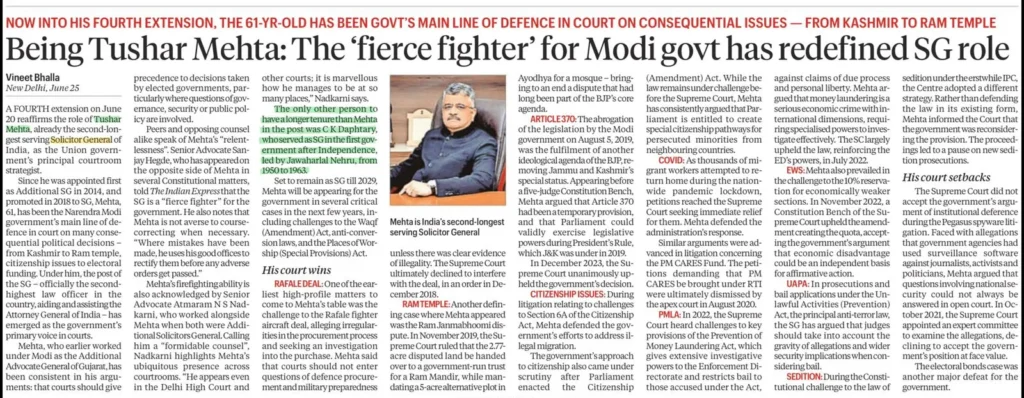
The Union Government granted a fourth extension to Solicitor General Tushar Mehta.
He was appointed Solicitor General in 2018 and has completed 8 years in office. With the fresh 3-year extension, he will complete 11 years by 2029, making him the second-longest serving Solicitor General of India after C.K. Daphtary, the first Solicitor General.
Attorney General of India
Article
- Article 76
Status
- Constitutional office
Position
- Highest law officer of India
Solicitor General of India
Status
- Non-constitutional post
- Non-statutory post
Position
- Second-highest law officer of India
Appointed By
- Central Government
Role of Solicitor General
The Solicitor General:
- Assists the Attorney General.
- Represents the Union Government before the Supreme Court.
- Represents the Union Government before High Courts.
- Handles important constitutional and policy-related litigation.
Parliament Participation
Attorney General
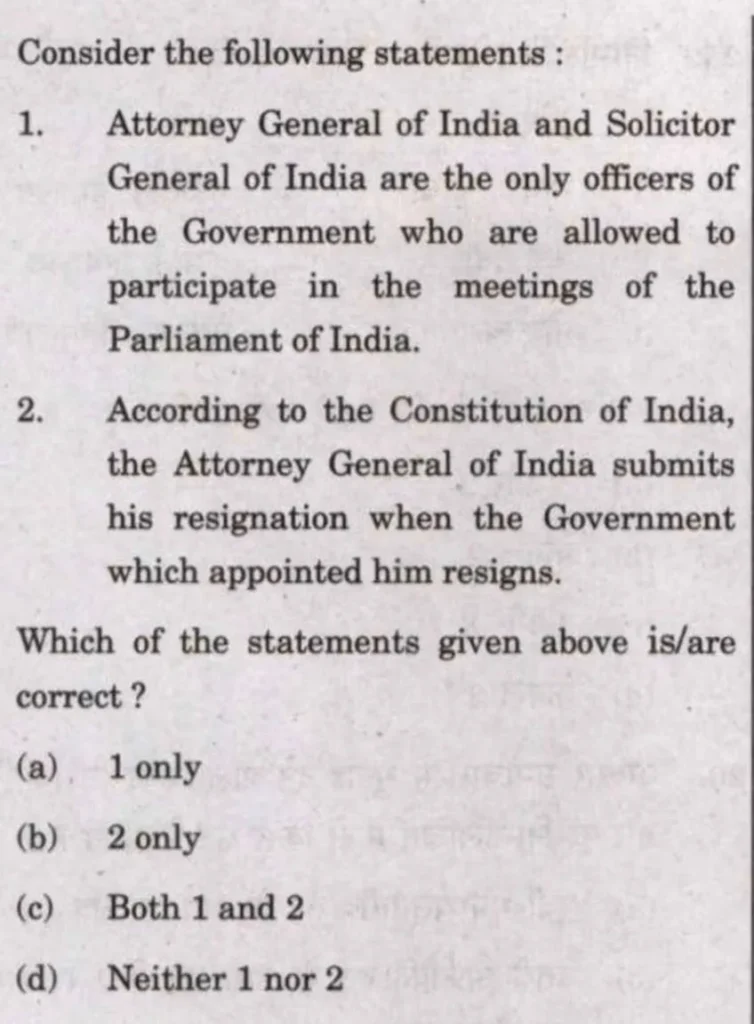
Under Article 88, the Attorney General can participate in the proceedings of Parliament.
However, the Attorney General cannot vote.
Solicitor General
The Solicitor General has no constitutional right to participate in Parliament.
Tenure
Both Attorney General and Solicitor General hold office during the pleasure of the Central Government.
Governing Rules
The Solicitor General is governed by:
- Law Officers Conditions of Service Rules, 1987
UPSC Value Addition
Attorney General
- Article 76
- Constitutional office
- Highest law officer
- Can participate in Parliament under Article 88
- No voting right
Solicitor General
- Executive appointment
- Not mentioned in the Constitution
- Second-highest law officer
- Assists Attorney General
- No constitutional right to participate in Parliament
PYQ Link
Attorney General and Solicitor General are not both constitutional officers.
Only the Attorney General has constitutional recognition.