Water Security in India: Challenges & UPSC Editorial Notes

Context: Water Security in India
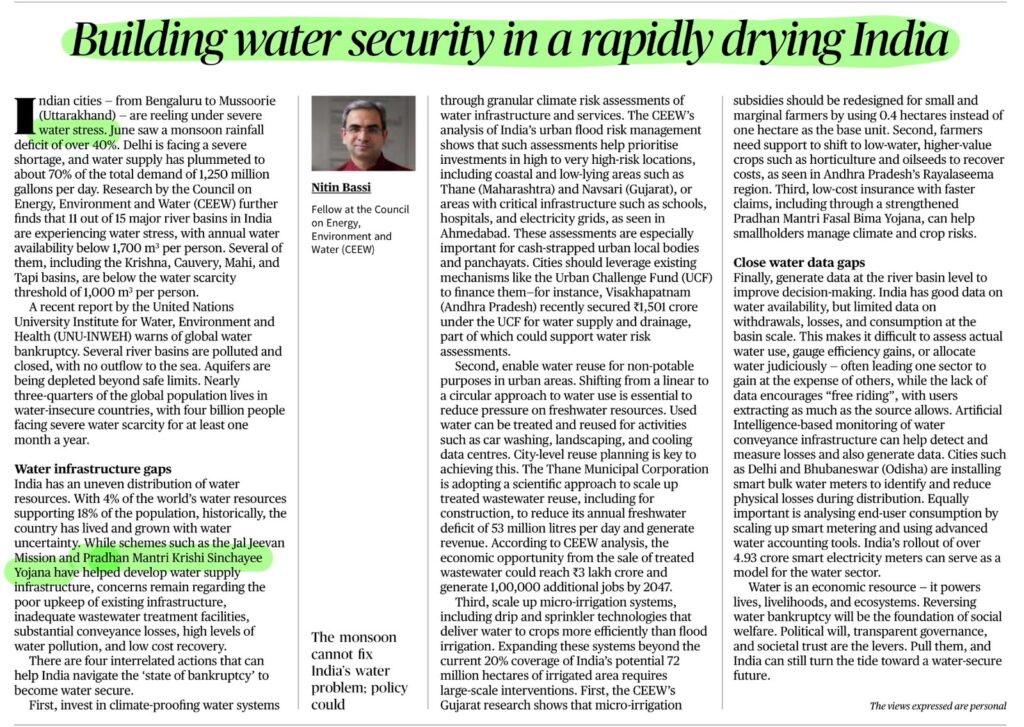
Increasing water stress, declining per capita water availability and climate variability have highlighted the need for climate-resilient water governance.

India has only 4% of the world’s freshwater resources but supports nearly 18% of the global population.

Also, 11 of India’s 15 major river basins are already water-stressed.

Water Security

Water security means reliable access to adequate quantity and quality of water for:

  • Drinking
  • Agriculture
  • Industry
  • Ecosystems
  • Livelihoods
  • Disaster resilience

Key Challenges

1. Rising Water Stress

Several river basins have annual per capita water availability below 1,700 cubic metres, making them water-stressed.

Some basins have already crossed the water scarcity threshold of below 1,000 cubic metres per person per year.

2. Groundwater Depletion

Over-extraction of groundwater for irrigation, urban use and industry is worsening water insecurity.

3. Pollution

Industrial waste, sewage discharge and agricultural runoff reduce usable water availability.

4. Erratic Rainfall

Climate change has made rainfall more unpredictable, increasing both drought and flood risks.

5. Infrastructure Gaps

India faces issues such as:

  • High transmission losses
  • Poor maintenance of water infrastructure
  • Inadequate wastewater treatment
  • Weak storage and distribution systems

6. Governance Gaps

Limited river-basin level data on water use, withdrawals and losses leads to inefficient allocation.

Way Forward

1. Build Climate-Resilient Water Infrastructure

  • Conduct climate-risk assessment of water projects.
  • Strengthen urban water systems.
  • Improve drainage and flood-water management.
  • Build resilient storage and distribution networks.

2. Improve Water-Use Efficiency

Scale up:

  • Drip irrigation
  • Sprinkler irrigation
  • Treated wastewater reuse
  • Low water-intensive crops
  • Efficient industrial water use

3. Strengthen Water Governance

Use:

  • AI-enabled monitoring
  • Smart water metering
  • River-basin water accounting
  • Real-time data systems
  • Evidence-based planning

4. Strengthen Flagship Schemes

Improve implementation of:

5. Promote Crop Diversification

Shift from water-intensive crops to climate-suitable and less water-intensive crops.

6. Reuse and Recycle Wastewater

Treated wastewater can be used for:

  • Industry
  • Construction
  • Landscaping
  • Agriculture where safe

Significance

  • Supports drinking water security.
  • Reduces agricultural vulnerability.
  • Helps climate adaptation.
  • Protects groundwater.
  • Improves urban resilience.
  • Strengthens food and livelihood security.
Subscribe
Notify of
guest
0 Comments
Oldest
Newest Most Voted

Water Security in India: Challenges & UPSC Editorial Notes

Got a question? We're here to help!

Our dedicated Student Support team is ready to assist you and guide you every step of the way.
Reach out to us, and let’s tackle your queries together!


About the UPSC Civil Services Examination (UPSC CSE)

The UPSC Civil Services Examination (CSE) is one of the most competitive and esteemed examinations in India, conducted by the Union Public Service Commission to recruit officers for services such as the Indian Administrative Service (IAS), Indian Police Service (IPS), Indian Foreign Service (IFS), and others. The exam comprises three stages — Prelims, Mains, and the Personality Test (Interview) — designed to test a candidate’s knowledge, aptitude, decision-making, and leadership skills.


How to Prepare Effectively for UPSC CSE

Cracking the UPSC CSE requires a deep understanding of the syllabus, consistent revision, structured answer writing, and smart test-taking strategies. The Prelims test analytical and conceptual clarity, the Mains focuses on critical thinking, articulation, and subject mastery, while the Interview assesses presence of mind, ethical judgment, and personality traits relevant to public service.

At UnderStand UPSC, we empower aspirants with a personalized and focused approach to each stage of the exam.


Why Choose UnderStand UPSC?

UnderStand UPSC is a mentorship-driven platform offering a clear, clutter-free strategy to tackle the Civil Services Examination. Our programs like Transform (for beginners and intermediate learners) and Conquer (for advanced mains preparation) provide structured study plans, syllabus-wise video content, interactive live sessions, and answer writing support.

We emphasize:

  • Concept clarity through topic-wise lectures

  • Test series designed around real UPSC standards

  • Personalized mentorship in small groups

  • Regular performance tracking and peer benchmarking

  • Doubt-clearing sessions, current affairs analysis, and monthly magazines


Join the UnderStand UPSC Learning Community

Our mission is to make UPSC preparation less overwhelming and more strategic. We combine mentorship, discipline, and academic rigor to help you clear CSE with confidence. Whether you’re preparing from Delhi, Mumbai, Bangalore, or a remote village — our online-first model ensures quality guidance reaches every corner of India.

Join the thousands of aspirants who trust UnderStand UPSC to guide their journey toward becoming civil servants.

Stay connected with us through our Telegram, YouTube, and Instagram channels for daily tips, strategies, and updates.

Copyright © 2026 USARAMBHA EDUCATION (UnderStand UPSC). All Rights Reserved.

Fill out the form for

Downloading the free Agriculture Short Notes


0
Would love your thoughts, please comment.x
()
x