Improve UPSC interview preparation with proven tips on DAF analysis, mock interviews, follow-ups, balanced opinions, and confident communication.
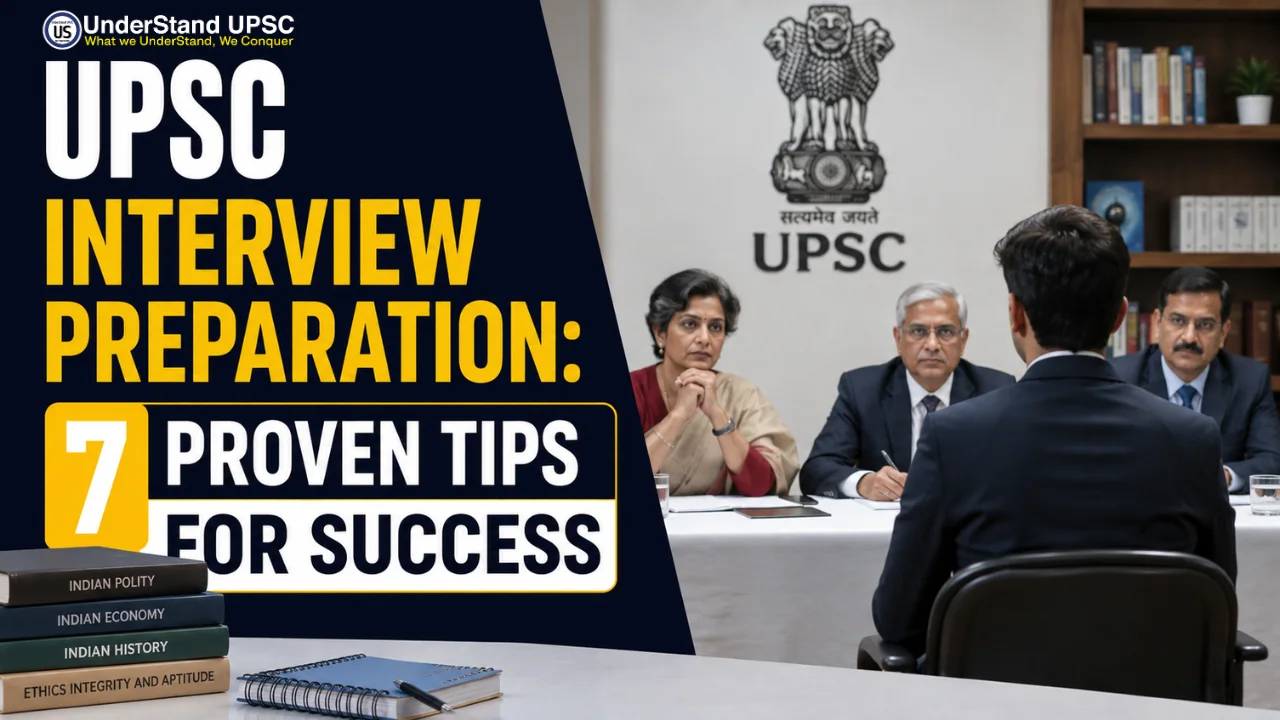
The biggest mistake candidates make after Mains is assuming that the interview is simply the next syllabus to finish. It is not. You can prepare Polity chapter by chapter; you cannot prepare a conversation in the same way.
The Personality Test rewards something subtler: whether your knowledge remains usable when a senior panel interrupts you, challenges your assumption, changes the direction of the conversation, or asks you something you never revised. Good UPSC interview preparation therefore has to train judgement, not just information.
| A useful rule: Do not prepare to sound impressive. Prepare to remain clear, honest and balanced even after the interview stops going according to your plan. |
UPSC interview preparation: 7 Proven Tips for Success
1. Read Your DAF at Two Levels
Most candidates prepare direct DAF questions: “Why this hobby?”, “Why this optional?”, “Tell us about your district.” The stronger preparation begins one step later, with the follow-up that your first answer is likely to invite.
If you mention that your district is known for tourism, the next question may be about carrying capacity, waste management or local employment. If you write cricket as a hobby and speak about the IPL, you may be asked about sports governance, betting, franchise economics or whether public money should fund elite sport. The Board often enters your comfort zone first and then moves from the personal to the public.
| DAF drill: For every important entry, prepare: direct question → likely follow-up → one policy/public issue → your own view. This makes your preparation much harder to derail. |
2. Know Where to Stop an Answer
Candidates usually worry about not knowing enough. In practice, many lose control because they say too much. The longer you speak, the more claims you make and the more doors you open for follow-up questions.
A good response usually does three things: answers the exact question, gives one layer of reasoning, and stops. If the Board wants more, it will ask. You do not need to display your entire note on the topic.
This is especially important in opinion questions. Give your position, one or two reasons, acknowledge the main trade-off, and stop. Conciseness is not lack of knowledge; it is control over knowledge.
3. Build Opinions Before You Build Facts
A newspaper-heavy candidate can still sound weak in the interview because facts do not automatically become judgement. Knowing about a policy is different from being able to discuss whether it is desirable, feasible and fair.
For major issues, prepare a simple decision frame: What problem are we solving? Who is affected? What is the strongest argument on each side? What practical constraint would an administrator face? What position would I take, and under what conditions would I change it?
That last question matters. Experienced panels often test whether a candidate treats an opinion as a conclusion or as a position open to better evidence.
| Better than a model answer: Prepare one defendable position and one limitation of your own position. That instantly makes your answer more mature. |
4. Practise Recovering After a Bad Question
One poor answer does not usually ruin an interview. The reaction to that answer can. Candidates sometimes carry the embarrassment of one factual mistake into the next three questions.
Train a reset. If you do not know, say so. If you realise you were wrong, correct yourself once. Then mentally close the question. Do not start apologising repeatedly or trying to compensate by over-answering the next one.
The Board may deliberately move rapidly from one subject to another. Your ability to recover is part of composure.
5. Use Mocks for Behavioural Diagnosis
The marks a mock panel gives you are among the least useful parts of a mock. What matters is what repeatedly happens to your behaviour under pressure.
After every mock, do a ten-minute debrief before listening to anybody else. Write where you became defensive, where you lost the question, which answer became unnecessarily long, which fact you guessed, and which follow-up exposed shallow preparation. Then compare this with panel feedback.
If the same weakness appears in three mocks, treat it as real. If one panel dislikes your hand movement and nobody else notices it, do not rebuild your personality around that comment.
| Experienced use of mocks: One mock should change the next mock. If you keep collecting feedback without designing a correction drill, you are only accumulating opinions. |
6. Train the Follow-Up, Not Just the First Answer
Most preparation material gives you isolated questions. Real interviews are connected. Your answer creates the next question.
If you say, “India needs stronger regulation of social media,” someone may ask who should regulate it. If you say the government, they may ask about censorship. If you say an independent regulator, they may ask who appoints it. This is where memorised answers collapse.
Use a simple practice method: after every answer, ask your partner to challenge the weakest word in it. If you say “more investment”, ask how much and from where. If you say “awareness”, ask why awareness has not already solved the problem. If you say “strict action”, ask what due process requires.
| Pressure drill: Answer → challenge → defend → modify if needed. This is closer to the actual skill the Board is testing than practising 100 unrelated questions. |
7. Protect Naturalness in the Final Weeks
Too much interview preparation can make a candidate worse. After ten mocks and hundreds of model answers, people begin monitoring every smile, every hand movement and every sentence. The result is a candidate who looks prepared but not present.
In the final weeks, reduce input and increase spoken practice. Revise your DAF, state, graduation, optional, work profile and major current issues. But spend more time answering aloud, listening to questions fully and keeping responses clean.
Body language should remain simple: sit comfortably upright, maintain natural eye contact, keep your hands settled, and allow a short pause before a difficult answer. You are not performing confidence. You are removing behaviours that interfere with it.
A Practical 3-Week Interview Routine
| Every day | 5 spoken questions: 2 DAF, 2 current issues, 1 uncomfortable or unpredictable question. |
| 3 times a week | 15-minute follow-up drill where every answer is challenged once. |
| Once a week | One quality mock, followed by a written behavioural debrief and correction plan. |
| Twice a week | Revise one personal cluster deeply: hometown/state, graduation, work profile, hobby or optional. |
| Final 3–4 days | No new interview material unless essential. Consolidate, sleep properly and preserve conversational sharpness. |
What a Strong Interview Actually Feels Like
It rarely feels perfect. You will probably leave remembering one answer you could have handled better. That is normal. A strong interview is not one in which you knew everything. It is one in which the Board could see a stable pattern: you listened, you did not bluff, you could think through trade-offs, and you did not become a different person when challenged. That is ultimately the point of UPSC interview preparation. Not to manufacture a personality for thirty minutes, but to make your real personality more informed, more disciplined and easier to trust under pressure.
FAQs :–
What is the best way to prepare for the UPSC Personality Test?
The best approach is to prepare your DAF thoroughly, develop balanced opinions on current issues, practise follow-up questions, and use mock interviews to improve behaviour under pressure.
How important is DAF for UPSC interview preparation?
DAF is central to preparation because questions can move from personal details such as education, hobbies and hometown to wider public-policy and governance issues.
How should I answer difficult questions in the UPSC interview?
Listen carefully, answer the specific question, give concise reasoning, acknowledge relevant trade-offs, and avoid bluffing when you do not know the answer.
Are mock interviews necessary for UPSC Personality Test preparation?
Mock interviews are useful when their feedback is converted into specific correction drills. The goal is to identify recurring weaknesses in clarity, answer length, composure and follow-up handling rather than simply collect mock scores.
How can I improve my confidence for the UPSC interview?
Practise speaking aloud, answer unpredictable questions, review your behavioural patterns after mocks, and focus on being clear, honest and balanced rather than trying to sound impressive.