Context: Right to belong citizenship
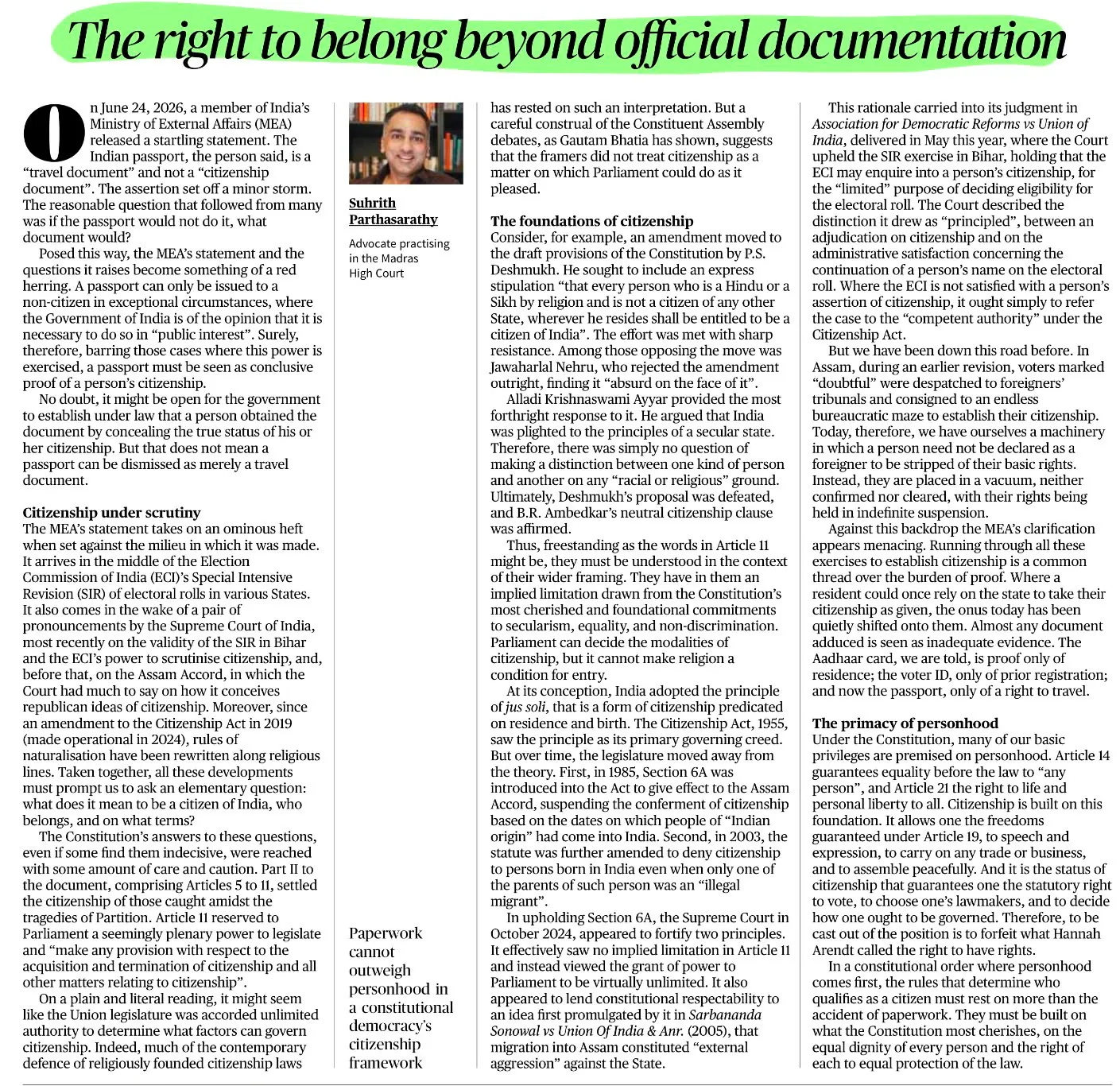
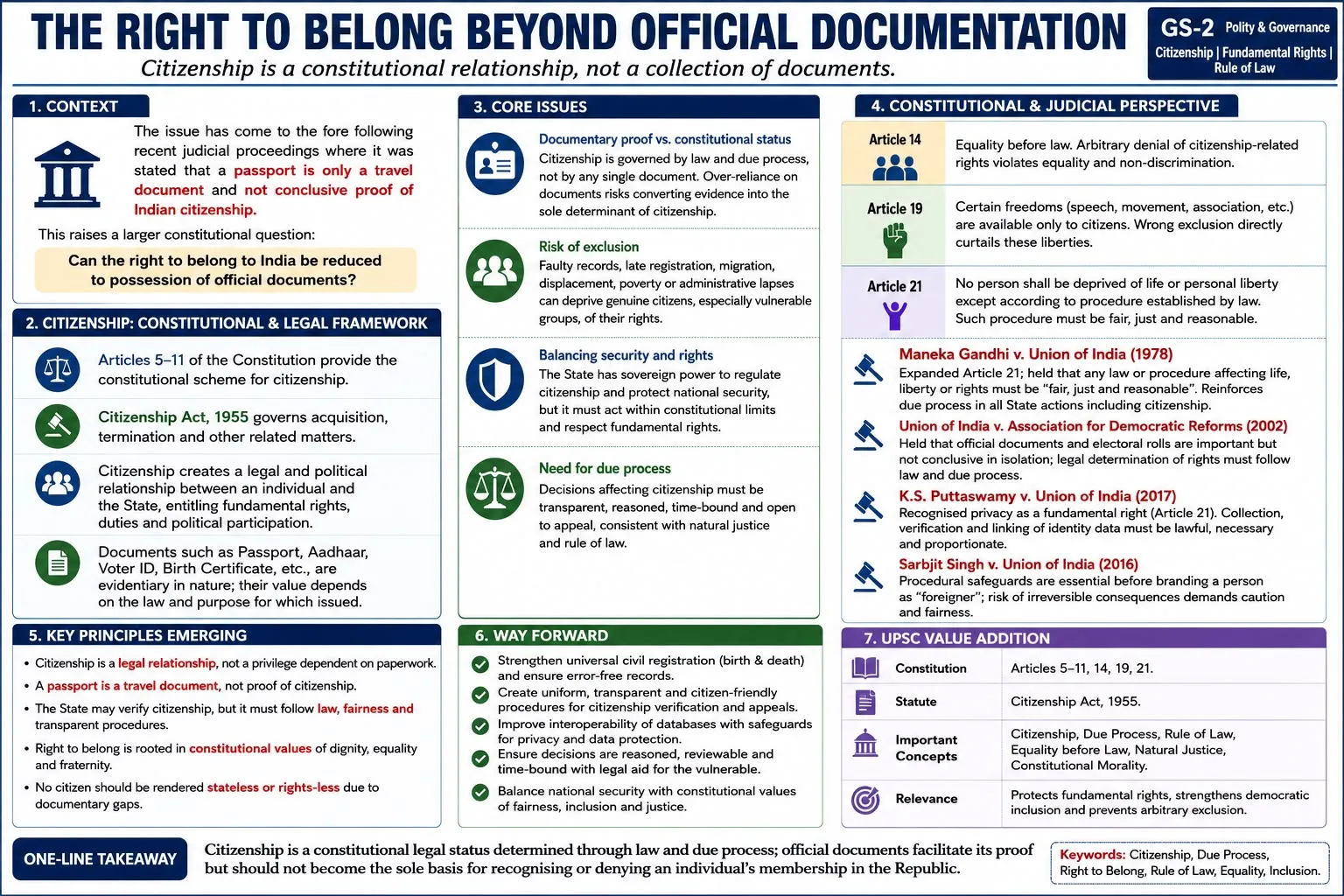
The article argues that citizenship is a constitutional relationship, not merely a collection of documents.
It raises the larger question of whether the right to belong can be reduced to the possession of official documentation.
Core Issue
Documentation is important for administration, but citizenship cannot depend only on papers.
Overdependence on documents can exclude vulnerable people such as:
- Migrants
- Poor households
- Displaced persons
- Women
- Elderly persons
- Marginalised communities
Citizenship: Constitutional and Legal Framework
Articles 5–11
Provide the constitutional scheme of citizenship.
Citizenship Act, 1955
Governs:
- Acquisition of citizenship
- Termination of citizenship
- Registration
- Naturalisation
Core Principle
Citizenship creates a legal and political relationship between an individual and the State.
It provides:
- Fundamental rights
- Duties
- Political participation
- Protection under law
Documents and Citizenship
Documents such as:
- Passport
- Aadhaar
- Voter ID
- PAN
- Birth certificate
may serve as evidence.
But they are not the source of citizenship.
Key Concerns
1. Documentary Proof vs Constitutional Status
Citizenship is created by law and due process, not by a single document.
2. Risk of Exclusion
People may lack documents due to:
- Poverty
- Migration
- Displacement
- Illiteracy
- Gender discrimination
- Administrative failure
3. Due Process
Decisions affecting citizenship must be:
- Fair
- Transparent
- Reasoned
- Time-bound
- Open to appeal
- Consistent with natural justice
4. Balancing Security and Rights
The State may regulate citizenship for national security, but it must not use documentation in a way that violates dignity, equality and due process.
Constitutional and Judicial Perspective
Article 14
Provides equality before law and protection against arbitrary State action.
Article 19
Certain freedoms are available only to citizens.
Wrong exclusion from citizenship directly affects these liberties.
Article 21
No person shall be deprived of life or personal liberty except according to procedure established by law.
Procedure must be fair, just and reasonable.
Important Cases
Maneka Gandhi v. Union of India, 1978
Expanded Article 21 and held that procedure must be fair, just and reasonable.
Union of India v. Association for Democratic Reforms, 2002
Held that official documents and electoral information must be linked to transparency and democratic rights.
K.S. Puttaswamy v. Union of India, 2017
Recognised privacy as part of Article 21.
Sarbananda Sonowal Case
Discussed illegal migration and national security concerns in Assam.
Key Principles Emerging
- Citizenship is a legal relationship, not a privilege dependent on paperwork.
- A passport is a travel document, not proof of citizenship.
- The State may verify citizenship, but it must follow fairness and transparency.
- Right to belong is rooted in constitutional values of dignity, equality and fraternity.
- No citizen should be rendered stateless or rightless due to documentary gaps.
Way Forward
- Strengthen universal civil registration.
- Ensure birth and death records are accessible.
- Create citizen-friendly procedures for correcting records.
- Protect vulnerable groups from exclusion.
- Provide legal aid and appeal mechanisms.
- Balance national security with constitutional values.
- Avoid overdependence on a single document.
- Ensure due process in citizenship verification.
Key Takeaway
Citizenship flows from law and constitutional status, not merely from documents. Official papers may support proof, but they cannot replace due process, dignity and the right to belong.