Context: Future of the Quad
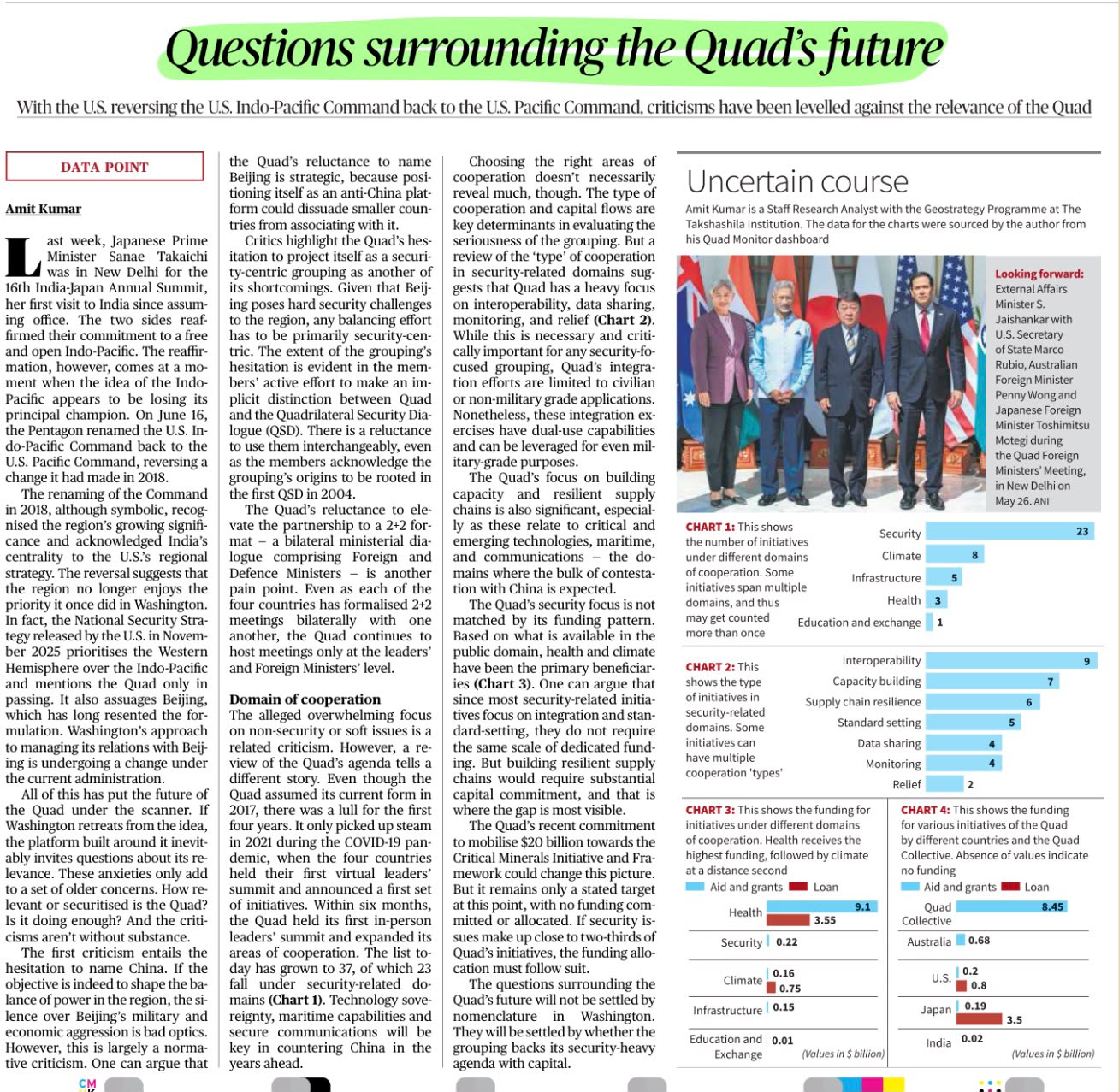
The article discusses uncertainty around the future of the Quad due to shifting U.S. priorities, questions over institutional depth and concerns about whether the grouping can deliver concrete outcomes in the Indo-Pacific.
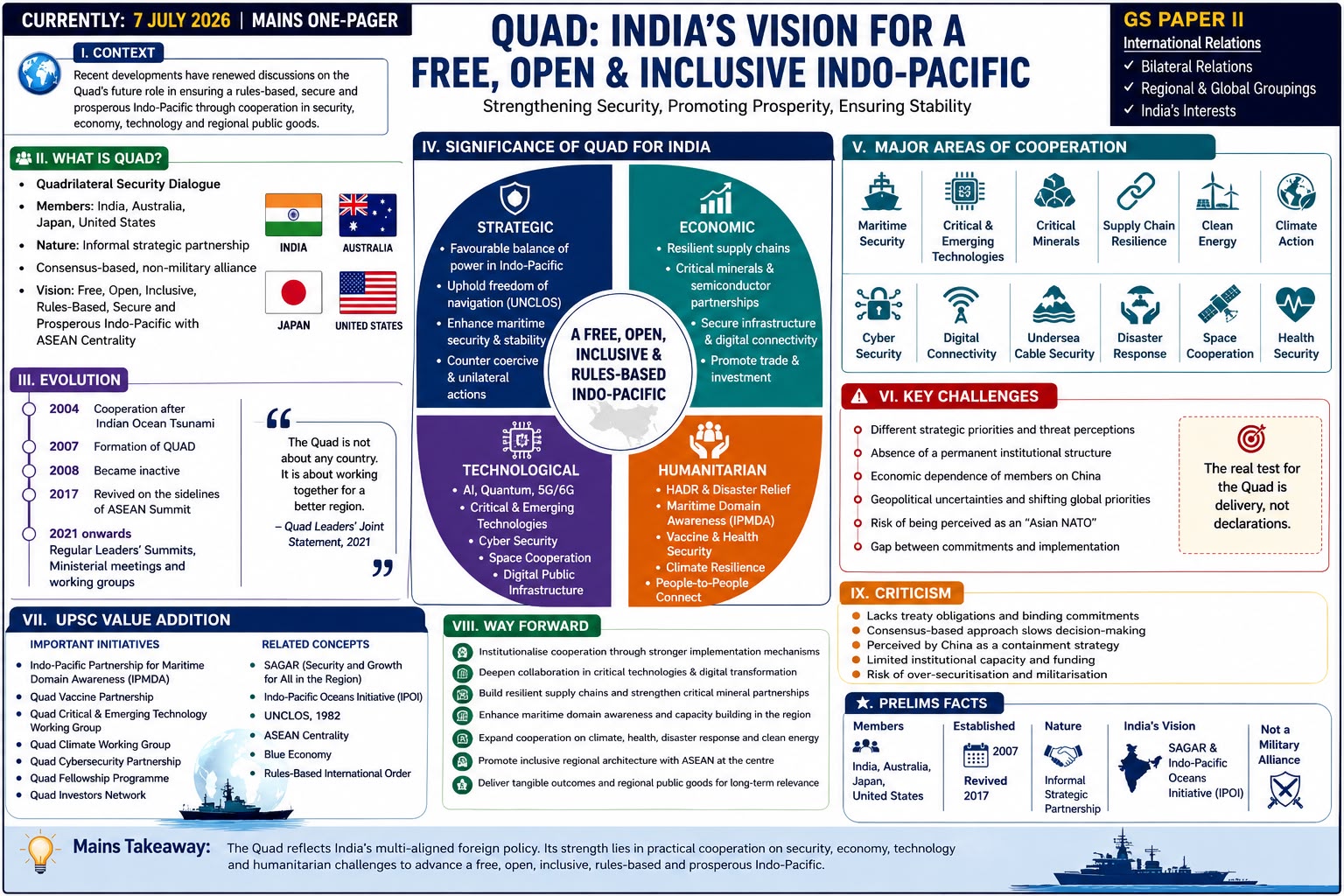
Quad
Full Form
- Quadrilateral Security Dialogue
Members
- India
- United States
- Japan
- Australia
Core Vision
A free, open, inclusive and rules-based Indo-Pacific.
Evolution
- 2004: Cooperation after Indian Ocean Tsunami.
- 2007: Formation of Quad.
- 2017: Revival on the sidelines of ASEAN Summit.
- 2021 onwards: Regular leaders’ summits, ministerial meetings and working groups.
Why Quad Matters for India
1. Strategic Balancing
Quad helps India balance China’s assertiveness in the Indo-Pacific.
2. Maritime Security
Supports freedom of navigation and maritime domain awareness.
3. Economic Security
Can strengthen supply chains and reduce dependence on China.
4. Technology Cooperation
Important for:
- Critical technologies
- Semiconductors
- Cybersecurity
- Digital public infrastructure
- Space cooperation
5. Humanitarian Assistance
Quad supports cooperation on:
- Disaster relief
- Health security
- Climate resilience
- Infrastructure
Major Areas of Cooperation
- Maritime security
- Critical and emerging technologies
- Critical minerals
- Supply-chain resilience
- Clean energy
- Climate action
- Cybersecurity
- Digital connectivity
- Undersea cable security
- Disaster response
- Space cooperation
- Health security
Key Challenges
1. Different Strategic Priorities
All members have different threat perceptions and regional priorities.
2. Lack of Formal Structure
Quad is not a treaty alliance and has no permanent secretariat.
3. China Factor
China sees Quad as an anti-China grouping.
4. Delivery Deficit
There are concerns that Quad announces many initiatives but implementation remains slow.
5. U.S. Policy Uncertainty
Changes in U.S. priorities can affect the grouping’s momentum.
6. India’s Strategic Autonomy
India supports Quad but avoids turning it into a military alliance.
Criticism
- It lacks binding obligations.
- It may duplicate other Indo-Pacific mechanisms.
- It risks becoming overly security-focused.
- It may not deliver enough public goods.
Way Forward
- Build institutional continuity.
- Focus on deliverables.
- Strengthen maritime domain awareness.
- Expand cooperation on resilient supply chains.
- Deliver climate, health and digital public goods.
- Avoid excessive militarisation.
- Maintain ASEAN centrality.
- Respect India’s strategic autonomy.
Key Takeaway
The Quad’s future depends on whether it can move from symbolism to delivery while maintaining flexibility, inclusiveness and strategic balance in the Indo-Pacific.